Photo: Wikipedia
Demographics of Kapolei, HI
Affluence Level in Kapolei, HI
An upper-middle-class area. Household wealth, education levels, and homeownership run ahead of national benchmarks.
People of Kapolei, HI
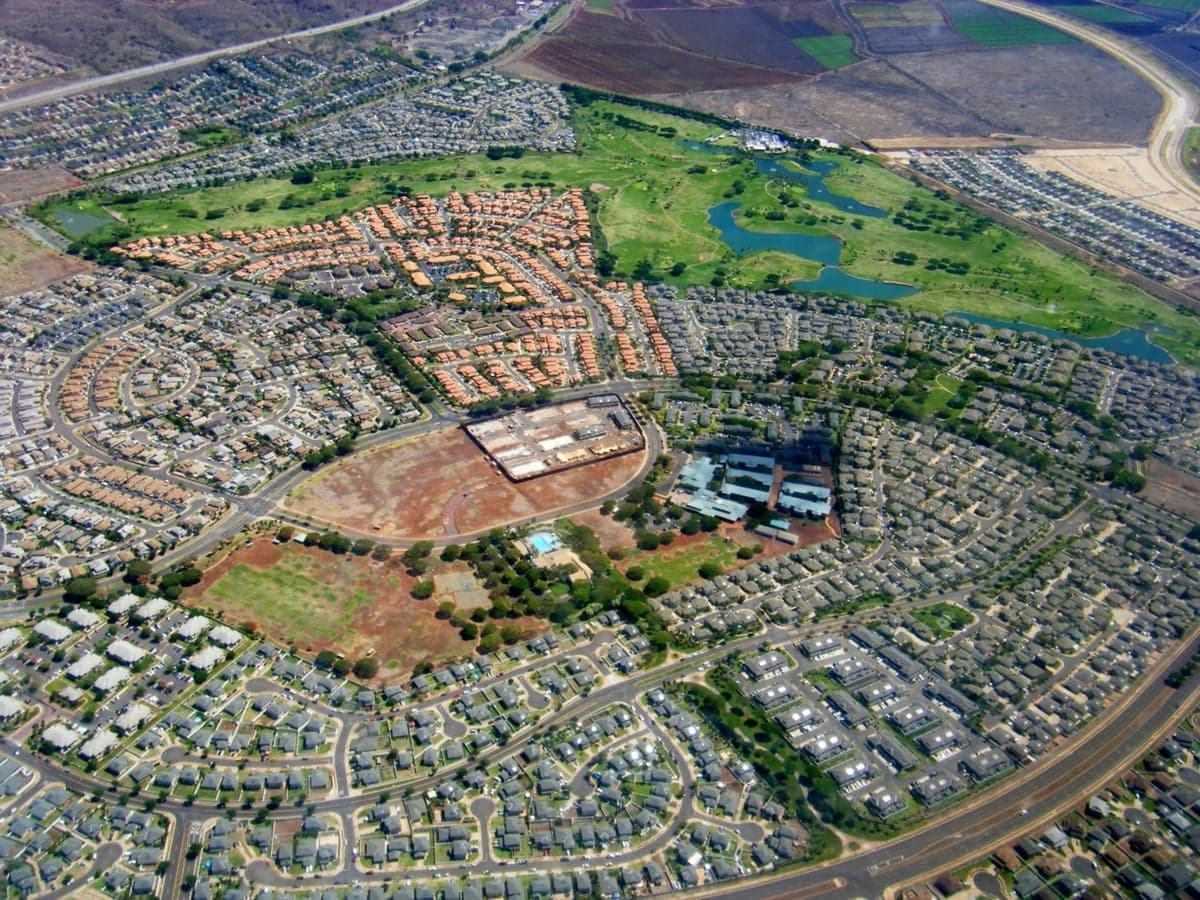
Today, Kapolei is a planned, master-planned community of roughly 23,000 residents that functions as Oahu’s “second city”—a suburban hub designed to relieve congestion in Honolulu. Its population is notably diverse, with the largest single group being East and Southeast Asian residents (25.9%), followed by Hispanic residents (17.0%), White residents (13.6%), and a small Black population (3.1%). The city has a very low foreign-born share (2.6%) and a college-educated rate of 31.8%, reflecting a largely native-born, middle-class workforce oriented toward government, retail, and service jobs in the nearby Kapolei Business Park and surrounding industrial areas.
How the city was settled and grew
Kapolei is a genuinely post-1960s planned community, not a historic plantation town. The land was originally part of the vast Campbell Estate, a private landholding that controlled much of the Ewa Plain. In the 1950s and 1960s, the estate began developing the area as a suburban alternative to Honolulu, with the first residential subdivisions opening in the 1970s. The original population was drawn by affordable housing and the promise of jobs at the then-new Barbers Point Naval Air Station (now Kalaeloa Airport) and the nearby industrial parks. The earliest neighborhoods—Kapolei Knolls and Kapolei Highlands—were built in the 1970s and 1980s, attracting a mix of military families, local Japanese and Filipino workers from Honolulu’s construction and service sectors, and a small number of White professionals. The city’s growth was slow through the 1980s, with fewer than 5,000 residents by 1990, as the area remained largely rural and agricultural.
Modern era (post-1965)
The post-1965 immigration reforms had little direct effect on Kapolei’s population, as the city’s growth has been driven almost entirely by domestic migration from other parts of Oahu and the mainland, not by new foreign arrivals. The foreign-born share (2.6%) is far below the national average, and the city’s East and Southeast Asian population (25.9%) is overwhelmingly composed of multi-generational local families—Japanese, Filipino, Chinese, and Korean—who moved from Honolulu’s older neighborhoods like Moiliili and Kalihi. The Hispanic population (17.0%) is a more recent addition, largely from Puerto Rican and Mexican families who arrived in the 1990s and 2000s for construction and hospitality jobs; they are concentrated in the Villages of Kapolei and Kapolei Lofts areas. The White population (13.6%) is split between military-affiliated families living near Kalaeloa and mainland transplants in the newer Hoakalei and Ka Makana Alii subdivisions. The Black population (3.1%) is small and largely military-connected. Notably, there is no measurable Indian subcontinent population (0.0%), a sharp contrast to many mainland suburbs. The city’s college-educated rate (31.8%) is slightly below the national average, reflecting a workforce heavy on retail, hospitality, and administrative roles rather than tech or finance.
The future
Kapolei’s population is likely to continue growing slowly, with the city’s build-out expected to reach roughly 30,000 residents by 2035 as remaining parcels in Kapolei East and Kapolei West are developed. The demographic trend is toward homogenization rather than tribalization: the East and Southeast Asian share is stable, the Hispanic share is slowly rising (projected to reach 20-22% by 2035), and the White share is declining slightly as military families rotate out and are replaced by local Asian and Hispanic buyers. The foreign-born share is expected to remain very low, as Kapolei lacks the immigrant gateway infrastructure of Honolulu. The city is not becoming an ethnic enclave for any single group; instead, it is evolving into a solidly middle-class, majority-minority suburb where local-born families of Asian and Hispanic heritage form the core. The Indian subcontinent population is unlikely to grow significantly, as Kapolei lacks the tech and professional job base that attracts that demographic.
For a conservative-leaning individual or family considering a move, Kapolei represents a stable, family-oriented suburb with a strong sense of local identity and low crime—but also limited economic dynamism and a population that is overwhelmingly native-born and locally rooted. The city is not a melting pot of new immigrants but a settled community of multi-generational Oahu families, where the dominant culture is a blend of local Hawaiian, Asian, and Hispanic traditions. New arrivals should expect a place that is welcoming but insular, where social networks are built through schools, churches, and neighborhood associations rather than through ethnic or professional enclaves. The next decade will likely see Kapolei solidify as a comfortable, middle-class suburb—not a boomtown, not a declining area, but a steady, predictable place to raise a family.

* Values derived from national, state, county, city and local statistics and may differ in a specific area. Last updated: 2026-04-24T00:10:34.000Z
Narrative content on this page is AI-generated and may contain mistakes. Verify any details that matter before acting on them.
ReloMaps may earn a commission from affiliate links at no extra cost to you.

