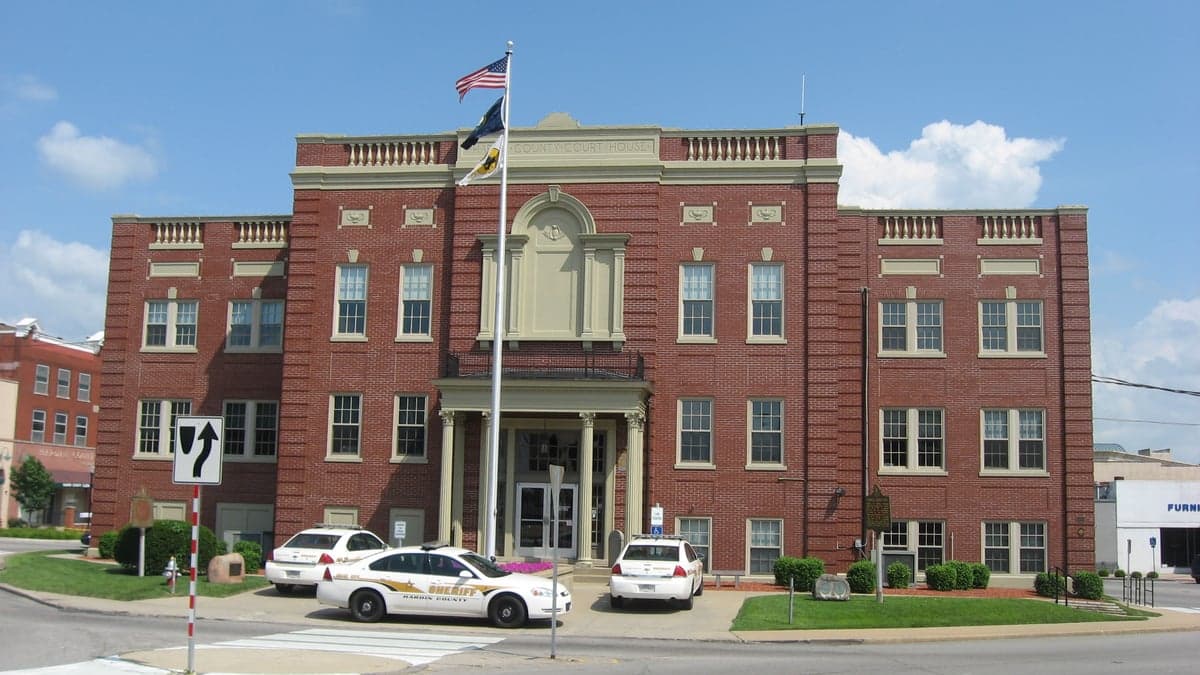
Photo: Wikipedia
Political ClimatePolitical Climate in Hardin County
Showing district-level results — no local-only data available.
Local Political AnalysisPolitical Analysis of Hardin County
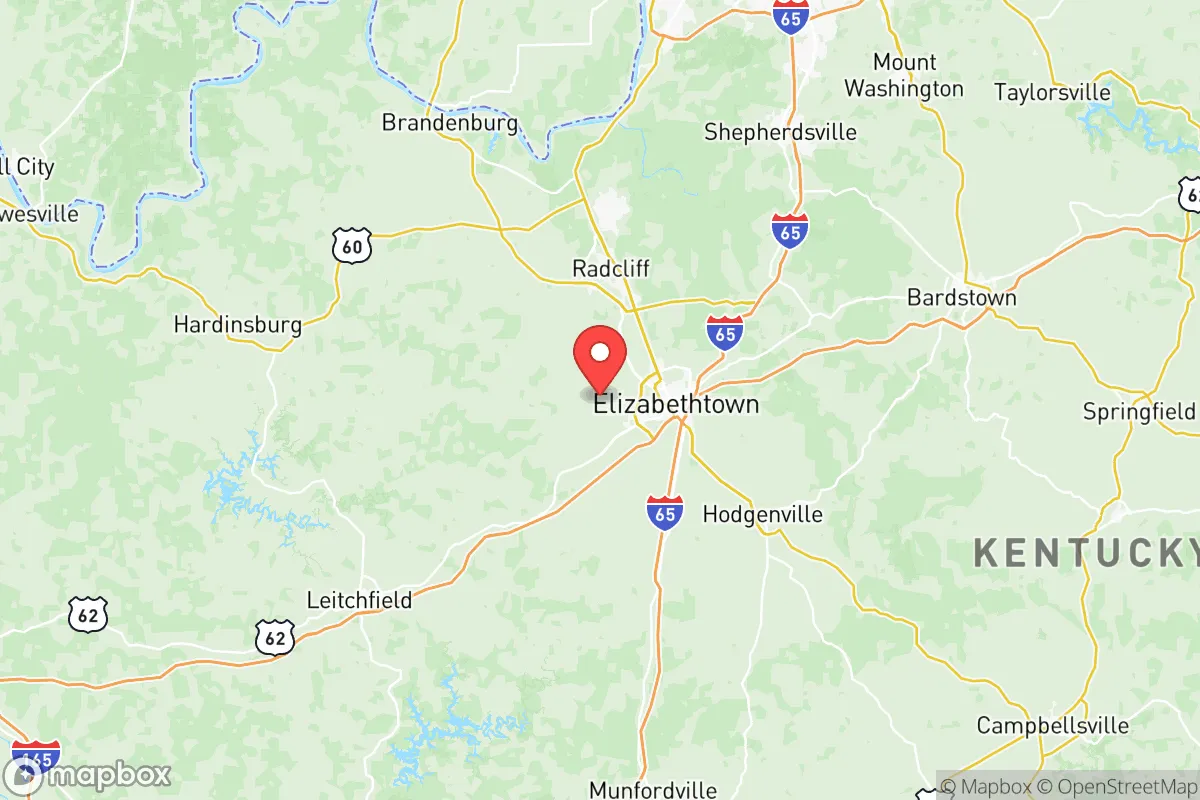
Hardin County, Kentucky, has long been a solidly conservative stronghold, with a Cook PVI of R+20 that puts it five points to the right of the state as a whole (R+15). This isn't just a number on a map—it reflects a deep-rooted culture of self-reliance, limited government, and traditional values that has held steady even as some neighboring areas have drifted. The county's political trajectory has been remarkably stable, though you can see subtle shifts in the precincts around Elizabethtown and Radcliff, where military families and newer transplants sometimes tip the scales in local races.
How it compares
When you stack Hardin County against Kentucky's statewide lean, the difference is real but not dramatic. The county's R+20 rating means Republicans consistently win by wider margins here than in the rest of the state. For example, in the 2024 presidential race, Hardin County went about 68% for the GOP candidate, while Kentucky overall sat around 62%. That extra six points comes from the rural precincts outside the main towns—places like Vine Grove, Cecilia, and the unincorporated areas around Glendale and Rineyville, where you'll find some of the reddest voting patterns in the county. On the flip side, the city of Elizabethtown itself has a few precincts that lean more purple, especially near the college and the downtown core, where younger voters and professionals sometimes push Democratic candidates to 40-45% of the vote. Radcliff, with its heavy military presence from Fort Knox, tends to be reliably conservative but can swing in local races depending on the candidates. The swing precincts are generally in the suburban fringe of Elizabethtown—places like the neighborhoods off Ring Road or near the Western Kentucky Parkway—where growth is bringing in folks from more moderate areas, but so far the overall trend hasn't budged much.
What this means for residents
For those of us who've lived here a while, the political climate means a government that mostly stays out of your business. Taxes are low, property rights are respected, and there's little appetite for the kind of progressive overreach you see in blue states—no heavy-handed zoning, no mandates on how you run your small business, and a general attitude that local folks know best. The county commission and school board have kept a conservative bent, pushing back on things like critical race theory in classrooms and keeping Second Amendment rights firmly protected. That said, there's a growing concern among long-time residents about the influx of outsiders from Louisville and other more liberal areas, who sometimes bring ideas that don't fit the local culture. You can see it in the occasional zoning fight or school board election where a progressive candidate gets 35-40% of the vote—still a minority, but enough to make you pay attention. The military community at Fort Knox tends to be a stabilizing force, as service members generally lean conservative, but the civilian contractors and their families can be a mixed bag.
Culturally, Hardin County stands apart from Kentucky's more liberal pockets like Louisville or Lexington. You won't find many pride flags flying in Elizabethtown's main square, and the local churches—especially the Baptist and non-denominational ones—still carry real weight in community life. The county's policy distinctions are subtle but meaningful: no sanctuary city nonsense, a sheriff's office that cooperates fully with federal immigration enforcement, and a school system that emphasizes parental rights over bureaucratic mandates. If you're looking for a place where your freedoms aren't constantly under threat from government overreach, Hardin County delivers. But keep an eye on those precincts around Elizabethtown's growing subdivisions—that's where the future of this county's political character will be decided.

State Political ClimatePolitical Climate in Kentucky
State Political AnalysisPolitical Environment in the State
Kentucky is a solidly Republican state with a Cook PVI of R+16, meaning it consistently votes about 16 points more Republican than the national average. The dominant coalition is a mix of rural conservatives, evangelical Christians, and working-class voters in both the Appalachian east and western farm counties. Over the last 20 years, the state has trended redder even while its two major urban centers — Louisville and Lexington — have shifted left, resulting in a stark urban–rural divide that defines almost every election.
Urban vs. rural divide
Geographically, the political map of Kentucky is simple: every large city votes blue, and everything else votes deep red. Louisville's Jefferson County and Lexington's Fayette County are the Democratic strongholds, reliably delivering 60-65% of their votes to Democratic candidates. Outside of those two islands, only a handful of smaller counties — Franklin County (Frankfort), Boyd County (Ashland), and parts of Kenton County (Covington) — occasionally lean Democratic. Meanwhile, rural and exurban counties like Letcher County in the east and Pike County routinely vote 75-80% Republican. The suburbs around Louisville — Oldham County and Shelby County — are solidly red and have grown more conservative as they’ve grown in population. The Northern Kentucky region (Boone, Kenton, Campbell counties) is a competitive area that has trended Republican in recent cycles, especially after the suburbanization of Cincinnati spillover. This geographic polarization means a new resident's political experience will vary dramatically depending on whether they settle in downtown Louisville or a rural county like Pendleton County.
Policy environment
Kentucky’s state-level policies lean heavily conservative and have become more so over the last decade. The state has a flat income tax now at 4.5%, with a planned phase-down to 4.0% by 2026. Property taxes are low, and there is no estate tax. The regulatory climate is business-friendly, and Kentucky is a right-to-work state. On education, the legislature passed HB 563 in 2022 to allow charter schools (though none have opened yet) and expanded school choice through education savings accounts for special-needs students. Healthcare is a mixed bag: Governor Andy Beshear expanded Medicaid under the ACA, but the Republican supermajority has repeatedly pushed for work requirements and cost-sharing. Election laws are strict: SB 1 (2021) requires photo ID to vote, limited in-person early voting to three days, and banned ballot drop boxes. Absentee voting is limited to specific excuses. Louisville and Lexington have attempted to be more progressive locally, but state preemption often blocks their efforts — for example, Louisville’s minimum wage ordinance was struck down, and local gun ordinances are preempted by state law.
Trajectory & freedom
On the whole, Kentucky is moving toward more personal freedom in the ways that matter most to conservative residents. In 2019, Kentucky became a constitutional carry state, allowing permitless carry of concealed firearms. The 2022 trigger law banned abortion in nearly all cases once the Supreme Court overturned Roe, with no exceptions for rape or incest. The Parents' Bill of Rights (HB 93, 2022) requires school transparency on curriculum materials and prevents schools from concealing a child's mental health or sex-related discussions from parents. Kentucky also banned COVID-19 vaccine mandates for state employees and students (HB 5, 2022). However, liberty is not uniform. In Louisville, the Metro Council passed a hate crime ordinance and a "fairness ordinance" that includes sexual orientation and gender identity protections — measures that some conservatives view as government overreach into private speech and religious liberty. Property rights are generally strong outside of Louisville, but the state has some quirks like broad eminent domain authority for economic development. On balance, a conservative moving to Kentucky will find a state that respects gun rights, parental authority, and low taxation, but should be aware of blue urban zones where local government may feel more intrusive.
Civil unrest & political movements
Kentucky has seen its share of political flashpoints. The most visible in recent memory was the 2020 protests in Louisville over the Breonna Taylor incident, which drew national attention and involved extended demonstrations, clashes with police, and property damage. The city remains a focal point for racial justice activism, and some new residents may find the political atmosphere there tense. Conservative grassroots movements are strong across the state: Moms for Liberty has active chapters in Boone County and Warren County, organizing around school curriculum and parental rights. Gun rights groups like the Kentucky Gun Rights Coalition hold regular rallies at the state capitol in Frankfort. Immigration politics are less heated here than in border states, but some counties have passed resolutions opposing sanctuary policies — Warren County (Bowling Green) and Madison County (Richmond) have symbolic "no sanctuary" positions. Election integrity concerns were prominent after the 2020 election, when Kentucky’s Republican Secretary of State Michael Adams (a moderate) worked with Beshear to expand pandemic absentee voting, which drew criticism from conservative activists. The legislature responded with SB 1 to tighten rules, but no major fraud was documented. Overall, the state avoids the kind of civil unrest seen in larger blue states, but Louisville remains a hotspot where political tensions are visible.
Projection
Over the next 5-10 years, Kentucky is likely to stay on its current trajectory: taxes will continue to fall (the flat income tax is on a glidepath to 4% and possibly 3.5%), school choice will expand (look for a broad education savings account bill), and gun rights will remain protected. The state’s demographic trends — slower growth, an aging population, and some out-migration from rural coal counties — will not flip the political map. However, in-migration from states like Illinois, Ohio, and California is increasing in the Louisville suburbs and Northern Kentucky, which could soften the Republican edge in those areas over time. The governor’s office is currently held by a Democrat, Andy Beshear, but he is term-limited in 2027, and the strong Republican supermajority in the legislature will ensure conservative policy continuity regardless of who sits in the governor’s mansion. If Louisville continues to grow and attract younger, more progressive residents, the urban-rural divide may deepen, but the state as a whole will remain solidly red. New residents should expect a stable environment where conservative values are the norm at the state level, but with local pockets of progressive politics they can easily avoid by choosing the right county.
For a conservative individual or parent moving to Kentucky
* Values derived from national, state, county, city and local statistics and may differ in a specific area. Last updated: 2026-06-01T15:00:15.000Z
Narrative content on this page is AI-generated and may contain mistakes. Verify any details that matter before acting on them.
ReloMaps may earn a commission from affiliate links at no extra cost to you.

