 Popular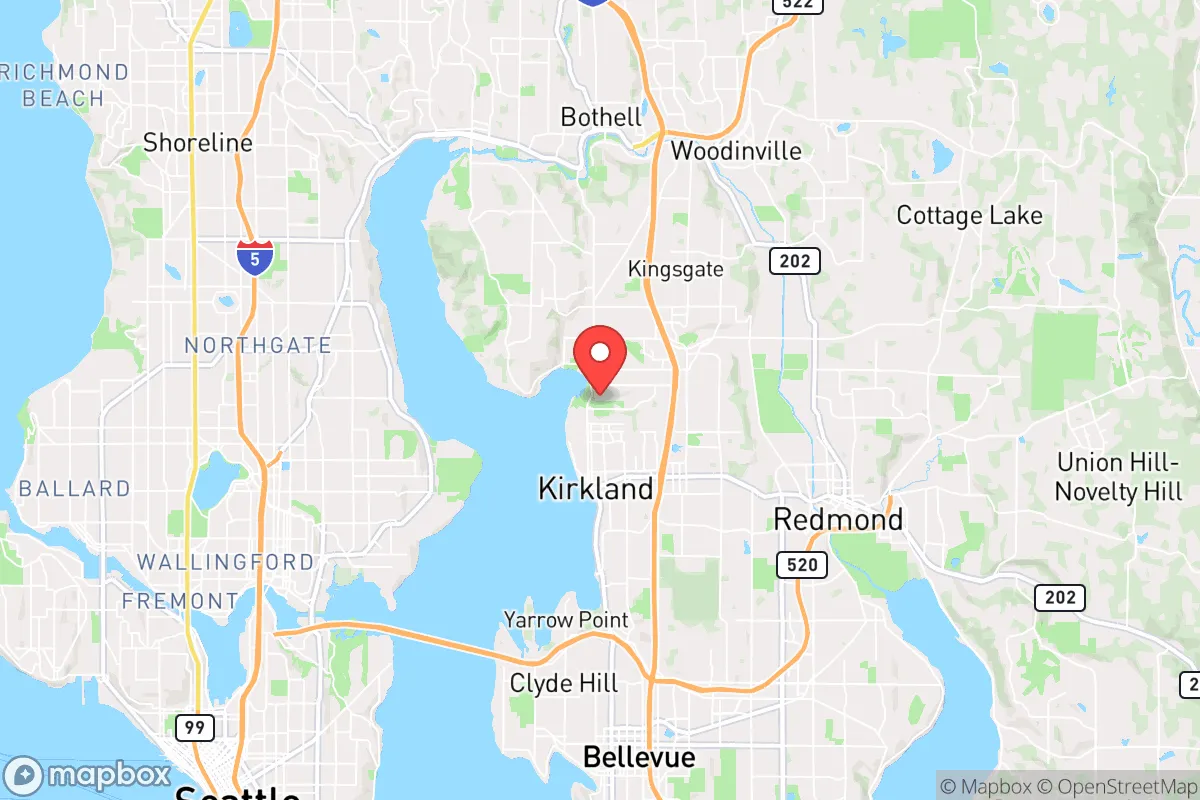
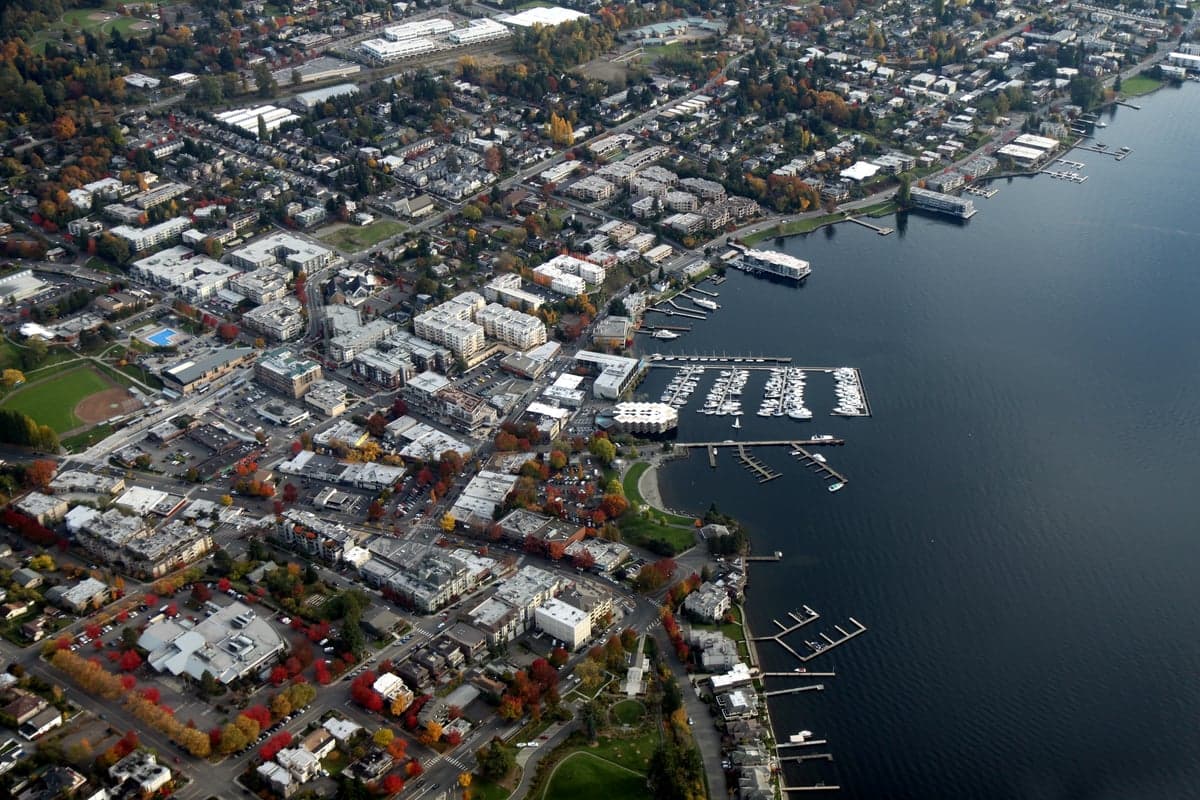
Photo: Wikipedia
Strategic Assessment of Kirkland, WA
High tactical risk. This location is likely close to major population centers, strategic targets, or sits in a high-disaster corridor. A retreat property and careful exit planning is required.
What does the Strategic Assessment tell us?
Our Strategic Assessment grades tactical survivability of an area. Major population centers, military targets, fallout zones, natural disasters, and border exposure all drive risk — lower exposure means a more defensible position in a crisis.
This is heavily inspired by Joel Skousen's Strategic Relocation book. Highly recommended you checkout the book ($)What does this tell us?
Our Strategic Assessment grades tactical survivability of an area. Major population centers, military targets, fallout zones, natural disasters, and border exposure all drive risk — lower exposure means a more defensible position in a crisis.
This is heavily inspired by Joel Skousen's Strategic Relocation book. Highly recommended you checkout the book ($)Strategic Pillars

Key Distances
Regional Safe Places
Below is our recommended "safe zones" in Washington and the surrounding area based on our strategic heuristics. For most people, it's unrealistic to live in a “safe zone” full-time due to work, family or other personal reasons. They tend to be more rural. However, many of these areas are perfect for second homes and retreat properties that double as a vacation home or even a short-term rental.
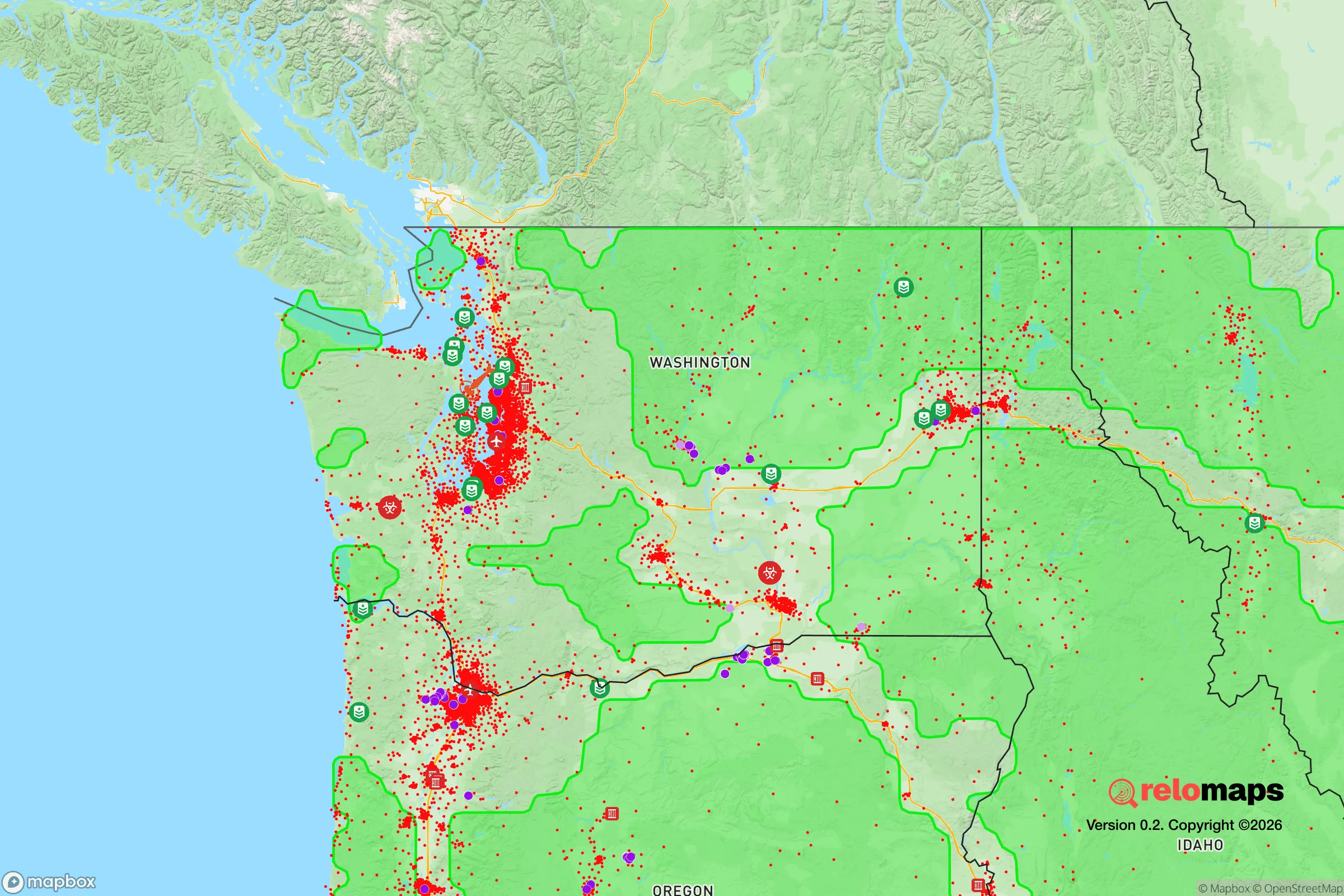
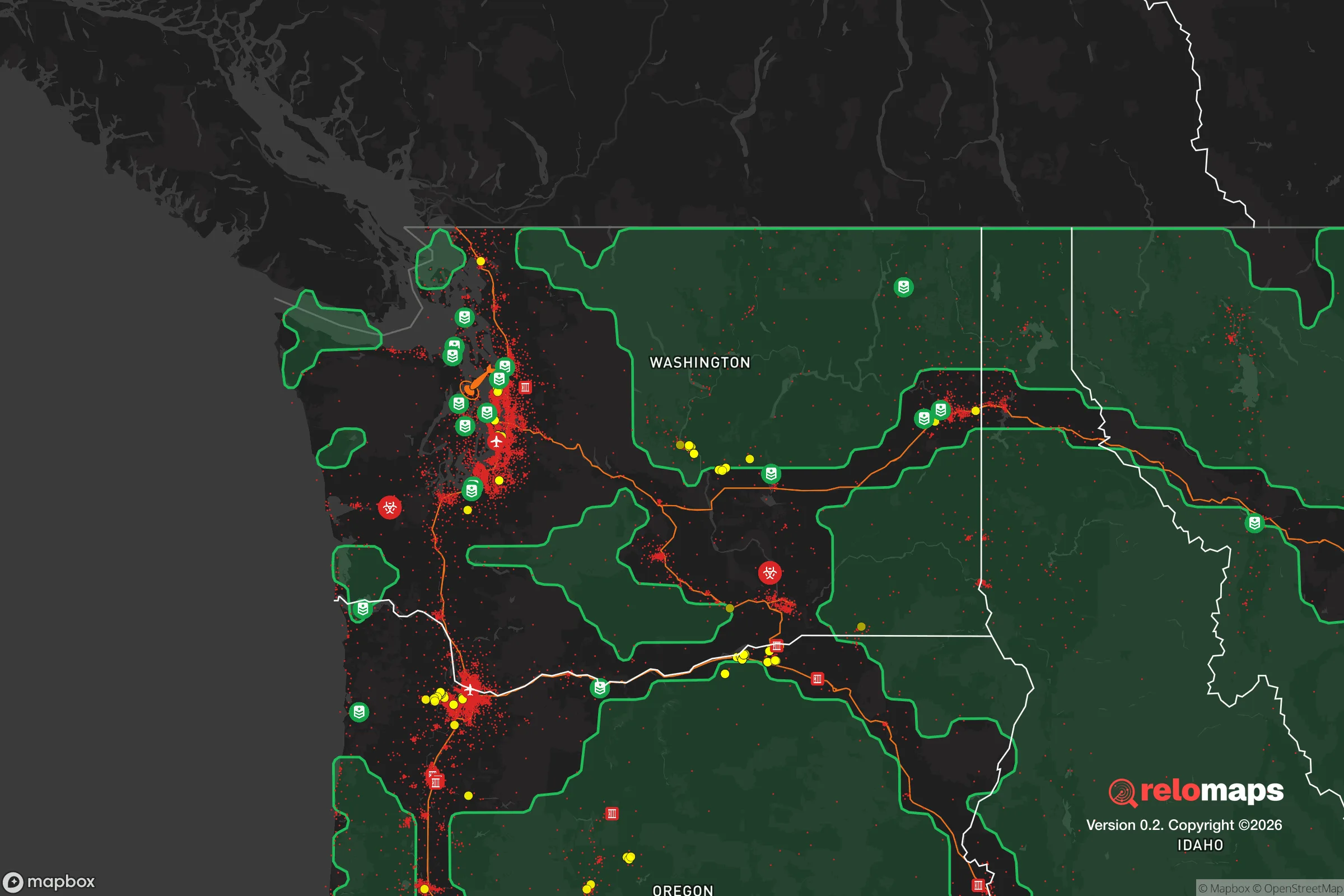


Important Note: For informational purposes only. This does not mean nothing bad ever happens in the green zones. Please use common sense. This is based on public data and modeled with AI. We tried to take a conservative approach but mistakes happen. We update this regularly as new information becomes available.
Solar Generator Recommendations
Backup power matters more here than in safer locations. We've picked three solar generators across budgets and capacity tiers — start with the budget unit if you only need a few essentials, or step up if you want to run a fridge and HVAC for days at a time.

Jackery Portable Power Station Explorer 300
Budget OptionPower on the Go: Weighing only 11 lbs, it's convenient to set up and store with book-sized foldable solar panels

BLUETTI Portable Power Station AC180
Designed for both indoor and outdoor scenarios, AC180 is highly capable as it has a robost capacity and continuous output power.

EF ECOFLOW DELTA Pro Ultra Power Station
Upgraded PickEcoFlow DELTA Pro Ultra is a whole-home energy system designed to grow with your family. Integrated with the Smart Home Panel 2, it scales to meet your evolving energy needs — keeping your home powered, intelligent, and secure through every stage of life.
We earn a commission, at no additional cost to you.
Strategic Assessment Analysis
Kirkland, Washington, presents a complex strategic picture for the conservative prepper or survivalist. While its location on the eastern shore of Lake Washington offers some natural defensive depth and resource access, its proximity to the Seattle metropolitan core and critical infrastructure makes it a high-risk, high-reward proposition for those prioritizing long-term resilience. The city’s relative affluence and educated populace provide a buffer against some forms of immediate social collapse, but its integration into the regional grid and transportation network creates significant exposure to cascading failures.
Geographic position and natural defensive advantages
Kirkland’s primary strategic asset is its position on the eastern side of Lake Washington. This natural barrier provides a meaningful chokepoint against any unrest originating from Seattle or the west side of the lake. The only direct road connections across the lake are the Evergreen Point Floating Bridge (SR 520) and the I-90 bridge further south, both of which can be monitored or, in a worst-case scenario, rendered impassable. This gives Kirkland a natural moat, slowing the movement of large, disorganized groups. The city itself is built on a series of hills and ridges, offering numerous vantage points and defensible neighborhoods, particularly in the northern areas like Finn Hill and Juanita. The terrain is heavily forested with second-growth Douglas fir and western red cedar, providing ample cover and a degree of visual and physical separation between properties. For a relocator, this means that a well-chosen home on a dead-end road or a hillside cul-de-sac can offer a level of security that is simply unavailable in flatter, more open suburbs like Redmond or Bellevue. The presence of Lake Washington also provides a massive, albeit vulnerable, freshwater source, though access points are limited and would become contested quickly.
Risks, exposures, and proximity to fallout-relevant landmarks
The downsides are substantial and cannot be ignored. Kirkland sits squarely within the blast and fallout shadow of several high-value targets. The city is approximately 10 miles from the Boeing Everett Factory, one of the largest buildings in the world and a clear strategic target. It is also within 15 miles of the Puget Sound Naval Shipyard in Bremerton and the Joint Base Lewis-McChord (JBLM) complex to the south. A nuclear or conventional strike on any of these would produce significant fallout patterns that, depending on wind direction, could directly impact Kirkland. Furthermore, the city is a bedroom community for Microsoft’s main campus in Redmond and Amazon’s headquarters in Seattle. In a scenario of economic collapse or targeted cyber-attacks on these corporate giants, the resulting population displacement and social friction would hit Kirkland hard. The city’s own infrastructure—including the Totem Lake area with its dense medical and commercial facilities—would become a magnet for desperate people. The Kirkland Transit Center and the regional bus rapid transit lines are chokepoints that could funnel unrest directly into the city. The 2020 protests in Seattle and Bellevue demonstrated how quickly civil unrest can spill across the lake, and Kirkland’s police force, while professional, is small relative to the population it would need to control in a crisis.
Practical resilience for a relocator: food, water, energy, and defensibility
For a relocator serious about self-sufficiency, Kirkland presents a mixed bag. Water is the single most critical resource, and the lake is both a blessing and a curse. While it provides an almost unlimited raw water source, treating it for consumption without municipal power would require a robust filtration system (e.g., Berkey or a Sawyer filter) and a way to pump it from the shore. Most homes are on hills, meaning gravity-fed systems are rare. Energy resilience is poor for most existing homes. The region is heavily dependent on hydroelectric power from the Columbia River system, which is vulnerable to both seismic events (the Cascadia subduction zone) and cyber-attacks. Natural gas is available in many areas, but the distribution network is fragile. A prepper relocating here should prioritize a property with solar panels, a battery backup, and a wood-burning fireplace or stove. The climate is mild, but the wet, gray winters make passive solar less effective than in sunnier states. Food security is a major concern. Kirkland has no significant agricultural land within city limits; the soil is thin, acidic, and rocky. The nearest reliable farmland is in the Sammamish Valley to the north or the Snoqualmie Valley to the east, both of which are a 20-30 minute drive and would be heavily contested in a collapse. Stockpiling at least a 6-month supply of food is non-negotiable here. Defensibility is neighborhood-dependent. The best options are the older, less dense areas of Finn Hill and the Houghton neighborhood, where lots are larger, setbacks are greater, and there are fewer through-streets. Avoid the new high-density developments around the Totem Lake mall and the downtown waterfront; these are population traps with limited egress. A key practical consideration: Kirkland has a very active community emergency response team (CERT) program. While this is a positive sign of local preparedness, it also means that in a crisis, your neighbors will be organized and potentially competing for the same resources. Building relationships with like-minded neighbors before a crisis is not optional; it is a survival imperative in this environment.
The overall strategic picture for Kirkland is one of calculated risk. It is not a retreat location; it is a forward operating base with significant exposure. For a single individual or a family with the resources to harden a home, stockpile supplies, and build a local network, it offers a high quality of life in normal times and a defensible position with access to water and timber. However, for those seeking true isolation and self-sufficiency, the areas east of the Cascades—like the Methow Valley or the Colville area—offer far lower population density and less strategic risk. Kirkland’s greatest vulnerability is its success: it is a desirable place to live, which means it will be a desirable place to loot, flee to, or fight over. If you are willing to invest in serious preparations and accept that you are living next to a potential powder keg, Kirkland can work. If you are looking for a quiet, low-profile place to ride out the storm, keep driving east.

* Values derived from national, state, county, city and local statistics and may differ in a specific area. Last updated: 2026-04-21T11:17:20.000Z
Narrative content on this page is AI-generated and may contain mistakes. Verify any details that matter before acting on them.
ReloMaps may earn a commission from affiliate links at no extra cost to you.

