Photo: Wikipedia
Demographics of Kwethluk, AK
Affluence Level in Kwethluk, AK
A low-income area with significant economic hardship. Household wealth and educational attainment are well below national averages.
People of Kwethluk, AK
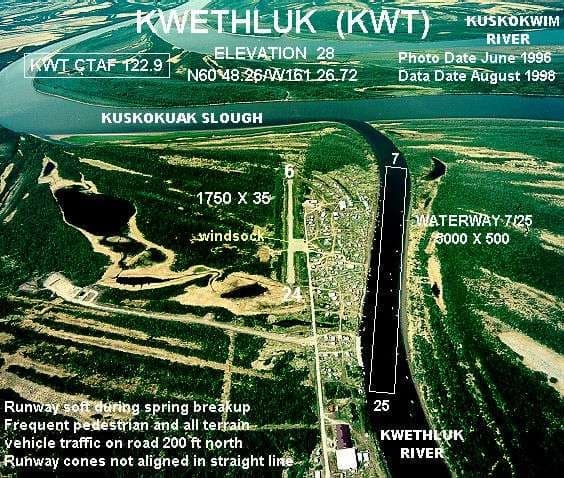
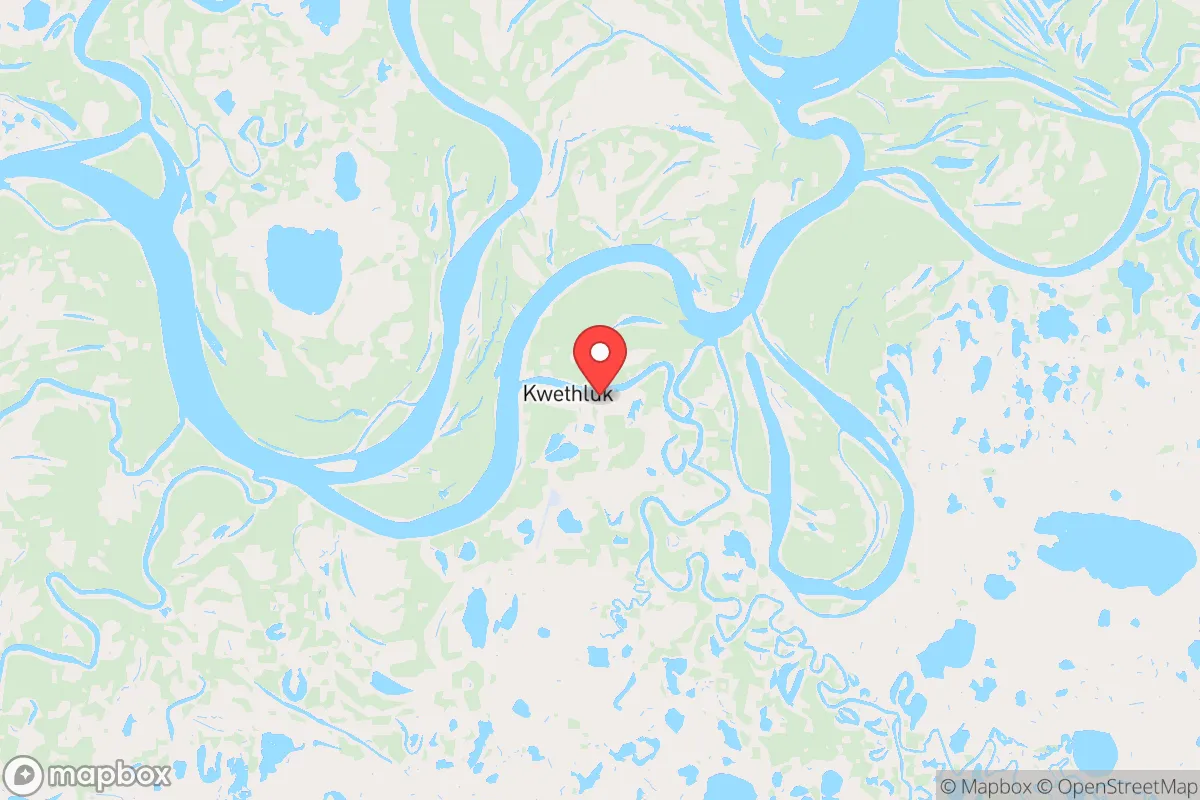
The people of Kwethluk, Alaska, are overwhelmingly Yup'ik, with 98.5% of the 852 residents identifying as Alaska Native or American Indian, making it one of the most homogeneously Indigenous communities in the state. This remote village on the Kwethluk River, a tributary of the Kuskokwim, has a population density of roughly 12 people per square mile, and its identity is deeply rooted in subsistence fishing, berry picking, and Yup'ik language preservation. Only 1.3% of residents are White, and there are no foreign-born, Hispanic, Black, or Indian subcontinent residents, with a negligible 0.2% East/Southeast Asian presence. The community is tight-knit, with a median age around 25, and daily life revolves around the Kwethluk River's salmon runs and the local Moravian Church, which remains a central institution.
How the city was settled and grew
Kwethluk's history is not one of colonial settlement but of continuous Yup'ik occupation along the Kuskokwim River system for thousands of years. The modern village was formally established in the late 19th century when Yup'ik families consolidated from seasonal fish camps into a permanent winter village, drawn by the reliable salmon and whitefish runs. The Moravian Church, arriving in the 1880s, built a mission and school in what is now Old Town Kwethluk, the original cluster of homes along the river's north bank. This neighborhood remains the historic core, where many of the village's oldest families—the Alexie, Andrew, and Nick families—still reside in traditional wooden houses with smokehouses. A second wave of consolidation occurred in the 1930s and 1940s when the Bureau of Indian Affairs (BIA) built a day school and airstrip, pulling in families from outlying fish camps like Kwigum and Akulurak. These newcomers settled in New Town, a grid of homes south of the airstrip, which today houses about 40% of the population. The village was officially incorporated as a second-class city in 1975, but its growth has remained organic, driven by family ties rather than outside migration.
Modern era (post-1965)
Since the 1960s, Kwethluk's population has grown slowly but steadily, from roughly 400 in 1970 to 852 today, almost entirely through natural increase—high birth rates among Yup'ik families—rather than in-migration. The Alaska Native Claims Settlement Act (ANCSA) of 1971 created the Kwethluk Native Corporation, which owns land around the village, including the Riverfront Subdivision, a newer area of homes built in the 1990s along the Kwethluk River's south bank. This subdivision absorbed younger families moving out of overcrowded homes in Old Town. The Airport Road corridor, developed in the 2000s, is where a handful of non-Native teachers, health aides, and state workers live in prefabricated houses, but they remain a tiny minority. There has been no significant domestic in-migration from outside the region; the 0.2% East/Southeast Asian population is likely a single individual married into a local family. The village has not experienced suburbanization or ethnic diversification—it remains a culturally and linguistically Yup'ik enclave, with Yup'ik spoken as the first language in most homes. The college-educated share is just 7.9%, reflecting the village's focus on subsistence and local employment in the school, clinic, and tribal government.
The future
Kwethluk's population is projected to remain stable or grow modestly, driven by a birth rate roughly double the national average, but out-migration of young adults to Bethel or Anchorage for education and work will likely offset gains. The village is not homogenizing—it is already nearly monolithic—but it is tribalizing in the sense that clan and family ties within neighborhoods like Old Town and New Town remain strong, with little mixing from outside groups. The immigrant population is zero and will likely stay near zero, as there are no economic opportunities or housing to attract outsiders. The next 10-20 years will see a continued Yup'ik majority, with English gradually gaining ground in younger generations but Yup'ik persisting in daily life. The biggest demographic shift may be a slight aging of the population as healthcare improves, but the median age will remain low.
For someone moving in now, Kwethluk is not a place of demographic change or diversity—it is a deeply traditional Yup'ik community where outsiders are rare and integration requires learning the language and respecting subsistence rhythms. The population is stable, young, and rooted, with no signs of the ethnic or cultural shifts seen in urban Alaska. New arrivals should expect a village where family and church are the primary social structures, and where the river dictates the calendar.

* Values derived from national, state, county, city and local statistics and may differ in a specific area. Last updated: 2026-04-19T19:31:32.000Z
Narrative content on this page is AI-generated and may contain mistakes. Verify any details that matter before acting on them.
ReloMaps may earn a commission from affiliate links at no extra cost to you.

