Demographics of Lake Worth, TX
Affluence Level in Lake Worth, TX
A middle-class area roughly in line with national averages across income, home values, education, and employment.
People of Lake Worth, TX
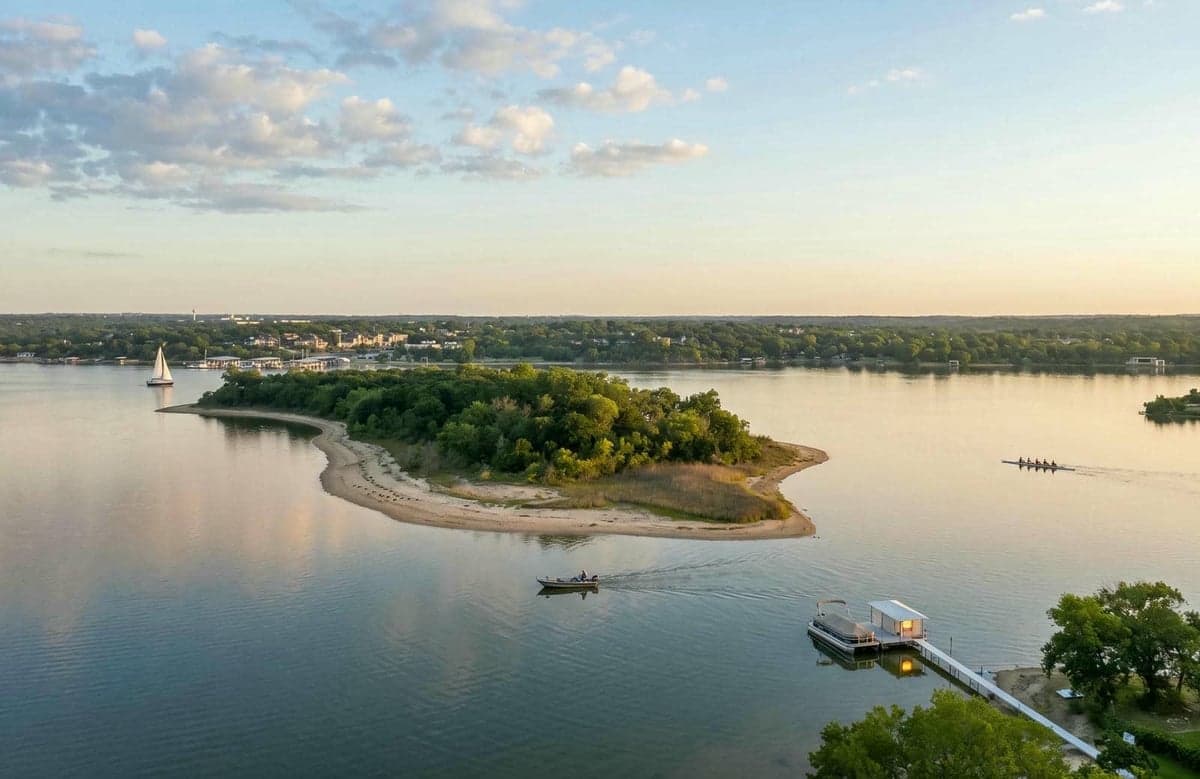
The people of Lake Worth, Texas, today form a compact, predominantly white and Hispanic community of 4,667 residents, characterized by a strong family-oriented, blue-collar identity rooted in the city’s mid-20th-century origins as a lakeside retreat and working-class suburb. With a foreign-born population of just 6.6% and a college attainment rate of 20.9%, the city remains less diverse and less educated than the broader Dallas-Fort Worth metroplex, reflecting its history as a stable, insular enclave. Distinctive markers include a high rate of homeownership, a visible presence of multi-generational families in neighborhoods like Lake Worth Village and Briarwood, and a local culture centered on Eagle Mountain Lake recreation and the annual Lake Worth Rodeo. The city’s population has remained nearly flat since 2000, suggesting a community that is aging in place rather than attracting new waves of migration.
How the city was settled and grew
Lake Worth was not a pioneer settlement or agricultural crossroads; it was a deliberate, post-1900 creation tied to the construction of Eagle Mountain Lake in the 1930s. The U.S. Army Corps of Engineers built the lake for flood control and water supply, and the surrounding land was platted for weekend cabins and summer homes for Fort Worth’s middle class. The original population was overwhelmingly white, Anglo, and Protestant—drawn from Fort Worth’s working and lower-middle classes seeking affordable lakefront property. The first permanent residents clustered in Lake Worth Village, the original plat along the lake’s eastern shore, where small frame houses and fishing camps dotted the shoreline. After World War II, returning veterans and their families settled in Briarwood and Lake Crest, neighborhoods of modest ranch-style homes built on former ranchland. The city incorporated in 1963, formalizing its identity as a self-governing suburb. No significant immigrant or minority populations settled during this era; the 1960 census recorded a population that was over 98% white, with a handful of Hispanic families working in service roles at the lake’s marinas and resorts.
Modern era (post-1965)
The post-1965 immigration reforms had minimal direct impact on Lake Worth. Unlike nearby Fort Worth or Arlington, which absorbed significant Mexican-American and Asian populations, Lake Worth remained overwhelmingly white through the 1970s and 1980s. The city’s population grew modestly from 3,200 in 1970 to 4,200 in 1990, driven by domestic in-migration from other parts of Tarrant County. The Hispanic share began rising in the 1990s, as families from Fort Worth’s North Side and the Rio Grande Valley moved into older, more affordable housing stock in neighborhoods like Lake Worth Estates and Sunset Shores. By 2000, the Hispanic population had reached 18%; by 2020, it had climbed to 35.3%. This growth was almost entirely Mexican-American, with no significant East/Southeast Asian, Indian, or Arab populations recorded. The white population declined from 80% in 1990 to 60.5% in 2024, but the city did not experience white flight—rather, older white residents aged in place while younger Hispanic families bought homes. The Black population remains negligible at 1.9%, concentrated in a handful of rental properties near Lake Worth Boulevard. The city’s foreign-born share (6.6%) is well below the Texas average of 17%, indicating that most Hispanic residents are U.S.-born or long-term legal residents.
The future
Lake Worth’s population is likely to continue its slow, incremental diversification rather than undergoing a rapid demographic transformation. The city’s housing stock—dominated by older, smaller homes on large lots—appeals to first-time buyers and families, but the lack of new construction and limited rental inventory will keep growth below 1% annually. The Hispanic share is projected to reach 40-45% by 2040, driven by natural increase and continued in-migration from adjacent Hispanic-majority neighborhoods in Fort Worth’s 76135 ZIP code. However, the city shows no signs of tribalizing into ethnic enclaves; Hispanic and white residents live intermingled in all neighborhoods, and local schools (Lake Worth ISD) report no significant segregation. The East/Southeast Asian and Indian populations will likely remain near zero, as Lake Worth lacks the job centers, ethnic grocery stores, or religious institutions that attract those groups to suburbs like Euless or Irving. The college-educated share (20.9%) may rise slightly as remote workers from Fort Worth seek lakefront property, but the city’s distance from major employment hubs and lack of high-end amenities will limit this trend.
For someone moving in now, Lake Worth offers a stable, affordable, and culturally homogeneous community where neighbors know each other and the pace of change is slow. The city is becoming slightly more Hispanic and slightly older, but it remains a place where a working-class family can buy a home on a quiet street and raise children in a low-crime, lake-oriented environment. The trade-off is limited economic opportunity, minimal ethnic diversity, and a population that is more rooted than mobile—a good fit for those seeking continuity, not for those seeking a dynamic, cosmopolitan suburb.

* Values derived from national, state, county, city and local statistics and may differ in a specific area. Last updated: 2026-04-19T07:26:42.000Z
Narrative content on this page is AI-generated and may contain mistakes. Verify any details that matter before acting on them.
ReloMaps may earn a commission from affiliate links at no extra cost to you.

