Political ClimatePolitical Climate in Lake Worth, TX
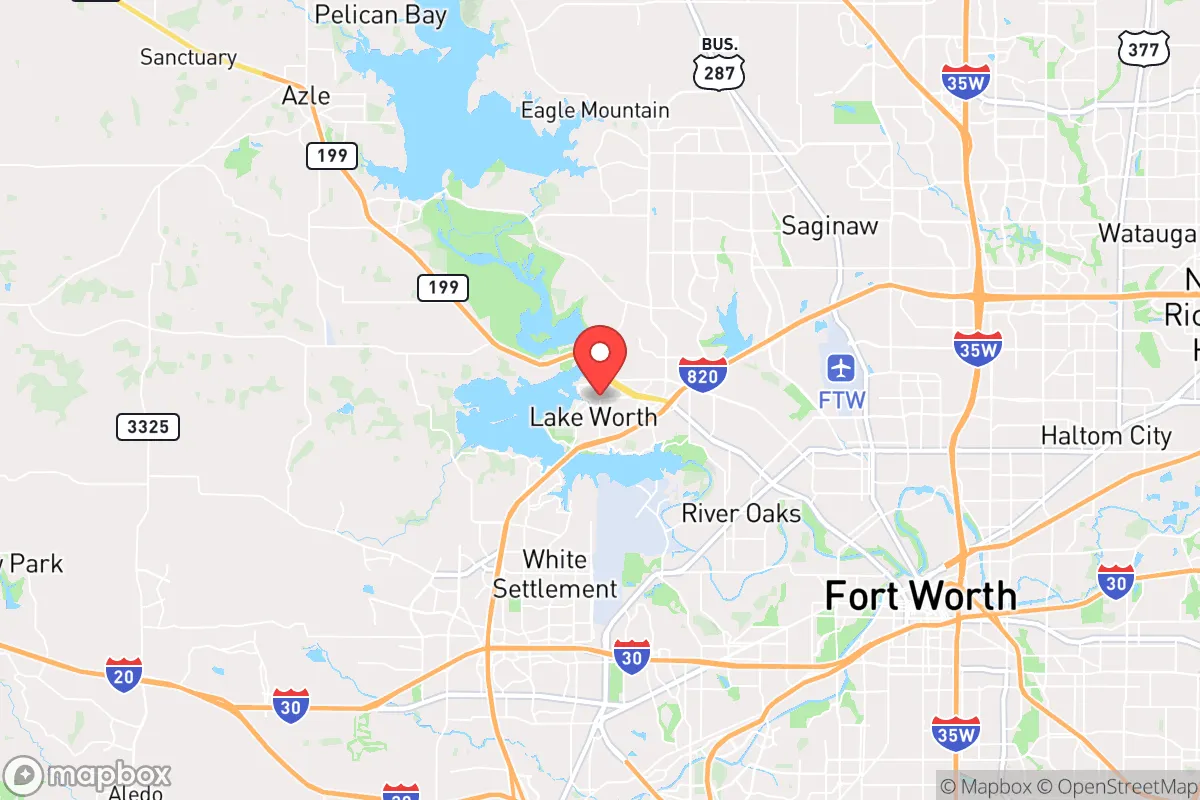
District shown is the primary district for this city’s centroid. Cities may span multiple districts.
Local Political AnalysisPolitical Analysis of Lake Worth, TX
Lake Worth, Texas, has long been a solidly conservative community, and that hasn't changed much despite the rapid growth all around it. With a Cook Partisan Voting Index of R+11, this is a place where folks still believe in limited government, personal responsibility, and the Second Amendment. The political lean here isn't just about party registration—it's a cultural thing, rooted in a deep skepticism of government overreach and a preference for local control over our own lives. You see it in the way people talk at the local diner or at the high school football games; there's a quiet but firm resistance to any progressive agenda creeping in from the bigger cities nearby.
How it compares
To really understand Lake Worth's politics, you have to look at the contrast with our neighbors. Head east a few miles into Fort Worth, and you're in a county that's been trending bluer for years, especially in the urban core. Even closer, places like Saginaw and Eagle Mountain are more mixed, but Lake Worth has held the line. We're not as deep red as the rural counties out west—Parker County, for instance, is even more conservative—but we're a reliable conservative pocket in a region that's seeing more and more progressive transplants. The R+11 rating tells you we're about 11 points more Republican than the national average, which means our local elections rarely see serious challenges from the left. That's a good thing, because it means our city council and school board are still focused on keeping taxes low and government out of our business, not on pushing social experiments.
What this means for residents
For those of us living here, the political climate translates directly into daily life. You don't have to worry about the city council trying to impose mask mandates or restrict your property rights. The local police are respected, not defunded, and the schools still teach kids how to think, not what to think. Property taxes are a concern everywhere in Texas, but our local leaders are generally more interested in cutting spending than raising rates. The downside? If you're hoping for a more progressive, "diverse" political environment, you'll find it frustrating. But for the majority of us who moved here to escape the chaos of the big city, it's a relief. The long-term trajectory is a bit concerning, though—as more people move in from blue states, we have to stay vigilant. The next few elections will be critical to keeping Lake Worth from sliding into the kind of overreach we see in places like Austin or Dallas.
Culturally, Lake Worth still feels like a small town in a lot of ways. The annual events, the church community, the local businesses—they all reflect a conservative, family-first mindset. One policy distinction that stands out is our approach to land use and zoning. We've resisted the kind of dense, high-rise development that brings in transient populations and progressive voting blocs. Instead, we've kept things low-key, with single-family homes and local shops. That's not an accident; it's a deliberate choice by a community that values its way of life. The biggest red flag I see on the horizon is the push for "regionalism" from the metroplex—efforts to consolidate school districts or water authorities that would dilute our local control. If that happens, we'll lose the ability to govern ourselves the way we see fit. For now, though, Lake Worth remains a place where you can still raise your kids with traditional values, keep your guns, and tell the government to stay out of your life. That's worth fighting for.

State Political ClimatePolitical Climate in Texas
State Political AnalysisPolitical Environment in the State
Texas has been a reliably Republican state for decades, but the political climate is more complex than a simple red-state label suggests. The GOP holds every statewide office and both legislative chambers, yet the margin of victory for presidential candidates has narrowed from 16 points in 2012 to just under 6 points in 2020, driven by explosive growth in the urban crescent from Dallas-Fort Worth down through Austin to Houston and San Antonio. The dominant coalition remains conservative-leaning suburbanites, rural voters, and a growing number of Hispanic and Asian voters who prioritize economic freedom and low taxes over the Democratic Party’s progressive agenda. However, the state’s trajectory is being pulled in two directions: the fast-growing metro areas are trending left, while the exurbs and small towns are digging in deeper on conservative values.
Urban vs. rural divide
The political map of Texas is a tale of two landscapes. The major metros—Houston, Dallas, San Antonio, and especially Austin—are the Democratic strongholds. Harris County (Houston) alone delivered over 1 million votes for Biden in 2020, and Travis County (Austin) gave him 72% of the vote. Meanwhile, the rural Panhandle, West Texas, and East Texas piney woods are deeply Republican. Lubbock, Midland, and Tyler routinely vote 70-80% GOP. The real battleground is the suburbs: Collin County (north of Dallas), Denton County, and Williamson County (north of Austin) have been drifting left as Californians and other transplants move in. Collin County went from 57% Romney in 2012 to 51% Trump in 2020—a massive shift. The exurbs like Kyle, Buda, and Forney are still red but showing cracks. The rural-urban divide is now a suburban-exurban tug-of-war.
Policy environment
Texas’s policy environment is a textbook example of limited-government conservatism, though with some notable exceptions. There is no state income tax, which is the single biggest draw for relocating families and businesses. Property taxes are high (roughly 1.6-2.5% of assessed value), but the state legislature has been using budget surpluses to buy down the school property tax rate—a trend that accelerated in 2023 with a $12.7 billion property tax cut package. The regulatory climate is business-friendly: no state-level minimum wage above the federal $7.25, no state-level paid leave mandate, and a right-to-work law that keeps unions weak. On education, the state funds public schools through a complex recapture system (Robin Hood), but also expanded school choice in 2023 with the creation of education savings accounts for special-needs students. Healthcare policy is hands-off: Texas did not expand Medicaid under Obamacare, and the state has some of the loosest telemedicine and direct-primary-care laws in the country. Election laws tightened in 2021 with SB 1, which banned 24-hour and drive-through voting, added ID requirements for mail ballots, and empowered poll watchers—moves that conservatives say protect integrity and progressives call suppression.
Trajectory & freedom
On the freedom front, Texas has been a mixed bag over the last five years, but the overall trajectory is toward more personal liberty in most areas. Gun rights expanded significantly: in 2021, Texas passed permitless carry (HB 1927), allowing any law-abiding adult to carry a handgun without a license. Parental rights saw a major win with the 2023 passage of the Texas Parental Bill of Rights (SB 1125), which codifies that parents have the fundamental right to direct their child’s education, healthcare, and moral upbringing. On medical autonomy, the state banned COVID-19 vaccine mandates for private employers (SB 7 in 2023) and prohibited mask mandates in schools. Property rights were strengthened with the 2023 law limiting eminent domain for private economic development. However, there are concerning areas: the state’s tax burden remains high for homeowners due to property taxes, and the 2023 law banning gender-affirming care for minors (SB 14) was a win for parental rights but also drew federal lawsuits. The biggest freedom concern is the growing power of local governments—cities like Austin and Houston have passed ordinances on paid sick leave and tenant protections that the state legislature has preempted, creating a patchwork that frustrates both businesses and residents.
Civil unrest & political movements
Texas has seen its share of political flashpoints. The 2020 Black Lives Matter protests in Austin, Dallas, and Houston were large and occasionally violent, leading to property damage and a lasting distrust of local law enforcement in those cities. The 2021 winter storm (Uri) became a political battleground, with conservatives blaming the grid’s failure on renewable energy mandates and progressives pointing to deregulation. Immigration politics are a constant: the border city of El Paso has been a focal point for migrant surges, and Governor Abbott’s Operation Lone Star has bused thousands of migrants to New York, Chicago, and Denver—a move that galvanized both supporters and detractors. Election integrity remains a hot-button issue: the 2020 election saw lawsuits over Harris County’s drive-through voting, and the 2022 primaries featured high-profile challenges to incumbents over election administration. Secession rhetoric (Texit) is a fringe but vocal movement, with the Texas Nationalist Movement claiming tens of thousands of supporters, though no serious political figure has endorsed it. The most visible flashpoint for a new resident would be the school board wars—over curriculum, library books, and critical race theory—which have turned local elections in suburbs like Southlake and Frisco into proxy battles for the national culture war.
Projection
Over the next 5-10 years, Texas is likely to become more conservative in policy but more competitive in elections. The demographic trends are clear: the state is adding about 1,000 new residents a day, many from California and the Northeast, and they tend to be younger and more moderate. The Hispanic vote is the wildcard—it’s not monolithic, but it’s trending rightward, especially among working-class men in the Rio Grande Valley. Counties like Starr and Zapata that voted for Obama by 40 points flipped to Trump in 2020. Meanwhile, the suburban shift left will continue, but the state legislature’s aggressive gerrymandering (2021 maps) will keep the GOP in power for at least another decade. The biggest wildcard is property taxes: if the legislature can’t keep cutting them, the cost of living advantage will erode, and the freedom message will ring hollow. Expect more school choice expansion, continued preemption of local progressive ordinances, and a hardening of border enforcement. A new resident moving in now should expect a state that is still very free by national standards, but with a growing tension between the libertarian-leaning suburbs and the interventionist impulses of both parties on social issues.
Bottom line for a new resident: If you’re moving to Texas for lower taxes, less regulation, and a culture that values personal responsibility, you’ll find that in spades—especially if you settle in the exurbs or smaller cities like College Station, San Angelo, or Tyler. Avoid the urban cores of Austin and Houston if you want to escape progressive governance, but know that even the red suburbs are changing. The state is still a beacon of freedom compared to California or New York, but the fight to keep it that way is ongoing. You’ll need to be engaged at the local level—school boards, city councils, and county commissioner courts—because that’s where the real battles over your rights are being fought.
* Values derived from national, state, county, city and local statistics and may differ in a specific area. Last updated: 2026-04-19T07:26:42.000Z
Narrative content on this page is AI-generated and may contain mistakes. Verify any details that matter before acting on them.
ReloMaps may earn a commission from affiliate links at no extra cost to you.

