Photo: Wikipedia
Demographics of Lakewood, OH
Affluence Level in Lakewood, OH
A middle-class area roughly in line with national averages across income, home values, education, and employment.
People of Lakewood, OH
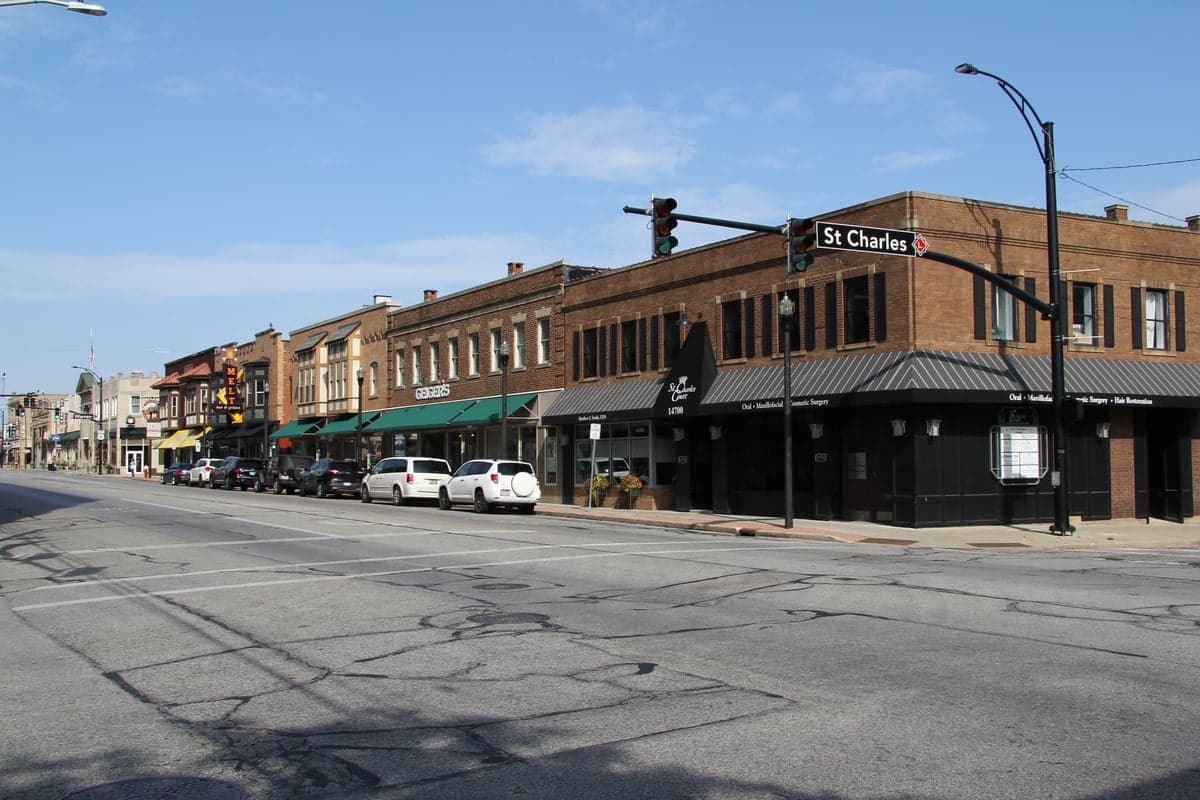
Lakewood, Ohio, is a dense, walkable inner-ring suburb of Cleveland with 50,229 residents who form one of the most educated and politically engaged communities in Cuyahoga County. Its population is predominantly white (83.2%) but includes growing Hispanic (4.5%) and Black (6.2%) communities, alongside small but established East/Southeast Asian (2.0%) and Indian (0.4%) populations. With 53.9% of adults holding a college degree, Lakewood attracts professionals, artists, and young families who value its historic housing stock, transit access, and independent business corridor along Detroit Avenue. The city’s identity is shaped by a century of European immigration, mid-century suburban stability, and a recent influx of younger, more diverse residents seeking urban amenities without the city of Cleveland’s tax burden.
How the city was settled and grew
Lakewood’s population history begins with its 19th-century role as a summer retreat for wealthy Cleveland industrialists, who built large estates along the Lake Erie shoreline in what is now the Clifton Park neighborhood. The arrival of the Cleveland, Cincinnati, Chicago and St. Louis Railway in the 1870s opened the area to middle-class commuters, and by 1900, Lakewood was transforming into a streetcar suburb. The first major wave of working-class immigrants—primarily German, Irish, and Polish families—settled in the Birdtown neighborhood, named for the bird-themed street names (Robin, Wren, Lark) that still define the area. These groups built the Catholic parishes and union halls that anchored the community through the early 1900s. A second wave of Italian and Slovak immigrants arrived between 1910 and 1930, clustering in the West End near the Detroit Avenue streetcar line and working in Cleveland’s steel mills and auto plants. By 1930, Lakewood’s population had surged past 70,000, making it one of Ohio’s most densely populated cities. The post-World War II era brought a third wave: Jewish families moving east from Cleveland’s Glenville and Mount Pleasant neighborhoods, who established a significant presence in the North Lakewood area around Lakewood Park and the former Lakewood Hospital.
Modern era (post-1965)
The 1965 Hart-Cellar Act and subsequent immigration reforms had a modest direct impact on Lakewood compared to gateway cities, but the city experienced significant domestic demographic shifts. White flight from Cleveland in the 1970s and 1980s brought middle-class Black families to Lakewood, primarily settling in the eastern sections near the Cleveland border, including the area around Madison Avenue and Bunts Road. This period also saw the arrival of Hispanic families, largely of Puerto Rican and Mexican heritage, who concentrated in the Birdtown neighborhood, where affordable housing and proximity to Cleveland’s industrial jobs provided a foothold. The East/Southeast Asian population—primarily Korean and Vietnamese families—grew slowly after 1990, often drawn by Lakewood’s school system and proximity to Cleveland’s University Circle medical and tech employers; they are dispersed across the city but have a visible commercial presence along Detroit Avenue near the Downtown Lakewood business district. The Indian subcontinent population (0.4%) remains small and professionally oriented, with families typically settling in the Clifton Park and West End areas for larger homes and shorter commutes to Cleveland’s hospitals and tech firms. Since 2000, Lakewood has attracted a wave of young, college-educated professionals from across the Midwest, drawn by the city’s walkability, historic architecture, and lower home prices compared to Cleveland’s Ohio City or Tremont neighborhoods. This group is overwhelmingly white but includes a growing share of mixed-race and multiethnic households.
The future
Lakewood’s population is slowly diversifying but remains majority-white, with the Hispanic and Black shares each projected to grow by 1-2 percentage points over the next decade. The East/Southeast Asian population is stable, sustained by professional families in the medical and tech sectors, while the Indian population is likely to remain small due to competition from Cleveland’s eastern suburbs (Beachwood, Solon) that offer larger homes and stronger ethnic infrastructure. The city is not tribalizing into distinct enclaves; instead, Birdtown is becoming more Hispanic and younger, while Clifton Park and the West End retain older, wealthier white households. The biggest demographic trend is aging in place: Lakewood’s median age has risen to 38.5, and the share of households with children under 18 has declined to 22%, as young professionals delay childbearing and empty-nesters stay in their historic homes. The city is also seeing a modest inflow of LGBTQ+ families and interracial couples, drawn by Lakewood’s reputation as one of the most socially liberal suburbs in conservative-leaning Ohio.
For a conservative-leaning individual or family considering a move, Lakewood is becoming a denser, more diverse, and more politically progressive community than its surrounding suburbs. The population is stable in size but shifting in composition—less uniformly white and Catholic than in 1950, more educated and secular than in 1980, and increasingly oriented toward Cleveland’s urban economy rather than local manufacturing. The city offers strong public schools, a low crime rate relative to Cleveland, and a walkable lifestyle that appeals to professionals, but it lacks the ethnic enclaves or conservative social infrastructure found in outer-ring suburbs like Strongsville or Medina. New residents should expect a community that values density, diversity, and civic engagement over privacy and homogeneity.

* Values derived from national, state, county, city and local statistics and may differ in a specific area. Last updated: 2026-04-21T18:21:54.000Z
Narrative content on this page is AI-generated and may contain mistakes. Verify any details that matter before acting on them.
ReloMaps may earn a commission from affiliate links at no extra cost to you.

