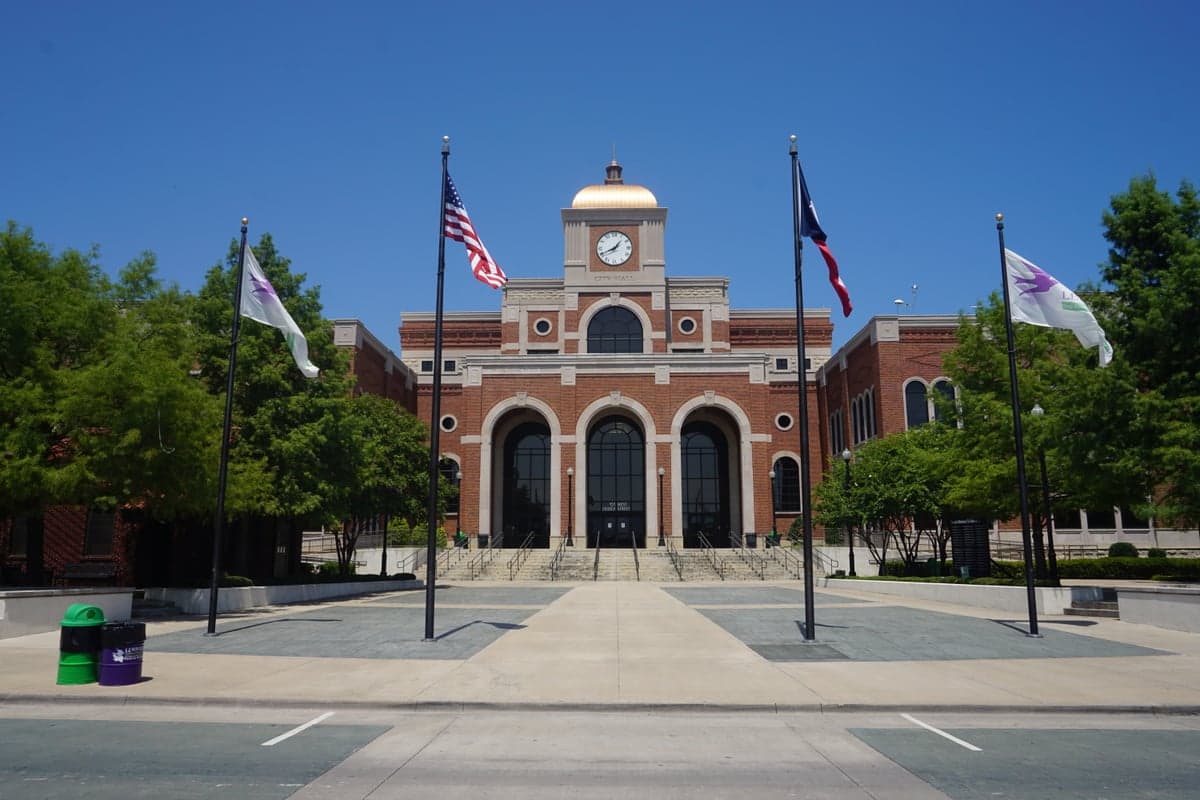
Photo: Wikipedia
Personal Sovereignty in Lewisville, TX
Strong independent fundamentals that actively favor personal liberty and low regulation.
What does Personal Sovereignty tell us?
Personal Sovereignty measures your capacity for self-reliance and independence with minimal government friction. Higher scores mean fewer barriers between you and the way you want to live... but it assumes you have the space you need and good neighbors.
What does this tell us?
Personal Sovereignty measures your capacity for self-reliance and independence with minimal government friction. Higher scores mean fewer barriers between you and the way you want to live... but it assumes you have the space you need and good neighbors.
State Policy
Energy independence: Net exporter (220% of energy produced in-state)
Personal Liberty
Homesteading

Personal Liberty Analysis
Lewisville, Texas, offers a notably high degree of personal sovereignty compared to many urbanized areas in the United States, largely due to Texas’s strong state-level preemption laws and a local culture that leans heavily toward self-reliance. While it sits within the Dallas-Fort Worth metroplex, the city’s governance is constrained by state statutes that limit local overreach on issues like firearms, property use, and taxation. For a survivalist or prepper mindset, the key question is whether Lewisville’s suburban environment allows enough breathing room to live according to your own rules, or whether the proximity to a major metro area introduces the kind of regulatory creep that erodes autonomy. The answer is nuanced: the state provides a solid legal foundation for personal liberty, but the city’s density and zoning can create friction for those seeking true self-sufficiency.
Tax burden and regulatory posture: How Texas state law limits local overreach
Texas has no state income tax, which immediately puts more money in your pocket and reduces the government’s direct claim on your earnings. In Lewisville, property taxes are the primary local revenue source, with a combined rate around 2.3% to 2.5% of assessed value, depending on the specific school district and municipal services. While that’s not low by national standards, the absence of income tax means your total tax burden is still competitive, especially when compared to states like California or New York. More importantly, Texas’s property tax code includes a homestead exemption that protects a portion of your home’s value from taxation, and the state caps appraisal increases at 10% per year for homesteads, preventing runaway assessments. On the regulatory front, Texas has strong preemption laws that prevent cities from enacting their own ordinances on matters like landlord-tenant relationships, occupational licensing, and even tree removal on private property. This means Lewisville cannot impose the kind of burdensome local regulations seen in cities like Austin or Portland. For a prepper, this translates to fewer bureaucratic hurdles when modifying your property, storing supplies, or running a home-based business. The city’s zoning code does require permits for major structures, but it generally allows accessory dwelling units and home occupations without excessive red tape, provided you stay within standard suburban limits.
Self-defense and gun law specifics: What the Castle Doctrine and permitless carry mean for you
Texas is one of the strongest states in the nation for self-defense rights, and Lewisville residents benefit directly from that. The state’s Castle Doctrine eliminates any duty to retreat in your home, vehicle, or workplace, and the Stand Your Ground law extends that protection to any place you are lawfully present. Since 2021, permitless carry (also called constitutional carry) allows any law-abiding adult 21 or older to carry a handgun openly or concealed without a license. This is a significant advantage for those who prioritize personal security without wanting to register with the government. Lewisville itself has no local gun ordinances that conflict with state law—city council cannot ban firearms in parks, restrict magazine capacities, or impose waiting periods, thanks to Texas’s preemption statute. The only local nuance is that carrying in certain government buildings or schools is still restricted, but those are state-level prohibitions, not local inventions. For a survivalist, this means you can maintain a fully stocked armory without fear of local confiscation or registration schemes. The legal environment is permissive enough that you can train, store, and carry without bureaucratic interference, though you should still be aware of federal restrictions on items like suppressors or short-barreled rifles, which require NFA paperwork regardless of state law.
Self-reliance and homesteading viability: Lot sizes, zoning, and off-grid feasibility in a suburban context
Lewisville is a mature suburb with typical lot sizes ranging from 6,000 to 12,000 square feet in most residential neighborhoods, though some newer developments offer smaller plots. This is not rural land—you won’t find the acreage needed for serious homesteading or off-grid living without looking further north toward Denton or west toward the Hill Country. However, within the city limits, you can still exercise a degree of self-reliance. Chickens are allowed on residential lots under 10,000 square feet with a permit, and larger lots can keep goats or other small livestock, subject to setback and noise restrictions. Gardening is unrestricted, and many homeowners maintain substantial vegetable plots. The city’s zoning code does not prohibit rainwater collection, and Texas law actually encourages it by exempting rainwater harvesting systems from sales tax. Solar panels are allowed, though homeowners’ associations (HOAs) in some neighborhoods may impose aesthetic restrictions—a common frustration for preppers. Off-grid living in the sense of disconnecting from the power grid or municipal water is technically possible but practically difficult due to building codes that require connection to city utilities for new construction. Existing homes can install solar with battery backup, but you’ll still pay a base fee for grid connection. For those serious about self-sufficiency, Lewisville is a compromise: you can grow food, keep some animals, and generate your own power, but you’ll be doing it within a suburban framework that limits total independence. The nearby rural areas of Denton County offer larger parcels and fewer restrictions, but they come with longer commutes and less access to emergency services.
Personal liberties: Parental rights, medical autonomy, speech, and property protections
Texas has been a battleground for parental rights, and the state’s laws generally favor family autonomy over government intervention. In Lewisville, parents have the legal right to direct their children’s education, including homeschooling without excessive state oversight—Texas requires only a written curriculum and a few basic subjects, with no standardized testing or home visits. Medical autonomy is more complicated. While Texas has strong protections for vaccine exemptions (both medical and conscientious), the state does not have a broad medical freedom law that protects alternative treatments or unapproved therapies. The Texas Medical Board retains authority to discipline doctors, so experimental treatments are risky. On speech and assembly, Lewisville is typical of a Texas suburb: public protests are allowed with permits, and there are no local ordinances restricting political speech or signage beyond standard time-place-manner rules. Property rights are robust under Texas law, with strong protections against eminent domain abuse and a requirement that any regulatory taking be compensated. However, HOAs in many Lewisville neighborhoods can impose restrictive covenants on everything from paint colors to vehicle storage, which can feel like a violation of personal sovereignty. For a prepper, the key is to buy in an area without an HOA, or at least one with minimal restrictions. Overall, Lewisville offers a legal environment that respects individual choice in most areas, but the suburban setting means you’ll still have neighbors and local codes to contend with.
Compared to other parts of the Dallas-Fort Worth metroplex, Lewisville strikes a reasonable balance between access to urban infrastructure and personal sovereignty. It is not as free as rural Texas counties where you can shoot on your property and live entirely off-grid, but it is far more permissive than cities like Austin or Dallas, where local governments have attempted to restrict everything from plastic bags to firearm storage. For a survivalist or prepper who needs to stay near employment centers but wants to minimize government overreach, Lewisville is a solid choice—provided you choose your neighborhood carefully and understand that true autonomy will require a move further out. The state’s legal framework gives you a strong foundation, but the city’s suburban character means you’ll always be balancing personal freedom with community norms.

* Values derived from national, state, county, city and local statistics and may differ in a specific area. Last updated: 2026-04-21T13:19:09.000Z
Narrative content on this page is AI-generated and may contain mistakes. Verify any details that matter before acting on them.
ReloMaps may earn a commission from affiliate links at no extra cost to you.

