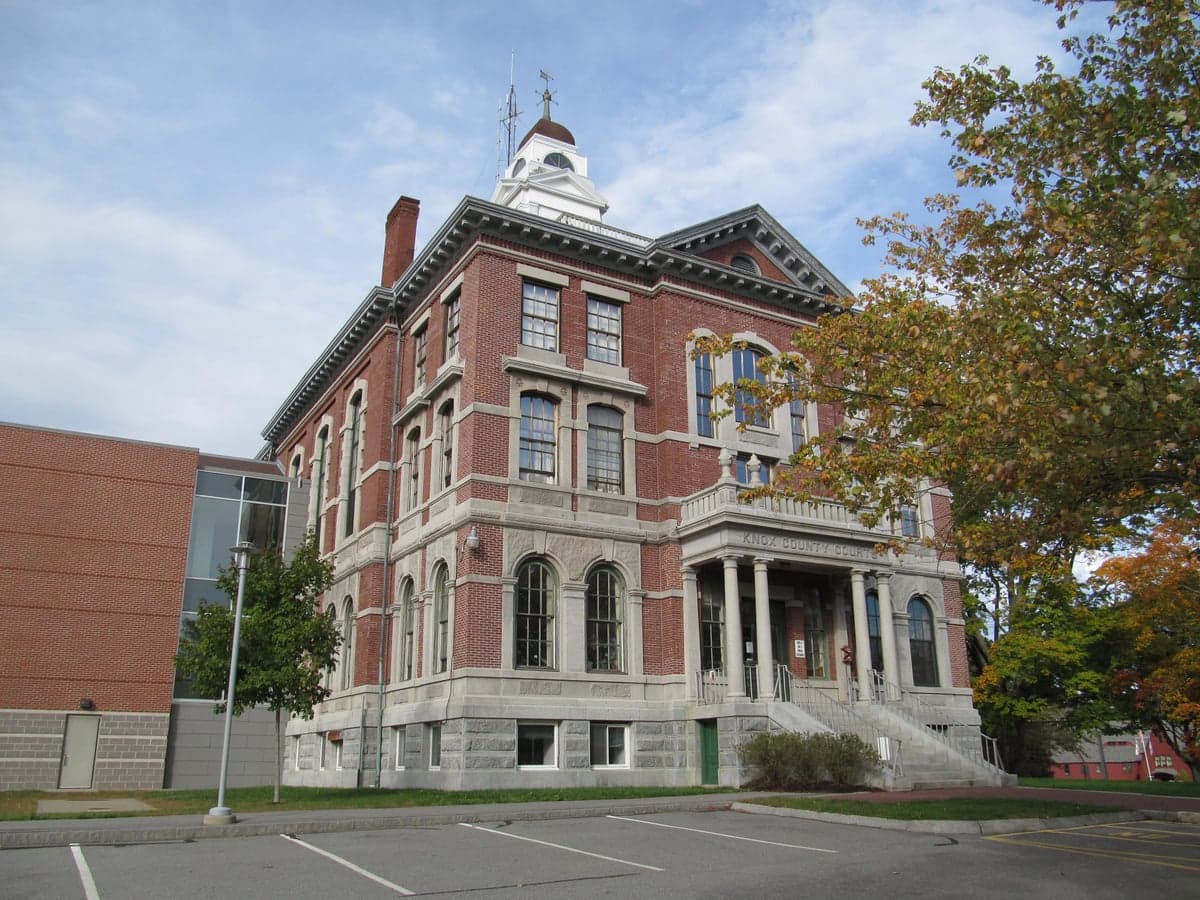
Photo: Wikipedia
Political ClimatePolitical Climate in Knox County
Showing district-level results — no local-only data available.
Local Political AnalysisPolitical Analysis of Knox County
Knox County, Maine, is a solidly Democratic area with a Cook PVI of D+11, meaning it votes about 11 points more Democratic than the national average. That said, the county is far from a monolith. The political energy is split between the reliably blue coastal towns like Camden and Rockport, and the more conservative, rural inland communities like Union, Washington, and Warren. Over the past decade, the Democratic lean has held steady, but the margins have tightened in some precincts as national polarization seeps into local conversations. The real story here isn't a uniform blue wave—it's a patchwork of blue, red, and purple that shifts depending on whether you're on the water or in the woods.
How it compares
Compared to Maine as a whole, Knox County is noticeably more Democratic. While the state's Cook PVI is unknown, Maine is known for its independent streak and split-ticket voting—think Susan Collins (R) winning statewide while the state goes blue for president. Knox County doesn't have that same swingy character. In the 2020 presidential election, Joe Biden won Knox County by about 20 points, while statewide he won by roughly 9 points. The county's Democratic edge is driven by the tourist-heavy, amenity-rich coastal towns. Camden and Rockland are the bluest, with precincts regularly delivering 65-70% Democratic votes. Rockport is a bit more moderate but still leans blue. In contrast, Union and Washington are the reddest towns, often voting Republican by 10-15 points. Warren and Thomaston are the true swing areas—Warren went for Trump in 2016 and 2020, but by narrow margins, while Thomaston has flipped back and forth in local races. This internal variation means the county's D+11 label hides a real urban-rural divide that mirrors the national pattern.
What this means for residents
For liberal residents, especially in Camden and Rockland, the political climate feels affirming. Local government, school boards, and town councils tend to reflect progressive values—think climate action, affordable housing initiatives, and support for LGBTQ+ rights. You'll find plenty of neighbors who share your views, and the local paper, the Knox County VillageSoup, covers these issues with a sympathetic lens. For conservative residents, especially in Union or Washington, the experience is different. You're in the minority countywide, but not isolated. Your town government and local school board may lean your way, and you'll find like-minded folks at the Grange hall or the local gun club. The key is that Knox County isn't hostile to conservatives—it's just that the dominant political culture is center-left. Property taxes are a unifying issue across the political spectrum, with both sides grumbling about the burden, especially as home values rise. The county's Democratic lean means state-level policy (like Maine's expanded Medicaid and renewable energy goals) is generally popular here, but local debates over development, fishing regulations, and school funding often cross party lines.
Culturally, Knox County's political identity is shaped by its mix of old-money summer residents, working lobstermen, and a growing creative class in Rockland. The county has a strong tradition of localism and self-reliance that tempers its blue lean. You won't see the same level of partisan activism as in Portland or Bangor. Instead, politics here is more pragmatic—people care about the working waterfront, the cost of heating oil, and keeping the schools funded. The biggest policy distinction from more conservative parts of Maine is the county's embrace of environmental regulation, particularly around coastal development and aquaculture. That said, even in blue Camden, there's a libertarian streak on issues like gun rights and land use. The near-term future looks stable: Knox County will stay D+11 or maybe drift a point or two left as coastal property values attract more out-of-state transplants, but the inland towns will hold their ground. For anyone moving here, the takeaway is simple: you'll find your people, whether you're flying a Biden flag or a Trump flag, but the conversation will always come back to the weather, the tides, and the taxes.

State Political ClimatePolitical Climate in Maine
State Political AnalysisPolitical Environment in the State
Maine has a reputation as a swing state, but the reality is more nuanced: it’s a Democratic-leaning state at the presidential level, having voted blue in every election since 1992 except 2000, but it’s also home to a fiercely independent streak and a strong conservative presence outside its coastal cities. The state’s political trajectory over the last 20 years has been one of slow, steady polarization, with the Portland metro area and college towns like Brunswick and Orono pulling left, while vast rural counties like Piscataquis, Franklin, and Aroostook have trended hard right. The wild card is Maine’s large bloc of unenrolled voters—roughly 37% of the electorate—who often split tickets and keep races competitive, especially in the state legislature and for governor.
Urban vs. rural divide
The political map of Maine is a textbook case of the urban-rural split. The Portland metro area, including South Portland, Westbrook, and Scarborough, is the Democratic engine, delivering margins of 60-70% in statewide races. Farther north, Bangor and the University of Maine in Orono are reliably blue, but the surrounding Penobscot County is a toss-up. The real conservative strongholds are the vast, sparsely populated northern and western counties: Aroostook County (the “Crown of Maine”) votes Republican by 20-30 points, as do Piscataquis, Franklin, and Oxford counties. A notable exception is the midcoast region around Camden and Rockland, which leans left due to a mix of wealthy retirees and creative-class transplants. The Second Congressional District, which covers the entire state outside of the Portland area, is one of the most competitive House seats in the country, flipping between parties every few cycles. In 2024, Republican Austin Theriault came within 2 points of unseating Democrat Jared Golden, a sign that the rural-urban gap is only widening.
Policy environment
Maine’s policy environment is a mixed bag that reflects its independent character. The state has a progressive income tax system with rates from 5.8% to 7.15%, and a sales tax of 5.5% that exempts groceries and most services. Property taxes are high—among the top 10 in the nation—which is a major pain point for rural landowners. On regulation, Maine is generally business-friendly for small enterprises but has strict environmental rules, especially around coastal development and forestry. Education policy is locally controlled, but the state mandates a “funding formula” that has led to consolidation of rural school districts, a sore spot in places like Eastport and Jackman. Healthcare is a bright spot for liberals: Maine expanded Medicaid under the Affordable Care Act via a 2017 ballot initiative, and the state runs its own exchange with robust subsidies. Election laws are notably open: same-day voter registration, no-excuse absentee voting, and ranked-choice voting for federal and state primaries (and presidential elections) make it one of the easiest states to vote in. For conservatives, the lack of voter ID laws and the use of ranked-choice voting are frequent targets of criticism.
Recent policy direction
Over the last five years, Maine has moved left on several fronts, but with notable exceptions. In 2023, the legislature passed a strict gun safety package—LD 2238—that expanded background checks to private sales, created a 72-hour waiting period for handgun purchases, and banned “ghost guns.” This was a direct response to the 2023 Lewiston mass shooting, and it passed with only Democratic support. On education, the state has embraced “comprehensive” sex education and LGBTQ+ inclusive curricula, while parental rights groups have pushed back with limited success. In 2024, a bill to require schools to notify parents of changes in a student’s gender identity failed, but the issue remains live. On property rights, Maine has a strong “right to farm” law that protects agricultural operations from nuisance lawsuits, but it also has a controversial “bottle bill” that adds a 5-cent deposit to most beverages. Taxation has been a flashpoint: in 2024, voters rejected a ballot measure to lower the income tax rate to 5%, but the legislature did pass a modest property tax relief program for seniors. On voting, ranked-choice voting survived a 2024 repeal attempt, and the state continues to mail absentee ballot applications to all registered voters. For conservatives, the overall direction is one of incremental expansion of government reach, tempered by a strong local control tradition that keeps some towns—like those in Washington County—largely unbothered by state mandates.
Civil unrest & political movements
Maine is not a hotbed of civil unrest, but it has seen its share of political movements. The 2023 Lewiston shooting, which killed 18 people, sparked massive protests for gun control in Portland and Augusta, with counter-protests by gun rights groups in smaller towns like Norway and Rumford. The “Yellow Vests” movement, a loose coalition of anti-lockdown and anti-vaccine mandate activists, had a strong presence in rural areas during the pandemic, and some of that energy has shifted to school board and town council races. Immigration politics are relatively low-key compared to other states, but there have been tensions in Portland over the influx of asylum seekers from Africa and the Middle East, leading to a 2024 city council vote to limit shelter stays. There is no sanctuary state law, but Portland and a few other cities have “welcoming” policies. Secession talk is mostly a joke, though the “Northern Maine” secession movement—which would create a new state from Aroostook and Washington counties—surfaced briefly in 2023 and got a few thousand signatures before fizzling. Election integrity controversies are minimal; Maine’s paper ballot system and mandatory audits are widely trusted, though some rural Republicans have questioned the use of ranked-choice voting in presidential elections.
Projection
Over the next 5-10 years, Maine’s political trajectory points toward continued polarization, with the Portland metro area growing and becoming more Democratic, while rural counties continue to bleed population and harden their Republican lean. In-migration from Massachusetts and New York—especially to coastal towns like Kennebunk and Belfast—is bringing more left-leaning voters, but also some libertarian-leaning remote workers who could shake up local races. The Second Congressional District will remain a toss-up, but the state as a whole is likely to stay blue in presidential elections, barring a major national shift. The biggest wild card is the aging population: Maine is the oldest state by median age, and younger voters moving in are more liberal, while older rural voters are dying off. This demographic shift will slowly push the state left, but the independent streak means that a moderate Republican—like former Senator Susan Collins—can still win statewide. For a new resident, expect a state where your vote matters more than in most, but where the political culture is more about local issues—like property taxes and school funding—than national culture wars.
For a conservative relocator, Maine offers a place where you can find like-minded communities in rural towns like Dover-Foxcroft or Houlton, but you’ll have to accept a state government that is reliably Democratic on most issues. For a liberal relocator, the Portland area provides a progressive bubble with strong public services, but you’ll pay for it with high taxes and a housing crunch. The bottom line: Maine is a state where your personal freedom is high—low crime, open spaces, and a live-and-let-live attitude—but your political influence is limited by the urban-rural divide. If you’re looking for a place where your vote consistently aligns with the majority, look elsewhere. If you value a community where neighbors respect each other’s differences, Maine delivers.
* Values derived from national, state, county, city and local statistics and may differ in a specific area. Last updated: 2026-08-18T17:54:33.000Z
Narrative content on this page is AI-generated and may contain mistakes. Verify any details that matter before acting on them.
ReloMaps may earn a commission from affiliate links at no extra cost to you.

