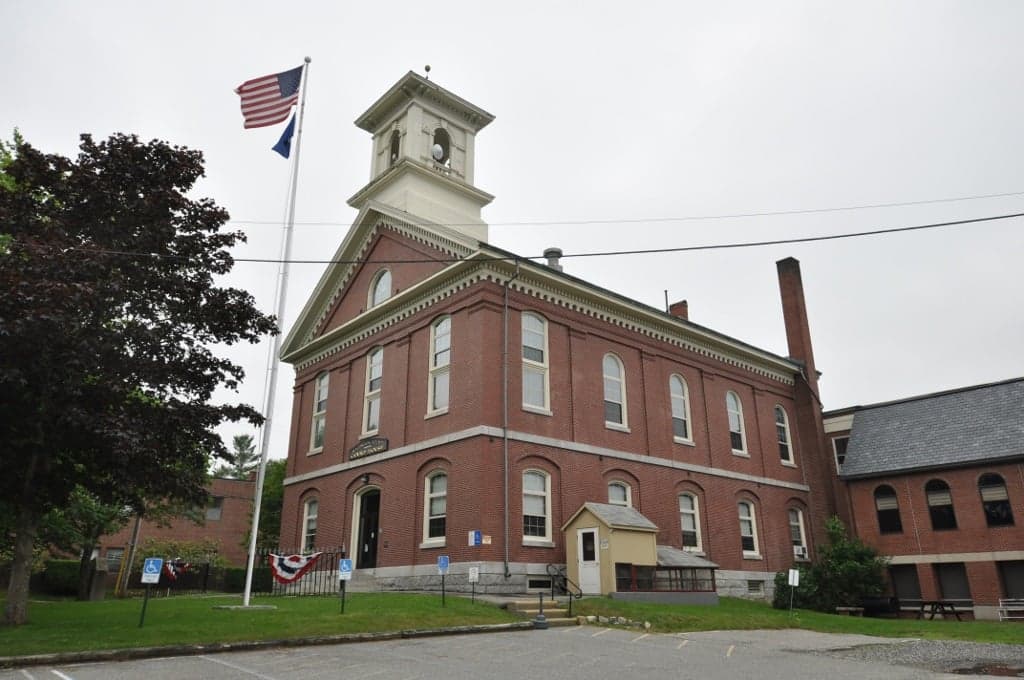
Photo: Wikipedia
Political ClimatePolitical Climate in Washington County
Showing district-level results — no local-only data available.
Local Political AnalysisPolitical Analysis of Washington County
Washington County, Maine, is a place where the political landscape feels as rugged and independent as its coastline. The county carries a Cook Partisan Voting Index (PVI) of R+4, meaning it leans Republican by a modest four points compared to the national average. But that number doesn't tell the whole story. This is a deeply rural, economically challenged region where party labels often take a backseat to local issues like the health of the lobster fishery, the cost of heating oil, and the availability of broadband. The trajectory here isn't a sharp swing to the right, but a slow, steady drift, driven more by cultural and economic frustration with coastal elites than by any unified conservative ideology.
How it compares
Comparing Washington County to the rest of Maine is like comparing a tidal pool to the open ocean. Maine as a whole is a famously independent state, with a strong libertarian streak and a history of splitting its tickets. While the state has voted for Democrats in recent presidential elections, it's a far cry from a deep-blue stronghold. Washington County, however, is a different animal. It's one of the most reliably Republican counties in New England, but with significant internal variation. The county seat, Machias, and the college town of Calais tend to be more moderate, often swinging between parties depending on the candidate. In contrast, towns like Eastport, with its working-class fishing heritage, and Baileyville, home to the now-shuttered paper mill, lean heavily red. The swing precincts are often found in the unorganized territories and smaller coastal villages like Lubec and Jonesport, where a candidate's stance on marine resources can outweigh any national party platform. The state's overall PVI is unknown in the data, but it's safe to say Washington County is significantly more conservative than the Portland metro area or the liberal enclaves of the midcoast.
What this means for residents
For a conservative resident, the R+4 lean means their vote carries real weight in local elections, but they live in a state where their county's voice is often drowned out by the population centers to the south. You'll find strong support for the Second Amendment and a general skepticism of Augusta's one-size-fits-all mandates. For a liberal resident, it means being in a clear minority, but not an isolated one. The progressive presence in Machias and Calais provides a counterbalance, and many residents are more focused on practical, non-partisan issues like keeping the local hospital open or supporting the working waterfront. The political reality is one of live-and-let-live, where a neighbor's party affiliation is less important than whether they'll help you haul in a trap or plow your driveway. The biggest friction points tend to be around land use, environmental regulations on the lobster industry, and the pace of renewable energy development, which can pit conservation-minded locals against those who see wind turbines as a threat to the working landscape.
The cultural and policy distinctions here are rooted in a deep sense of place. Washington County is the poorest county in New England, and that economic reality shapes everything. There's a palpable distrust of outside influence, whether it comes from Portland, Boston, or Washington D.C. This isn't a place where national culture wars dominate kitchen-table conversations. Instead, the political climate is defined by a fierce, practical independence. You'll find a strong tradition of town meeting democracy, where decisions about the school budget or road maintenance are made face-to-face. The policy debates that matter most are about how to keep young people from leaving, how to attract a single new employer, and how to preserve a way of life that's been here for generations. It's a political climate that can be frustrating for ideologues of either stripe, but for those who value local control and neighborly pragmatism, it feels like home.

State Political ClimatePolitical Climate in Maine
State Political AnalysisPolitical Environment in the State
Maine has a reputation as a blue state, but that’s a simplification that misses the real story. The state’s overall partisan lean is Democratic at the presidential level — Joe Biden won it by 9 points in 2020 — but that masks one of the most politically divided landscapes in New England. Over the last 20 years, Maine has shifted leftward in its population centers while its vast rural interior has swung hard right, creating a state that feels like two different countries sharing a border. For a conservative-leaning relocator, the key takeaway is that your experience will depend almost entirely on where you land: Portland and its suburbs are solidly blue, while places like Oxford County and Aroostook County are as red as anywhere in the country.
Urban vs. rural divide
The political map of Maine is a textbook case of urban-rural polarization. The Portland metro area — including South Portland, Westbrook, and Scarborough — drives the state’s Democratic vote. Cumberland County, home to Portland, gave Biden 65% of the vote in 2020. Bangor and the mid-coast towns like Camden and Rockland also lean blue, though less overwhelmingly. Meanwhile, the vast 2nd Congressional District, which covers everything north and west of Bangor, has voted for Donald Trump twice and is one of the most conservative districts in the Northeast. Washington County in the far east and Franklin County in the west have both trended Republican over the past decade. The most dramatic shift is in Oxford County, which went from a swing county in 2000 to a +20-point Trump county by 2020. Even within the 1st District, which is reliably blue, towns like Kennebunk and York have a noticeable conservative minority, while inland towns like Gray and New Gloucester are more mixed. The practical effect is that a conservative moving to Portland will feel like a minority, while one settling in Presque Isle or Rumford will find neighbors who share their views.
Policy environment
Maine’s state-level policy leans left, but with important caveats. The state has a progressive income tax system with rates from 5.8% to 7.15%, and a 5.5% corporate tax rate. Property taxes are high — the median effective rate is about 1.3%, among the highest in the nation — and there is no statewide sales tax on groceries, though the general sales tax is 5.5%. The regulatory environment is generally business-friendly compared to Massachusetts, but stricter than New Hampshire. Education policy is dominated by the state’s 260 school districts, with a strong teachers’ union and a recent push for universal pre-K. Healthcare is a major issue: Maine expanded Medicaid under the Affordable Care Act via a 2017 ballot initiative, and the state runs its own health insurance marketplace. Election laws are among the most accessible in the country: same-day voter registration, no-excuse absentee voting, and ranked-choice voting for federal and state offices. Gun laws are moderate — no permit required for open carry, but a permit is needed for concealed carry, and there is a three-day waiting period for handgun purchases. There is no red-flag law, but a 2023 law raised the minimum age to purchase a firearm to 21.
Recent policy direction
The last five years have seen Maine move decisively left on several fronts, though not without pushback. In 2023, the legislature passed a paid family and medical leave program funded by a 1% payroll tax split between employers and employees, set to begin in 2026. A 2021 law expanded abortion access by allowing advanced practice clinicians to perform the procedure, and the state has no gestational limit. On gun policy, a 2023 law banned firearms from state-owned buildings and polling places, and a 2024 law created a 72-hour waiting period for all gun purchases. On education, a 2022 law requires schools to adopt policies on transgender student participation in sports, and a 2023 law prohibits conversion therapy for minors. Property rights saw a win for landowners in 2022 when the state supreme court ruled that the public has no right to cross private land to access waterways, a significant clarification for rural property owners. On taxation, a 2023 law indexed the state’s estate tax exemption to inflation, raising it to about $6 million. Voting access was expanded in 2023 with automatic voter registration at the DMV. For a conservative relocator, the net direction is clearly leftward, but the pace is slower than in Massachusetts or Vermont, and rural counties often resist or ignore state mandates.
Civil unrest & political movements
Maine has a history of low-key political activism compared to other states, but there have been flashpoints. The most visible recent movement is the push for a state-level version of the Second Amendment Preservation Act, which would nullify federal gun laws in Maine. A bill to that effect failed in 2023 but has grassroots support in rural counties. The 2020 protests over George Floyd’s death were relatively small in Portland, with no major property damage, but they did lead to a push for police reform that resulted in a 2021 law banning chokeholds and requiring body cameras. Immigration politics are less heated than in border states, but there is tension in Portland over the city’s status as a sanctuary city — the city council reaffirmed that policy in 2023, while the state has no such law. The 2020 election saw no major fraud controversies in Maine, but the 2nd District’s ranked-choice voting system has been a source of debate, with Republicans arguing it disadvantages their candidates. The most notable political movement is the Maine Independence Party, a small but vocal group advocating for secession from the U.S., though it has no real electoral impact. For a new resident, the political atmosphere is generally civil, but you’ll see more Trump flags in rural areas and more Pride flags in Portland than almost anywhere else in New England.
Projection
Over the next 5-10 years, Maine’s political trajectory points toward continued polarization, with the urban-rural gap widening. In-migration from Massachusetts and New York is accelerating, particularly in the southern coastal counties, and these newcomers tend to be more liberal. The 2020 census showed Cumberland County growing by 8% while Aroostook County lost 5% of its population. This demographic shift will likely make the 1st District even more Democratic and could eventually flip the 2nd District back to blue if population trends continue. However, the state’s independent streak — about 35% of voters are unaffiliated — means that statewide races can still be competitive. Governor Janet Mills, a Democrat, won re-election in 2022 by 12 points, but the state legislature is closely divided. The biggest wildcard is the state’s aging population — Maine has the oldest median age in the nation at 44.8 years — which could shift priorities toward healthcare and property tax relief. For a conservative moving in now, expect the Portland area to become more liberal, but rural Maine to remain a reliable redoubt. The practical implication is that you can find a community that matches your values, but you’ll have to choose your location carefully.
For a conservative relocator, Maine offers a mixed bag. The state’s tax burden is high, its gun laws are tightening, and its cultural centers are increasingly liberal. But the rural interior remains a place where conservative values are the norm, property is affordable, and the pace of life is slow. The key is to pick a town like Rumford, Dover-Foxcroft, or Houlton rather than Portland or Brunswick. If you value low taxes and minimal regulation, New Hampshire is a 30-minute drive from most of southern Maine. But if you want ocean access, four seasons, and a community where your vote actually matters in local elections, Maine’s 2nd District is one of the last places in New England where a conservative can feel at home. Just know that the state government in Augusta will often work against your preferences, and that’s unlikely to change soon.
* Values derived from national, state, county, city and local statistics and may differ in a specific area. Last updated: 2026-09-24T07:13:37.000Z
Narrative content on this page is AI-generated and may contain mistakes. Verify any details that matter before acting on them.
ReloMaps may earn a commission from affiliate links at no extra cost to you.

