Photo: Wikipedia
Demographics of Marysville, WA
Affluence Level in Marysville, WA
A middle-class area roughly in line with national averages across income, home values, education, and employment.
People of Marysville, WA
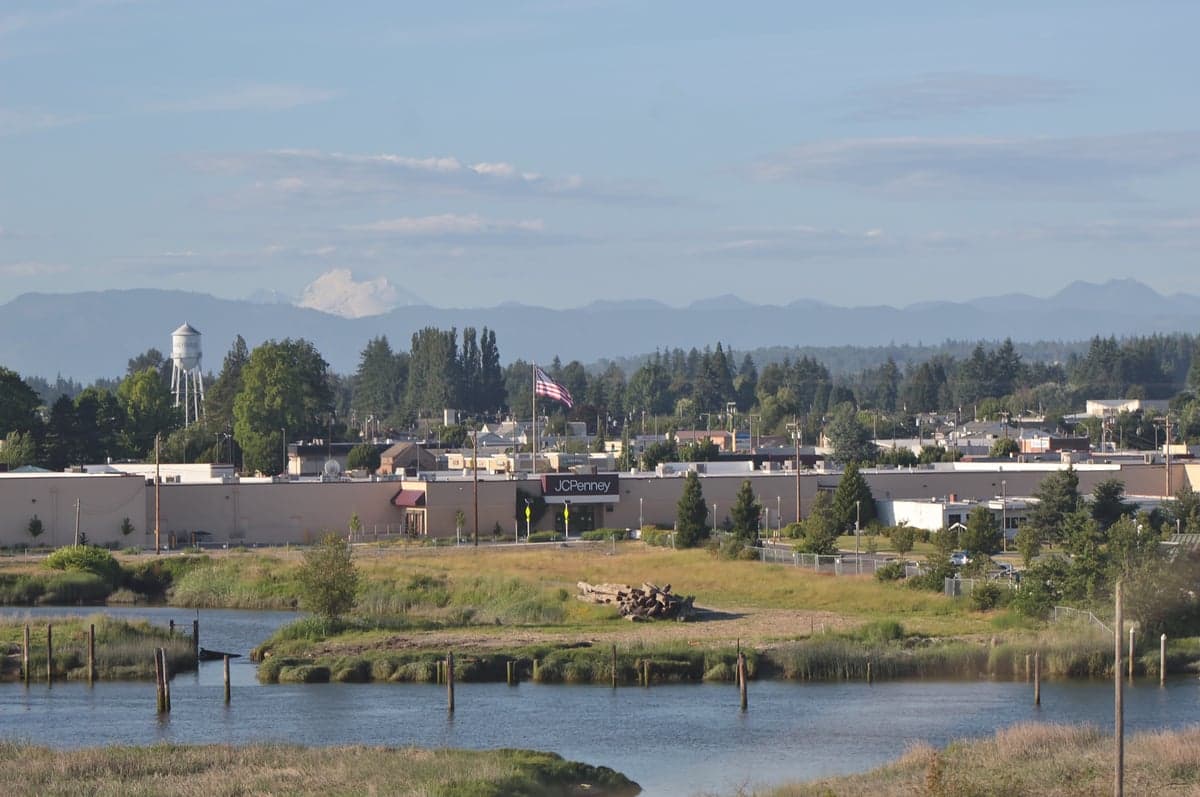
The people of Marysville, Washington today number 71,570, forming a predominantly white (65.4%) working-class city with a significant and growing Hispanic minority (16.1%) and smaller but established East/Southeast Asian (6.3%) and Indian (1.2%) communities. The city’s character is defined by its transition from a historic mill town to a commuter-heavy suburb of Everett and Seattle, with a notably low college attainment rate (22.7%) and a foreign-born population of just 5.4%, reflecting a population that is largely native-born and rooted in the region. Distinctive identity markers include a strong sense of local pride tied to the Tulalip Tribes’ reservation on the city’s western edge, a visible military-affiliated population due to nearby Naval Station Everett, and a family-oriented, suburban feel that contrasts with the denser urban core to the south.
How the city was settled and grew
Marysville’s human history begins with the Coast Salish peoples, particularly the Tulalip Tribes, who have inhabited the area along the Snohomish River and Puget Sound for millennia. The first permanent American settlers arrived in the 1870s, drawn by the region’s dense timber and the promise of farmland along the river flats. The city was officially platted in 1885 by James Comeford and others, and its early growth was fueled by the lumber industry, with mills along Ebey Slough and the Snohomish River employing Scandinavian and German immigrants who built the first homes in what is now the Historic Downtown Marysville district. By the early 1900s, the arrival of the Great Northern Railway solidified Marysville as a shipping hub for timber and agricultural products, attracting a wave of Finnish, Swedish, and Norwegian settlers who established tight-knit communities in neighborhoods like Jennings Park and the Smokey Point area (then a separate crossroads). The city’s population remained small—under 1,000 until the 1940s—and its economy was dominated by the Marysville Mill and the nearby Tulalip Indian Boarding School, which operated from 1905 to 1932 and brought Native children from across the region, though many returned to their home communities after the school’s closure.
Modern era (post-1965)
The post-1965 era transformed Marysville from a sleepy mill town into a rapidly growing suburb. The 1965 Hart-Cellar Act had a limited direct impact here—the foreign-born share remains low at 5.4%—but the broader suburbanization of the Seattle metropolitan area drove explosive domestic in-migration. The completion of Interstate 5 in the late 1960s made Marysville a viable commuter town for Boeing workers in Everett and, later, tech employees in Seattle. This wave of white and Asian middle-class families settled in new subdivisions like Lakewood (a master-planned community developed in the 1970s and 1980s) and the Grove neighborhood, which absorbed many of the East/Southeast Asian families—primarily of Filipino and Vietnamese ancestry—who moved north from Seattle’s International District for cheaper housing and better schools. The Hispanic population began to grow noticeably in the 1990s, driven by agricultural and construction jobs, and concentrated in the Sunrise area and along the State Avenue corridor, where many Mexican-American families established small businesses and churches. The Indian community, though small at 1.2%, is a more recent arrival, with many professionals working in healthcare and technology settling in the newer developments near Smokey Point and the Quil Ceda Village area (a Tulalip Tribes-owned commercial district). The Tulalip Tribes themselves have seen a resurgence in population and economic power, with the opening of the Tulalip Resort Casino in 2004 and the Seattle Premium Outlets drawing visitors and workers, though the reservation’s population remains distinct from the city’s non-Native majority.
The future
Marysville’s population is heading toward greater diversity, but the pace is moderate. The white share (65.4%) is declining slowly as the Hispanic and Asian populations grow through both natural increase and domestic migration from other parts of Washington. The Hispanic community, now 16.1%, is the fastest-growing group and is likely to reach 20-22% by 2035, with continued concentration in the Sunrise and State Avenue neighborhoods, though some families are moving into newer subdivisions in the Smokey Point area. The East/Southeast Asian population (6.3%) is plateauing, as younger generations often move to Seattle or Bellevue for professional opportunities, while the Indian community (1.2%) is growing slowly but steadily, driven by tech and healthcare jobs in the broader Everett area. The city is not tribalizing into distinct enclaves—most neighborhoods remain mixed—but there is a subtle economic divide: older, whiter neighborhoods like Jennings Park and Historic Downtown are seeing reinvestment, while newer developments in Lakewood and Smokey Point attract a more diverse, younger demographic. The Tulalip Tribes’ continued economic expansion, including plans for more retail and housing on the reservation, will likely draw more Native and non-Native residents to the western edge of the city. Overall, Marysville is becoming a more diverse, still predominantly white, working-to-middle-class suburb, with a growing Hispanic presence and a stable but small Asian and Indian population.
For someone moving in now, Marysville offers a relatively affordable, family-oriented community with a strong sense of local identity, but the low college attainment rate (22.7%) and heavy reliance on commuting mean that economic opportunities within the city itself are limited. The city is becoming more diverse, but slowly, and the social fabric remains rooted in its native-born, working-class history. New residents should expect a place that values stability and community over rapid change, with the Tulalip Tribes’ influence and the growing Hispanic population gradually reshaping the city’s cultural landscape.

* Values derived from national, state, county, city and local statistics and may differ in a specific area. Last updated: 2026-05-03T20:38:55.000Z
Narrative content on this page is AI-generated and may contain mistakes. Verify any details that matter before acting on them.
ReloMaps may earn a commission from affiliate links at no extra cost to you.

