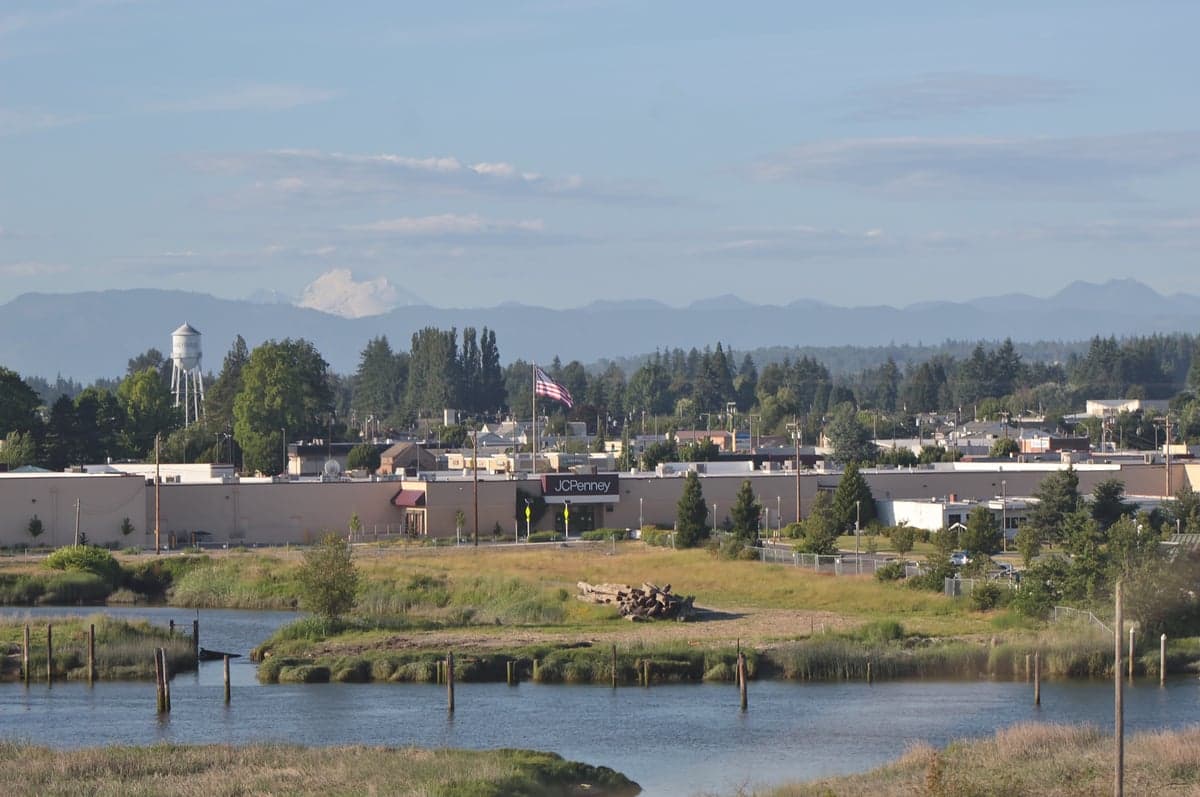
Photo: Wikipedia
Personal Sovereignty in Marysville, WA
Viable for self-reliance. Generally workable, though some barriers may limit total independence.
What does Personal Sovereignty tell us?
Personal Sovereignty measures your capacity for self-reliance and independence with minimal government friction. Higher scores mean fewer barriers between you and the way you want to live... but it assumes you have the space you need and good neighbors.
What does this tell us?
Personal Sovereignty measures your capacity for self-reliance and independence with minimal government friction. Higher scores mean fewer barriers between you and the way you want to live... but it assumes you have the space you need and good neighbors.
State Policy
Energy independence: Importer (55% of energy produced in-state)
Personal Liberty
Homesteading

Personal Liberty Analysis
Marysville, Washington, offers a mixed bag for those prioritizing personal sovereignty, with a state-level political climate that increasingly challenges individual autonomy but a local environment where self-reliance and community resilience can still be cultivated. While Washington State has moved aggressively on gun control, vaccine mandates, and energy regulations, Marysville’s working-class roots, proximity to rural Snohomish County, and relatively affordable land provide a foothold for those seeking to live by their own rules. The key is understanding where the state’s overreach ends and where local practicalities—like zoning, property rights, and neighborly norms—still allow for a degree of independence that is vanishing in Seattle or King County.
Tax burden and regulatory posture in Snohomish County
Washington State has no personal income tax, which is a significant advantage for sovereignty-minded individuals, but it compensates with high sales tax (10.1% in Marysville as of 2025) and property taxes that have risen sharply—Snohomish County’s average effective property tax rate is about 0.93%, but assessed values have doubled in the last decade, meaning real tax bills have climbed. The state’s regulatory posture is heavy-handed in areas like environmental permitting (the Growth Management Act restricts rural development) and energy (the state mandates a transition to electric vehicles by 2035 and has banned natural gas in new construction in many jurisdictions). Marysville itself is more pragmatic than Seattle, but it still enforces building codes, septic rules, and business licensing that can frustrate those wanting to build a workshop, run a home-based firearms business, or install solar panels without red tape. For a prepper, the lack of income tax is a win, but the creeping regulatory burden on property use and energy independence is a real concern.
Self-defense and gun law specifics in Washington State
This is the sharpest edge of the sovereignty debate in Marysville. Washington State has enacted some of the strictest gun laws in the nation since 2020, including a ban on "assault weapons" (defined broadly to include many semi-automatic rifles), a ban on high-capacity magazines (over 10 rounds), and a requirement for a 10-day waiting period and a state-issued permit to purchase any firearm. Magazine capacity limits are particularly onerous for self-defense and prepping—you cannot legally buy new standard-capacity magazines for a Glock 19 or AR-15, though existing ones are grandfathered. Open carry is legal without a permit, but concealed carry requires a license (shall-issue, but with training requirements). Marysville itself is not a sanctuary city for gun rights; the Snohomish County Sheriff’s Office generally supports the Second Amendment, but state law supersedes local enforcement. For a survivalist, this means you can still own firearms, but you must be meticulous about compliance, and the legal landscape could worsen. Stockpiling parts and magazines before further restrictions is a common workaround among local preppers.
Self-reliance and homesteading viability in Marysville
Marysville’s zoning and lot sizes offer real opportunities for self-reliance, especially compared to urban areas. The city has a mix of suburban lots (6,000–10,000 sq ft) and larger rural parcels in the annexed areas and unincorporated Snohomish County nearby, where you can find 1–5 acre properties. Chickens are allowed within city limits (hens only, no roosters), and larger lots can support goats, bees, and even a small orchard. Off-grid feasibility is limited—Marysville requires connection to municipal water and sewer in most developed areas, and solar panels are permitted but must meet building codes and utility interconnection rules. True off-grid living (no grid power, no water hookup) is effectively impossible within city limits, but just outside, in areas like the Tulalip reservation or rural Snohomish County, you can find properties with wells and septic that allow for a more independent lifestyle. Rainwater collection is legal but must not interfere with downstream water rights. For a prepper, the best strategy is to buy a few acres in the county, not in the city, and build a self-sufficient homestead with a backup generator, wood stove, and food storage—all of which are common among locals.
Personal liberties in Marysville: parental rights, medical autonomy, and property
Parental rights in Washington State have been under pressure, with laws that allow minors to consent to certain medical treatments (including reproductive care and mental health) without parental notification, and a state law that prohibits "conversion therapy" for minors. Marysville School District has been a battleground over curriculum transparency and mask mandates, but as of 2025, the district has returned to a more neutral posture—parents can opt out of sex education, and the board is currently conservative-leaning. Medical autonomy is constrained by state vaccine mandates for school attendance (COVID-19 is not currently required, but MMR and others are) and for healthcare workers. Ivermectin and hydroxychloroquine are legal but hard to get prescribed locally. Property rights are decent—you can build fences, store vehicles, and run a home business (with a license), but the state’s Growth Management Act limits how much you can subdivide or develop rural land. Free speech is protected, but the state has broad hate crime laws and social media regulation that some see as chilling. Overall, Marysville offers more breathing room than Seattle, but the state legislature in Olympia is a persistent threat to personal liberties.
In the broader Pacific Northwest, Marysville stands as a pragmatic middle ground for the sovereignty-minded individual. It lacks the outright libertarian ethos of Idaho or Montana, but it also avoids the total regulatory capture of Portland or Seattle. The tax burden is manageable if you avoid high-consumption habits, the gun laws are restrictive but navigable with careful planning, and the land-use rules allow for a modest homestead if you choose the right parcel. For a survivalist or prepper, Marysville’s real value is its community—a network of like-minded people who value self-reliance, mutual aid, and preparedness. The state will continue to push for more control, but locally, you can still build a life that prioritizes personal sovereignty, as long as you stay informed, stay compliant where necessary, and stay ready to adapt.

* Values derived from national, state, county, city and local statistics and may differ in a specific area. Last updated: 2026-05-03T20:38:55.000Z
Narrative content on this page is AI-generated and may contain mistakes. Verify any details that matter before acting on them.
ReloMaps may earn a commission from affiliate links at no extra cost to you.

