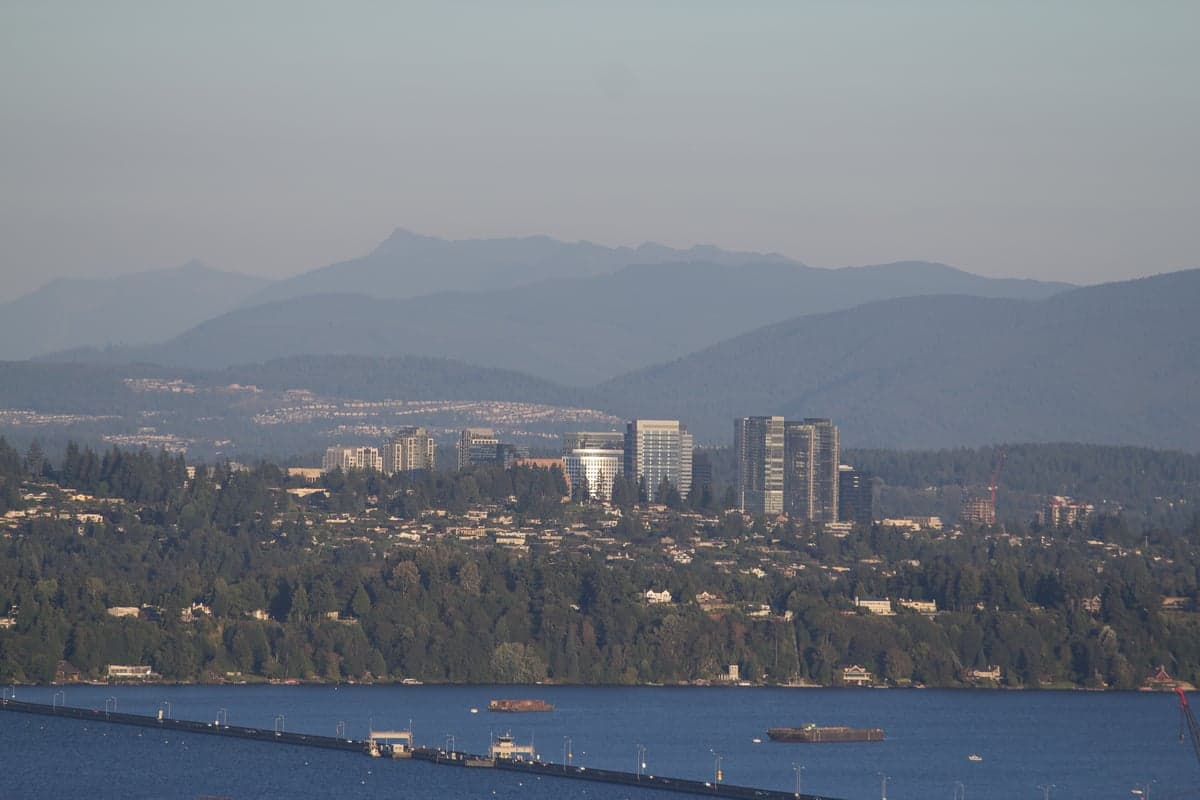
Photo: Wikipedia
Strategic Assessment of Medina, WA
High tactical risk. This location is likely close to major population centers, strategic targets, or sits in a high-disaster corridor. A retreat property and careful exit planning is required.
What does the Strategic Assessment tell us?
Our Strategic Assessment grades tactical survivability of an area. Major population centers, military targets, fallout zones, natural disasters, and border exposure all drive risk — lower exposure means a more defensible position in a crisis.
This is heavily inspired by Joel Skousen's Strategic Relocation book. Highly recommended you checkout the book ($)What does this tell us?
Our Strategic Assessment grades tactical survivability of an area. Major population centers, military targets, fallout zones, natural disasters, and border exposure all drive risk — lower exposure means a more defensible position in a crisis.
This is heavily inspired by Joel Skousen's Strategic Relocation book. Highly recommended you checkout the book ($)Strategic Pillars

Key Distances
Regional Safe Places
Below is our recommended "safe zones" in Washington and the surrounding area based on our strategic heuristics. For most people, it's unrealistic to live in a “safe zone” full-time due to work, family or other personal reasons. They tend to be more rural. However, many of these areas are perfect for second homes and retreat properties that double as a vacation home or even a short-term rental.
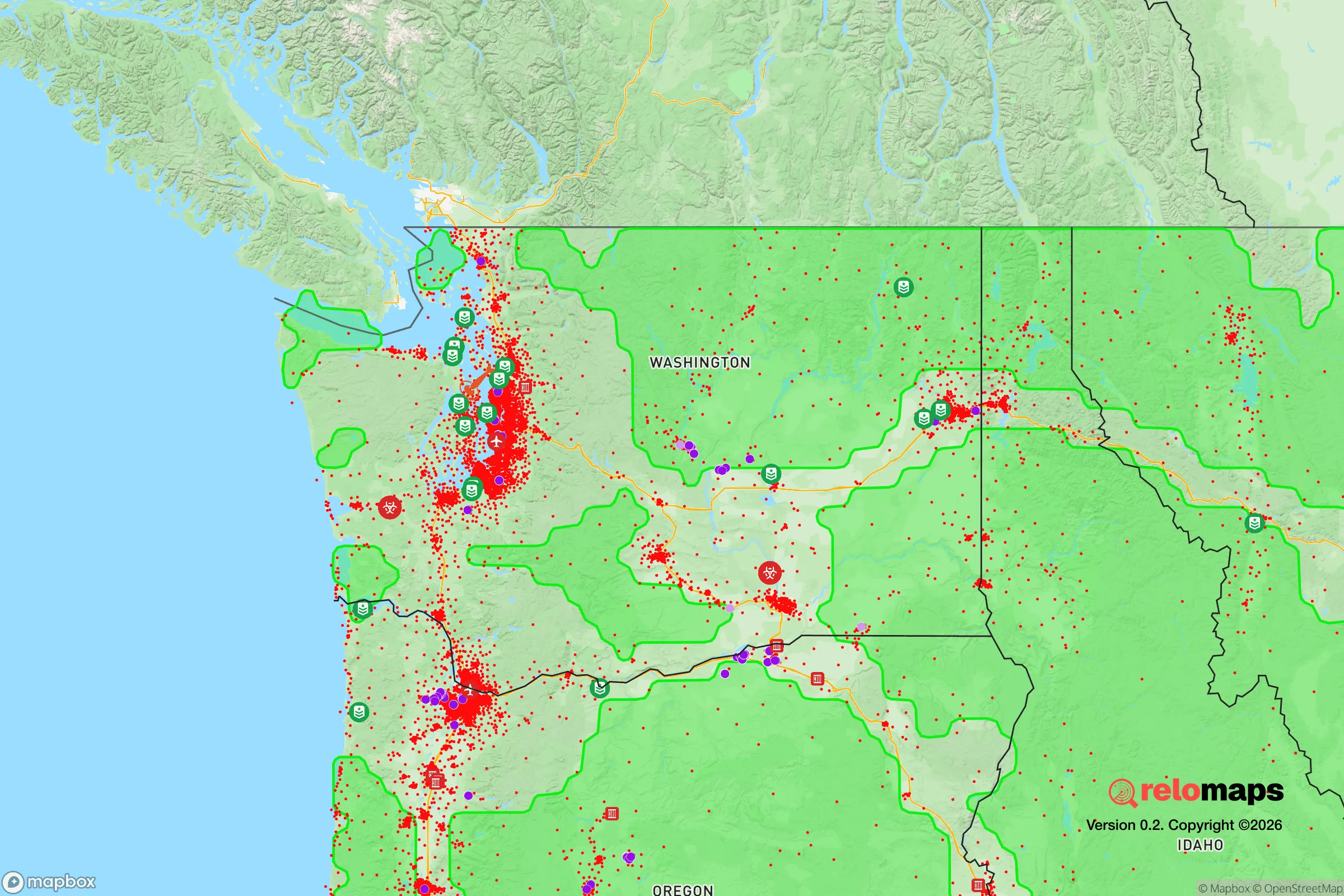
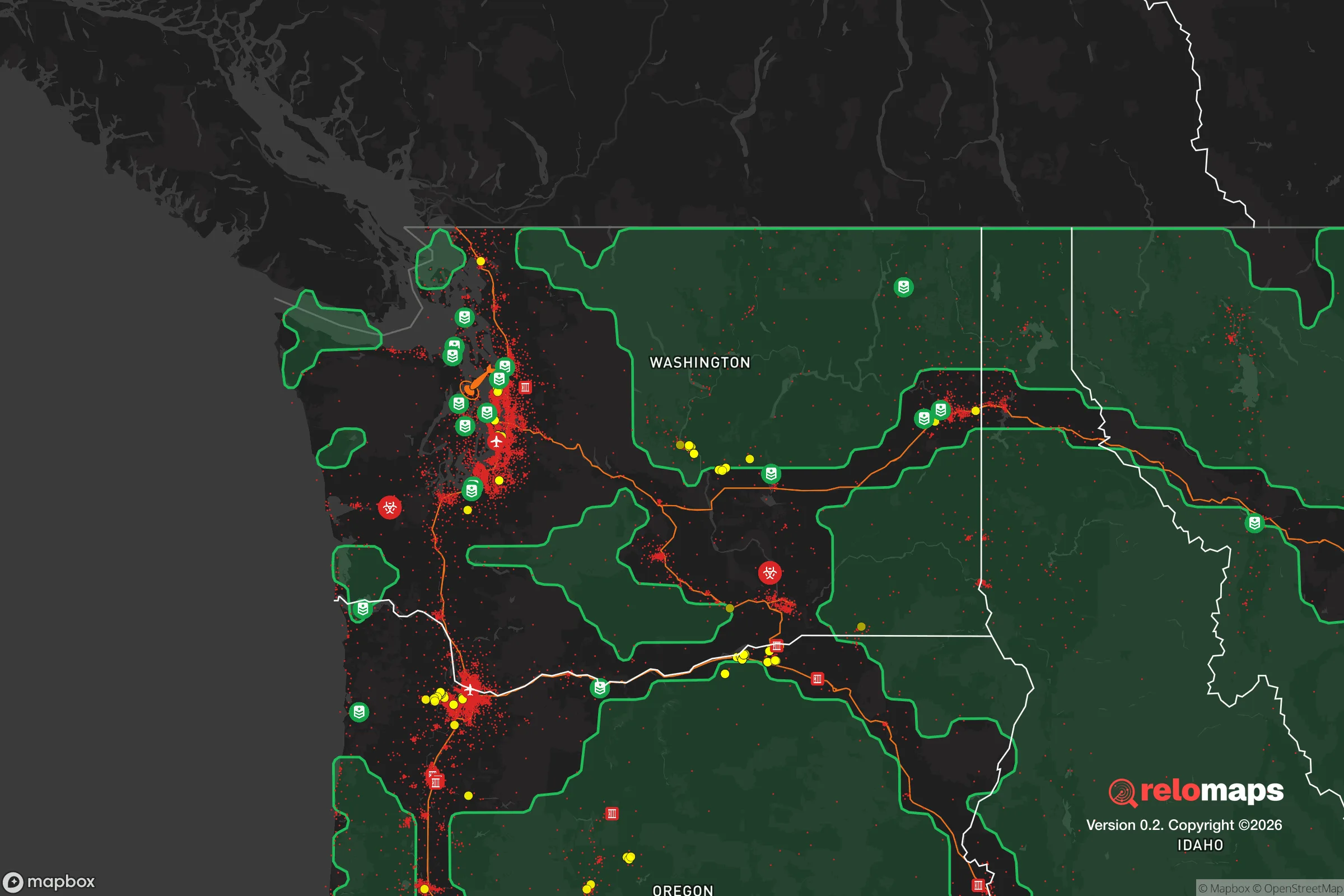


Important Note: For informational purposes only. This does not mean nothing bad ever happens in the green zones. Please use common sense. This is based on public data and modeled with AI. We tried to take a conservative approach but mistakes happen. We update this regularly as new information becomes available.
Solar Generator Recommendations
Backup power matters more here than in safer locations. We've picked three solar generators across budgets and capacity tiers — start with the budget unit if you only need a few essentials, or step up if you want to run a fridge and HVAC for days at a time.

Jackery Portable Power Station Explorer 300
Budget OptionPower on the Go: Weighing only 11 lbs, it's convenient to set up and store with book-sized foldable solar panels

BLUETTI Portable Power Station AC180
Designed for both indoor and outdoor scenarios, AC180 is highly capable as it has a robost capacity and continuous output power.

EF ECOFLOW DELTA Pro Ultra Power Station
Upgraded PickEcoFlow DELTA Pro Ultra is a whole-home energy system designed to grow with your family. Integrated with the Smart Home Panel 2, it scales to meet your evolving energy needs — keeping your home powered, intelligent, and secure through every stage of life.
We earn a commission, at no additional cost to you.
Strategic Assessment Analysis
Medina, Washington, presents a paradox for the strategic relocator: it offers exceptional natural resilience and defensible geography, yet its extreme proximity to a major metropolitan target zone and its status as a high-value symbolic asset make it a high-risk, high-reward proposition for those prioritizing long-term survival and civic stability. Nestled on a peninsula jutting into Lake Washington, this enclave of roughly 3,000 residents is physically isolated by water on three sides, creating a natural moat that few suburban locations can match. However, its location directly across from Seattle and its role as the home of some of the world's most powerful tech executives means that in any scenario involving civil unrest, economic collapse, or targeted attacks, Medina would be a primary focus of attention rather than a place to hide. For the conservative prepper weighing location trade-offs, Medina offers a unique combination of tactical defensibility and extreme strategic vulnerability that demands careful, sober consideration.
Geographic position and natural advantages for long-term security
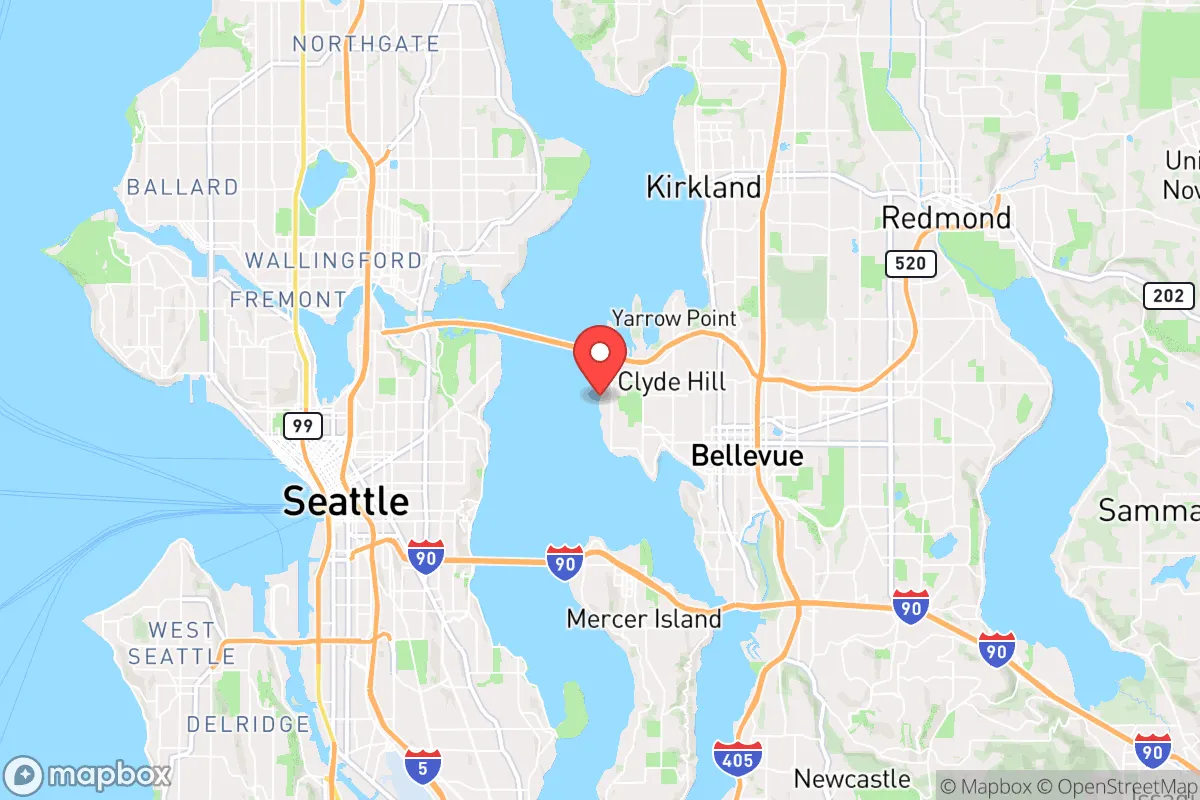
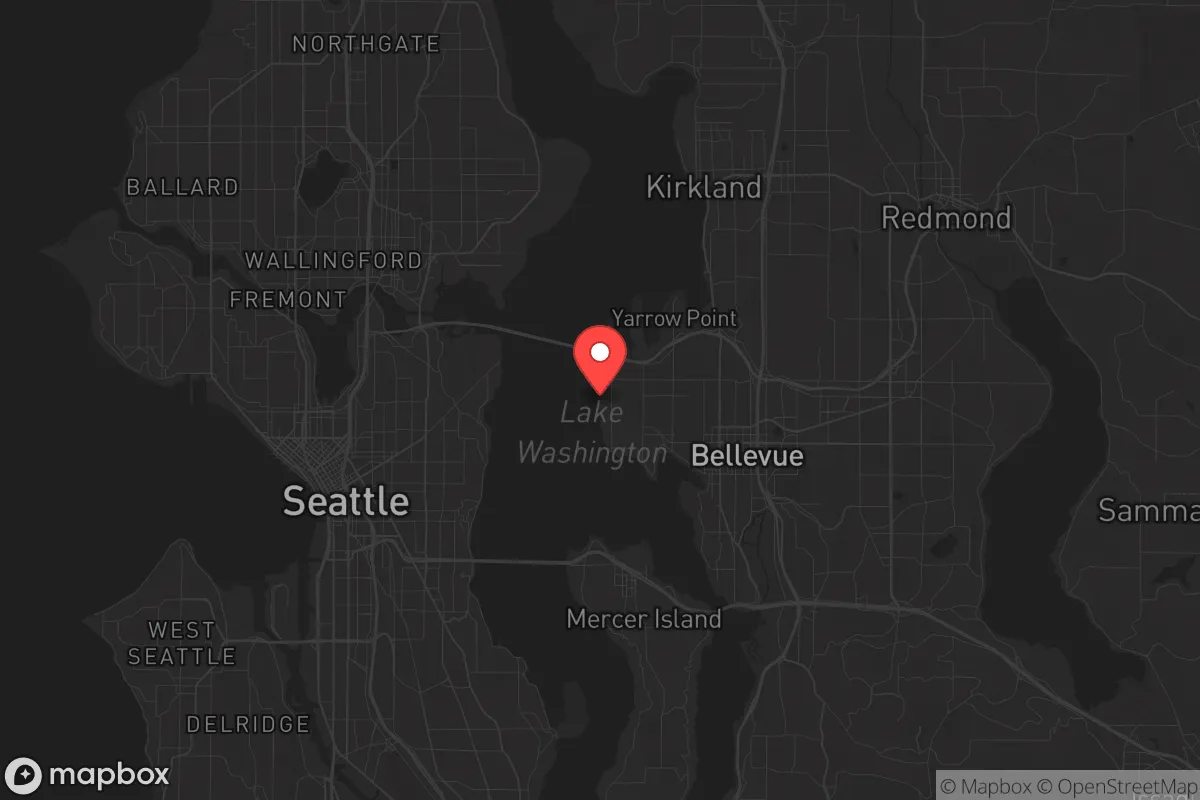
Medina’s geography is its single strongest asset for a survivalist mindset. The city occupies a narrow peninsula on the eastern shore of Lake Washington, with only a single land-based entry point via the Evergreen Point Floating Bridge (SR-520) from Seattle to the west, and a narrow isthmus connecting it to the mainland suburbs of Bellevue and Clyde Hill to the east. This configuration means that in a grid-down or civil unrest scenario, the number of vehicular access points can be counted on one hand, and all of them are chokepoints that could be monitored or defended with minimal manpower. The lake itself provides a natural barrier against foot traffic from Seattle, and the dense tree canopy and winding, low-traffic streets (like 84th Avenue NE and points along the waterfront) offer excellent cover and concealment. The area’s elevation is moderate—roughly 200 to 300 feet above lake level—which provides vantage points for observation without the exposure of a high ridgeline. For a relocator concerned with maintaining a low profile, Medina’s residential character, with large lots and mature landscaping, allows for discreet stockpiling, gardening, and water collection without drawing neighborly attention. The lake also serves as a massive, renewable freshwater source, though treatment and purification would be required.
Risks, exposures, and proximity to fallout-relevant landmarks
The most glaring vulnerability for Medina is its location as a primary target in any scenario involving strategic strikes or civil unrest. The city is home to the residences of Jeff Bezos, Bill Gates, and other high-net-worth individuals whose assets and influence make Medina a symbolic and practical target for any adversary seeking to destabilize the U.S. economy or political system. In a mass casualty event or EMP scenario, Medina would likely be among the first locations to experience looting, hostage-taking, or direct assault by organized groups. Furthermore, the city sits less than 10 miles from Seattle-Tacoma International Airport (Sea-Tac), a major logistical hub that would be a primary target in any conventional or asymmetric attack. The proximity to the Puget Sound Naval Shipyard (Bremerton, roughly 20 miles by water) and Joint Base Lewis-McChord (40 miles south) means that any military conflict involving the West Coast would place Medina within a secondary blast or fallout zone, depending on the weapon type. The I-90 and SR-520 bridges, both critical evacuation routes, are single points of failure; a single vehicle-borne improvised explosive device or structural failure would trap residents on the peninsula. For the prepper, the risk of being caught in a mass evacuation of the Seattle metro area—with Medina as a bottleneck—is a serious concern. The city’s high property values also mean that in a prolonged crisis, it would be a target for organized crime or militia groups seeking resources.
Practical resilience for a relocator: food, water, energy, and defensibility
For a single individual or family willing to invest in hardening a property, Medina offers a surprisingly strong baseline for practical resilience. The lake provides an essentially unlimited water source, though a high-quality filtration system (e.g., Berkey or reverse osmosis) and a manual pump are non-negotiable, as municipal water treatment would fail in a grid-down scenario. The area’s mild maritime climate (average 40-75°F year-round) allows for year-round vegetable gardening in raised beds or greenhouses, and the large lots common in Medina (many 0.5 to 2 acres) provide space for fruit trees, chickens, or even a small goat herd without violating zoning—though homeowners’ associations may impose restrictions. Solar panels are viable, with the region averaging 150-160 sunny days per year, but a ground-mounted system with battery storage (e.g., Tesla Powerwall or Generac) and a backup propane generator is recommended to handle the frequent winter overcast. Defensively, the natural water barriers and limited road access are a double-edged sword: they make Medina easy to defend but also easy to besiege. A well-prepared relocator would need to establish a secure perimeter with reinforced doors, window film, and a clear line of sight to the single land entrance. The local police department (Medina PD) is small—roughly 15 officers—and would be overwhelmed in a widespread crisis, so self-reliance is paramount. For food storage, the proximity to Bellevue’s grocery supply chains (QFC, Whole Foods, and Costco within 5 miles) is useful for pre-crisis stockpiling, but a six-month supply of non-perishables, medical kits, and ammunition should be considered the minimum for a family of four.
The overall strategic picture for Medina is one of extreme trade-offs. It offers some of the best natural defensibility in the Puget Sound region, with water barriers, limited access, and a climate that supports self-sufficient food and water production. However, its status as a high-value target—due to its wealthy residents and proximity to Seattle—makes it a location that would attract attention in any large-scale crisis, rather than offering the anonymity of a rural retreat. For the conservative relocator who values preparedness and has the resources to harden a property, Medina can work as a base of operations if combined with a secondary bug-out location in eastern Washington (e.g., the Okanogan or Colville areas). But for those seeking a low-profile, low-risk environment where they can ride out societal disruptions without being a target, the drawbacks likely outweigh the benefits. The prudent assessment is that Medina is a location for those who plan to actively defend their position and have the means to do so, not for those seeking a quiet, off-grid existence. In a world of increasing uncertainty, it is a fortress—but one that sits on a hill that everyone can see.

* Values derived from national, state, county, city and local statistics and may differ in a specific area. Last updated: 2026-04-27T14:12:45.000Z
Narrative content on this page is AI-generated and may contain mistakes. Verify any details that matter before acting on them.
ReloMaps may earn a commission from affiliate links at no extra cost to you.

