Photo: Wikipedia
Demographics of Miami Beach, FL
Affluence Level in Miami Beach, FL
A middle-class area roughly in line with national averages across income, home values, education, and employment.
People of Miami Beach, FL
Miami Beach today is a densely populated, majority-Hispanic city of 81,319 residents, where over half the population identifies as Hispanic (55.8%) and just over a third as White (34.0%). It is a place of stark contrasts: a global tourism hub with a 51.2% college-educated workforce, yet also a city where 26.9% of residents are foreign-born, primarily from Latin America and the Caribbean. The city’s identity is shaped by a history of successive immigrant waves, real estate booms, and cultural shifts that have transformed it from a swampy barrier island into a dense, vertical urban enclave.
How the city was settled and grew
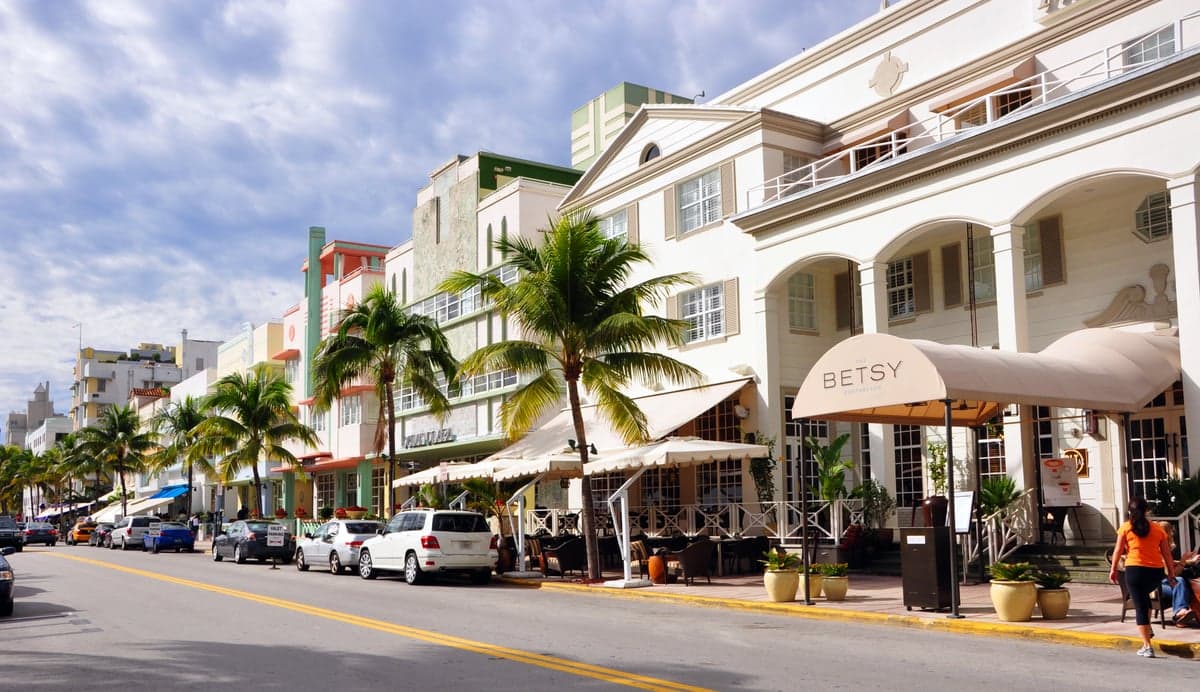
Miami Beach was not settled until the early 20th century. Before 1912, the barrier island was largely mangrove swamp and coconut plantation, with no permanent population. The city’s founding father, Carl Fisher, began dredging and developing the island in 1913, marketing it as a winter playground for wealthy Northerners. The first major population wave came in the 1920s land boom, drawing white Anglo-Protestant developers, hoteliers, and seasonal residents to what is now South Beach (south of 5th Street) and the Collins Avenue corridor. A second wave followed in the 1930s and 1940s, when Jewish families fleeing discrimination in the Northeast and Midwest began settling in Mid-Beach (roughly 41st to 63rd Streets) and North Beach (north of 63rd Street). By 1950, Miami Beach was roughly 60% Jewish, with a thriving resort economy centered on Ocean Drive and Collins Avenue. The city’s population peaked at around 87,000 in the 1960s, before a period of decline as older hotels aged and middle-class families moved to mainland suburbs.
Modern era (post-1965)
The 1965 Hart-Cellar Act and the 1980 Mariel boatlift dramatically reshaped Miami Beach’s population. Cuban exiles, followed by Nicaraguans, Colombians, and Venezuelans, began moving into the aging Art Deco hotels and apartment buildings of South Beach and City Center (around 5th to 15th Streets). By 1990, the Hispanic share of the population had risen to over 40%, while the White non-Hispanic share fell below 30%. The 1990s brought a new wave of domestic in-migration: artists, fashion models, and tech entrepreneurs drawn by cheap rents and the emerging South Beach nightlife scene. This gentrification pushed many lower-income Hispanic families north into North Beach and La Gorce Island area, where rents remained more affordable. Today, the Hispanic population is concentrated in North Beach (over 70% Hispanic) and the western edge of South Beach, while White non-Hispanic residents cluster in the luxury condos of Sunny Isles Beach (a separate city but contiguous) and the eastern half of South Beach. The Black population (3.4%) is small and largely concentrated in the West Avenue corridor and public housing complexes near the Julia Tuttle Causeway. East/Southeast Asian residents (1.4%) and Indian-subcontinent residents (0.8%) are scattered but have small clusters in the high-rise condos of Mid-Beach.
The future
Miami Beach’s population is slowly homogenizing into two distinct enclaves: a wealthy, predominantly White non-Hispanic zone along the oceanfront luxury towers, and a working-to-middle-class Hispanic zone in the northern and western neighborhoods. The Hispanic share has stabilized around 55% since 2010, suggesting the city is not becoming more Hispanic but rather that the existing Hispanic population is aging in place while younger, wealthier White professionals move into new developments. The foreign-born share (26.9%) is lower than Miami-Dade County’s overall 52%, indicating that Miami Beach is less of a first-stop immigrant gateway than the mainland. The college-educated share (51.2%) is high and rising, driven by the tech and finance sectors. Over the next 10–20 years, expect continued gentrification of North Beach as developers build luxury towers, pushing lower-income Hispanic residents further north into Surfside and Bal Harbour. The city will likely become more economically stratified, with a shrinking middle class and a growing divide between the oceanfront wealthy and the inland working class.
For a conservative-leaning individual or family considering a move, Miami Beach is becoming a city of two worlds: a high-cost, amenity-rich enclave for professionals and retirees, and a more affordable, family-oriented Hispanic community in the northern neighborhoods. The city’s politics lean Democratic, but the local government is pro-business and focused on public safety and infrastructure. The key question for newcomers is which Miami Beach they want to live in — the luxury high-rise corridor or the older, more diverse residential blocks — as the gap between them continues to widen.

* Values derived from national, state, county, city and local statistics and may differ in a specific area. Last updated: 2026-04-15T23:47:15.000Z
Narrative content on this page is AI-generated and may contain mistakes. Verify any details that matter before acting on them.
ReloMaps may earn a commission from affiliate links at no extra cost to you.

