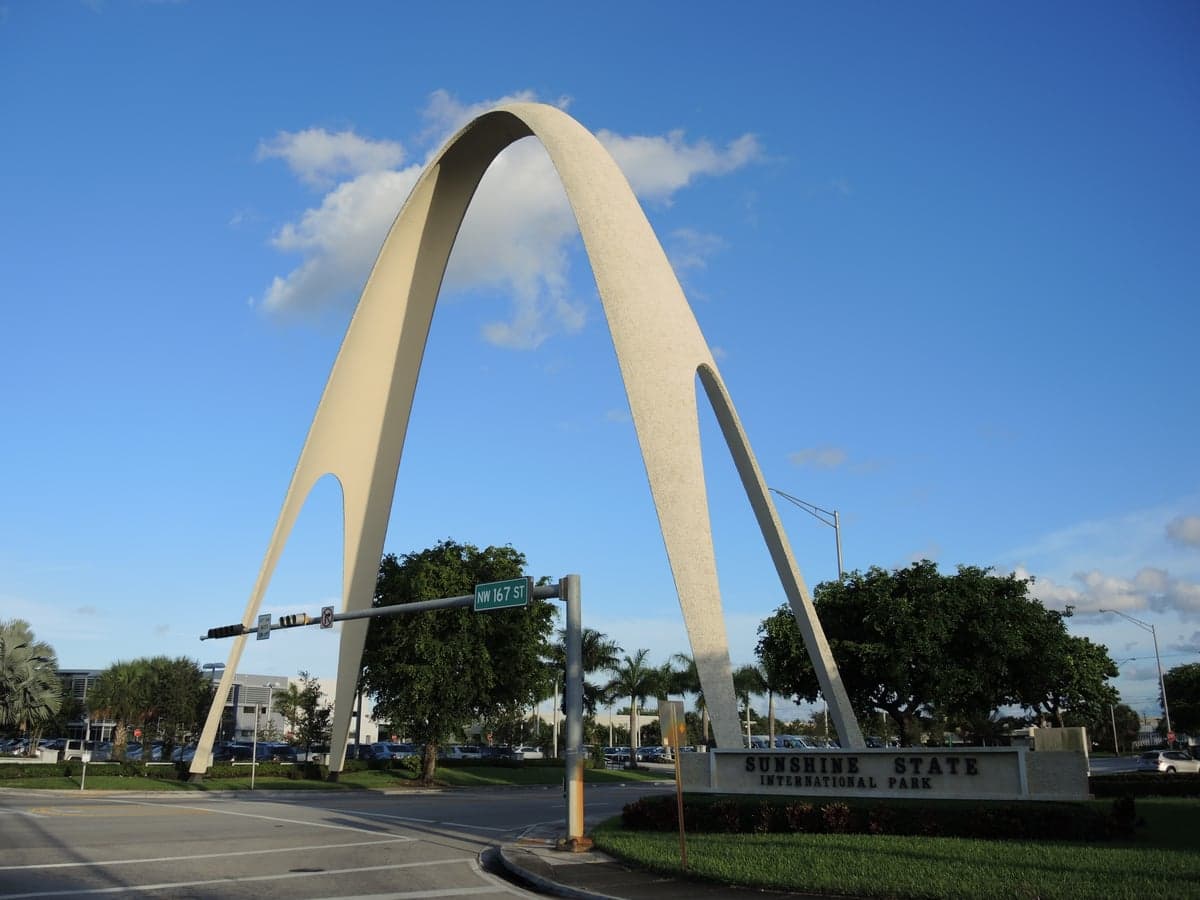
Photo: Wikipedia
Demographics of Miami Gardens, FL
Affluence Level in Miami Gardens, FL
A middle-class area roughly in line with national averages across income, home values, education, and employment.
People of Miami Gardens, FL
Miami Gardens, Florida, is a majority-Black city of 111,264 residents, characterized by a dense, suburban feel and a strong sense of community identity forged from waves of Caribbean immigration and domestic migration. With a population that is 61.7% Black and 33.6% Hispanic, the city is one of the most predominantly African American municipalities in the southeastern United States. Its residents are notably younger than the national median age, and the city’s identity is deeply tied to its role as the home of the Miami Dolphins' Hard Rock Stadium and a hub for Black entrepreneurship and culture.
How the city was settled and grew
Miami Gardens is a post-1960s planned city, not a historic settlement. The land was originally part of the vast South Florida wetlands, drained for agriculture in the early 20th century. The area’s first significant development came in the 1950s and 1960s as part of the post-World War II suburban boom, when white, middle-class families moved into newly built subdivisions like Andover and Bunche Park. These neighborhoods were initially restricted to white residents through racial covenants. The city’s modern character began to take shape in the 1970s, when white flight to farther suburbs accelerated, and Black families—both African Americans from northern states and Afro-Caribbean immigrants from Jamaica, Haiti, and the Bahamas—began moving into the area. The neighborhood of Carol City, originally a separate unincorporated community, became a primary landing point for these new residents, offering affordable single-family homes and proximity to Miami’s job market.
Modern era (post-1965)
The 1965 Hart-Cellar Immigration Act dramatically reshaped Miami Gardens. It opened the door for large-scale Caribbean immigration, particularly from Haiti and Jamaica. By the 1980s and 1990s, Norland and Scott Lake emerged as neighborhoods with heavy concentrations of Haitian-American families, while Jamaican and Trinidadian communities settled throughout Bunche Park and Andover. The city’s Hispanic population, now 33.6%, grew later, primarily from Cuban and Central American families moving north from Miami proper. This wave settled in the western parts of the city, near the border with Hialeah, in areas like Lake Lucerne. The city was officially incorporated in 2003, largely to gain local control over zoning and policing. Since incorporation, the Black share of the population has remained stable, while the Hispanic share has grown from roughly 25% to over 33%, driven by both immigration and higher birth rates. The foreign-born population stands at 14.0%, with the vast majority hailing from the Caribbean. The East/Southeast Asian population is negligible at 0.2%, and the Indian-subcontinent population is similarly tiny at 0.2%.
The future
Miami Gardens is likely to continue its gradual diversification, with the Hispanic share projected to approach 40% within the next decade, while the Black share may decline slightly to around 58-60%. This shift is not driven by white in-migration—the white population is a mere 2.5% and falling—but by the growth of the Hispanic population through both immigration and natural increase. The city is not homogenizing; instead, it is tribalizing into distinct enclaves. The eastern neighborhoods like Carol City and Norland remain overwhelmingly Black and Afro-Caribbean, while western areas near Lake Lucerne are becoming more Hispanic. The city’s low college attainment rate (17.6%) and median household income below the state average suggest that upward mobility remains a challenge, though the presence of Florida Memorial University and St. Thomas University provides some local educational infrastructure. Gentrification pressure from Miami’s core is minimal, as the city lacks beachfront or major transit links.
For a conservative-leaning individual or family considering relocation, Miami Gardens offers a stable, family-oriented environment with strong community institutions, but it is not a place of rapid economic growth or demographic mixing. It is becoming a more Hispanic city within a Black-majority framework, with distinct cultural zones that are unlikely to blur significantly in the near term. The city’s future is one of slow, organic change rather than transformation—a place where Caribbean heritage and African American history remain the dominant forces shaping daily life.

* Values derived from national, state, county, city and local statistics and may differ in a specific area. Last updated: 2026-05-03T05:02:52.000Z
Narrative content on this page is AI-generated and may contain mistakes. Verify any details that matter before acting on them.
ReloMaps may earn a commission from affiliate links at no extra cost to you.

