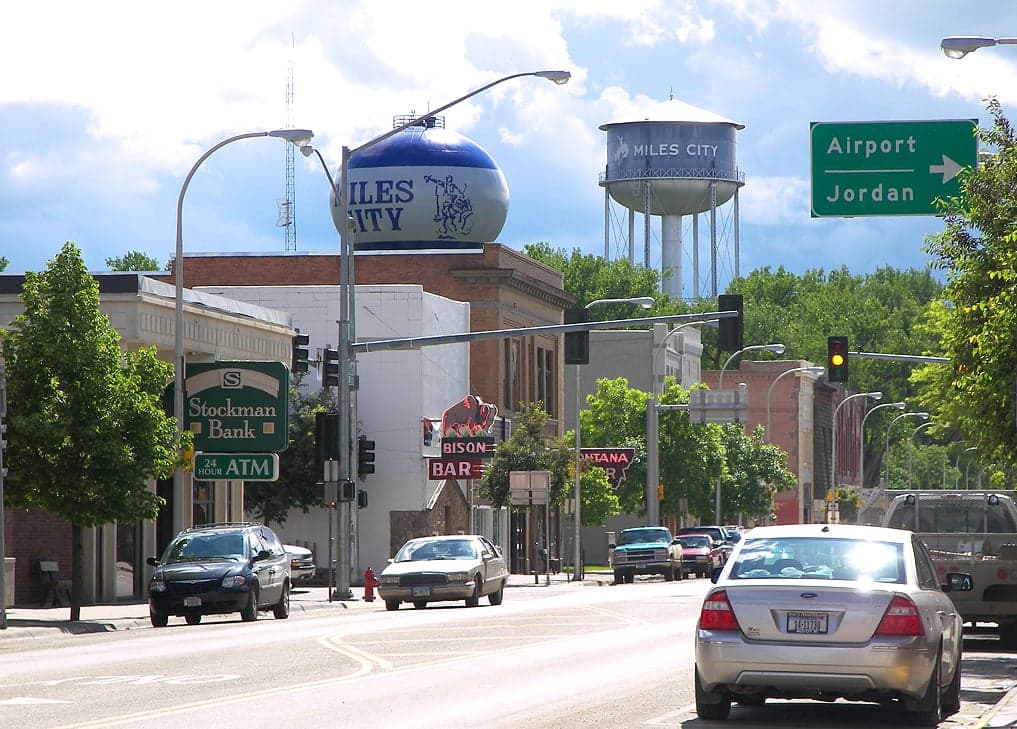
Photo: Wikipedia
Personal Sovereignty in Miles City, MT
Viable for self-reliance. Generally workable, though some barriers may limit total independence.
What does Personal Sovereignty tell us?
Personal Sovereignty measures your capacity for self-reliance and independence with minimal government friction. Higher scores mean fewer barriers between you and the way you want to live... but it assumes you have the space you need and good neighbors.
What does this tell us?
Personal Sovereignty measures your capacity for self-reliance and independence with minimal government friction. Higher scores mean fewer barriers between you and the way you want to live... but it assumes you have the space you need and good neighbors.
State Policy
Energy independence: Net exporter (120% of energy produced in-state)
Personal Liberty
Homesteading

Personal Liberty Analysis
Miles City, Montana, offers a personal sovereignty environment that is markedly stronger than most of the United States, rooted in a deep-seated cultural expectation of self-reliance and a state-level legal framework that actively resists federal overreach. For the strategic relocator—whether a single individual or a parent—this translates into a place where the default assumption is that you can manage your own affairs, from your property to your family's education, without constant interference from a distant bureaucracy. The key is understanding that this freedom is not handed out; it is protected by a combination of low population density, a county commission that leans heavily toward individual rights, and Montana's constitutional and statutory protections that push back against government expansion into daily life.
Tax burden and regulatory posture: How Montana's fiscal landscape protects your autonomy
Montana's tax structure is a significant pillar of personal sovereignty here. There is no state sales tax, which means the government does not take a cut of every transaction you make for food, gear, or building supplies—a direct benefit to anyone aiming to stockpile or be self-sufficient. The state income tax is a flat rate of 6.75% on all income over a certain threshold, but for most residents in Custer County, the effective rate is lower due to deductions. Property taxes are the main revenue source, and they are assessed at a relatively modest rate compared to coastal states; the average effective property tax rate in Montana is around 0.83% of a home's value, which is below the national average. Critically, Custer County has not adopted the kind of aggressive growth management or zoning regulations seen in Bozeman or Missoula. The regulatory posture here is one of "prove there's a problem before you restrict it," not the reverse. For a prepper or survivalist, this means fewer hoops to jump through for building a shop, installing a backup generator, or keeping livestock on your property. The state's business climate is also friendly, with no corporate income tax on pass-through entities like LLCs, which is a common structure for small-scale homesteading operations or side businesses.
Self-defense and gun law specifics: What the Second Sanctuary status means for your rights
Miles City sits in a county that has formally declared itself a Second Amendment Sanctuary, and the state of Montana has some of the strongest preemption laws in the nation. This means local ordinances cannot be more restrictive than state law, so you will not face the patchwork of gun bans that plague cities in blue states. Montana is a constitutional carry state: no permit is required to carry a concealed firearm for anyone legally allowed to possess one. There is no state-level registration of firearms, no "assault weapon" ban, and no magazine capacity limit. For a parent, this means you can train your children in firearms safety on your own property without fear of state interference, as long as you follow basic safety laws. The state also has a strong "stand your ground" law, with no duty to retreat in any place where you are lawfully present. Castle doctrine protections extend to your vehicle and your place of business. For the survivalist mindset, the practical reality is that you can own, carry, and store the tools of self-defense without bureaucratic hurdles, and the local sheriff's office in Custer County is known to be supportive of these rights, not adversarial to them.
Self-reliance and homesteading viability: Lot sizes, zoning, and off-grid feasibility in Custer County
The ability to actually live a self-reliant life is where Miles City shines. Within the city limits, standard residential lots are typically around 6,000 to 10,000 square feet, which is enough for a substantial garden and a small chicken coop, but not for larger livestock. The real opportunity lies just outside town, in the unincorporated areas of Custer County. Here, zoning is minimal to nonexistent. You can find raw land parcels starting at 5 to 20 acres for under $50,000, and many of these properties have no building codes beyond basic septic and well requirements. Off-grid living is entirely feasible: there are no county laws mandating a connection to the power grid, and many residents use solar panels with battery backup or small wind turbines. Water rights are a serious matter in Montana, but if you own land with a well, you have a senior right to that water. The county health department does require a permit for a septic system, but the process is straightforward and not overly burdensome. For a prepper, this means you can build a remote cabin, set up a rainwater catchment system, and live without monthly utility bills, all within a 15-minute drive of a town with a grocery store, hospital, and hardware store.
Personal liberties: Parental rights, medical autonomy, speech, and property protections
Montana's legal environment is exceptionally protective of parental rights. The state has a constitutional provision that explicitly recognizes the "fundamental right of parents to direct the upbringing and education of their children." This is not just rhetoric; it has been upheld in court. Homeschooling is lightly regulated—you simply file a notification with the county superintendent, and there are no mandated curriculum requirements or standardized testing for private homeschoolers. Medical autonomy is also strong. Montana has no state-level vaccine mandate for adults, and while schools have immunization requirements, there are broad exemptions for medical, religious, and personal beliefs. The state's constitution also includes a strong right to privacy, which has been interpreted to protect individuals from government intrusion into medical decisions. Free speech is robustly protected, with no hate speech laws that chill political or cultural commentary. Property rights are defended by a state law that requires the government to compensate landowners for any reduction in property value caused by a regulation—a powerful check against overreach. For the conservative relocator, this means you can speak your mind, educate your children as you see fit, make your own medical choices, and use your land without the government second-guessing your every move.
In the broader landscape of American personal sovereignty, Miles City and the surrounding Custer County represent a stronghold of individual liberty that is increasingly rare. Compared to the Pacific Northwest or the Northeast, where regulatory overreach on guns, property, and parenting is the norm, this area offers a tangible alternative. It is not a perfect libertarian utopia—you still pay taxes and must follow basic health and safety codes—but the default posture of the local government is one of trust in the individual, not suspicion. For the strategic relocator who values the ability to live life on their own terms, with minimal interference from a state or federal apparatus, Miles City is a serious contender. The trade-off is that you must be prepared to handle your own problems, from medical emergencies to property maintenance, because the safety net is thin. That is precisely the point for those with a survivalist or prepper mindset: here, personal sovereignty is not just a legal concept, it is a daily practice.

* Values derived from national, state, county, city and local statistics and may differ in a specific area. Last updated: 2026-04-29T21:08:11.000Z
Narrative content on this page is AI-generated and may contain mistakes. Verify any details that matter before acting on them.
ReloMaps may earn a commission from affiliate links at no extra cost to you.

