 Popular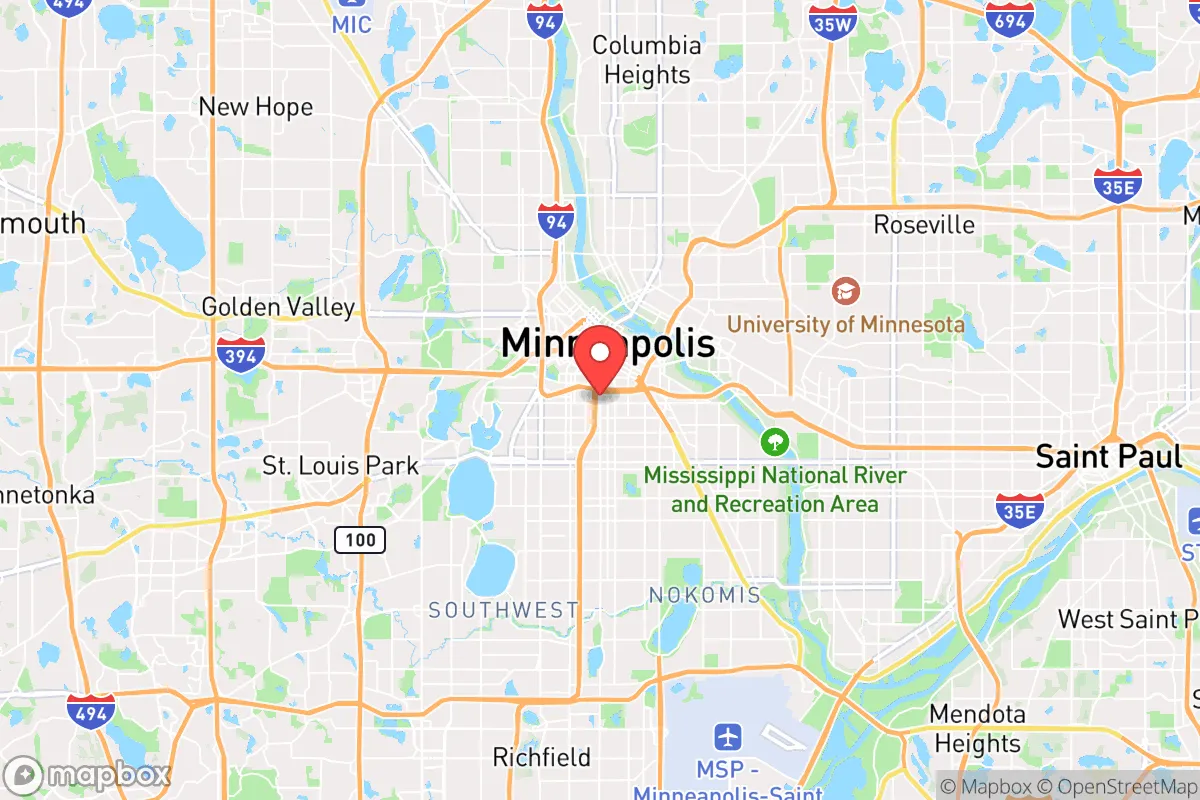
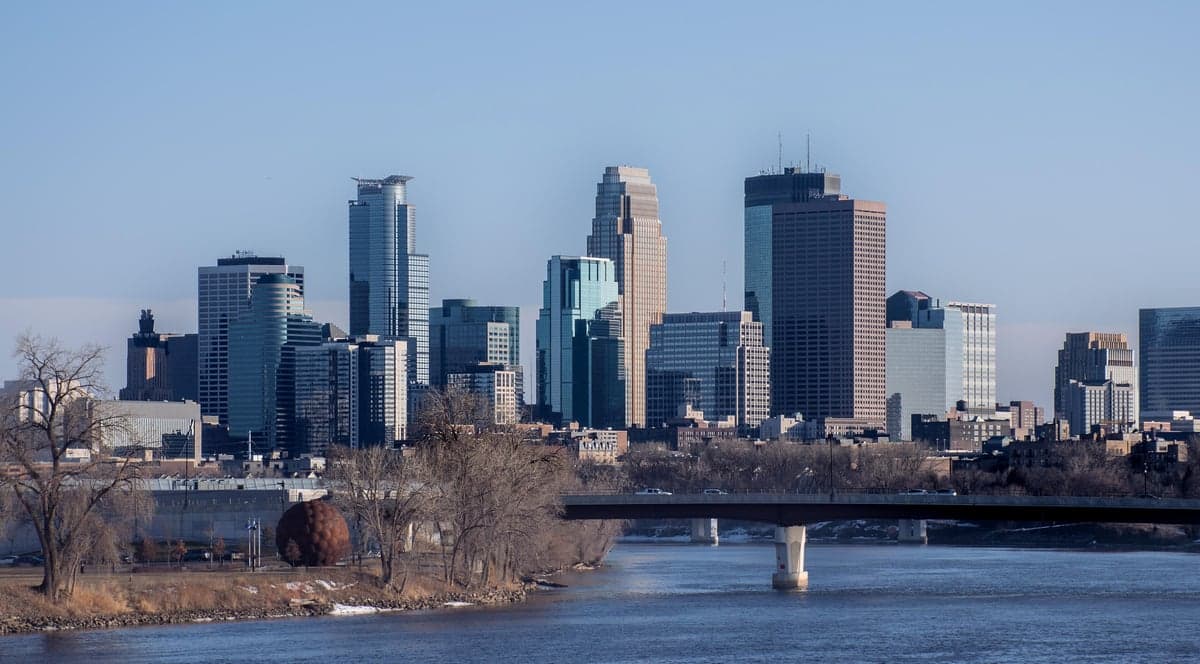
Photo: Wikipedia
Strategic Assessment of Minneapolis, MN
Multiple tactical vulnerabilities. Population density, target proximity, or disaster risk are likely compounding. A retreat property and exit planning is required.
What does the Strategic Assessment tell us?
Our Strategic Assessment grades tactical survivability of an area. Major population centers, military targets, fallout zones, natural disasters, and border exposure all drive risk — lower exposure means a more defensible position in a crisis.
This is heavily inspired by Joel Skousen's Strategic Relocation book. Highly recommended you checkout the book ($)What does this tell us?
Our Strategic Assessment grades tactical survivability of an area. Major population centers, military targets, fallout zones, natural disasters, and border exposure all drive risk — lower exposure means a more defensible position in a crisis.
This is heavily inspired by Joel Skousen's Strategic Relocation book. Highly recommended you checkout the book ($)Strategic Pillars

Key Distances
Regional Safe Places
Below is our recommended "safe zones" in Minnesota and the surrounding area based on our strategic heuristics. For most people, it's unrealistic to live in a “safe zone” full-time due to work, family or other personal reasons. They tend to be more rural. However, many of these areas are perfect for second homes and retreat properties that double as a vacation home or even a short-term rental.
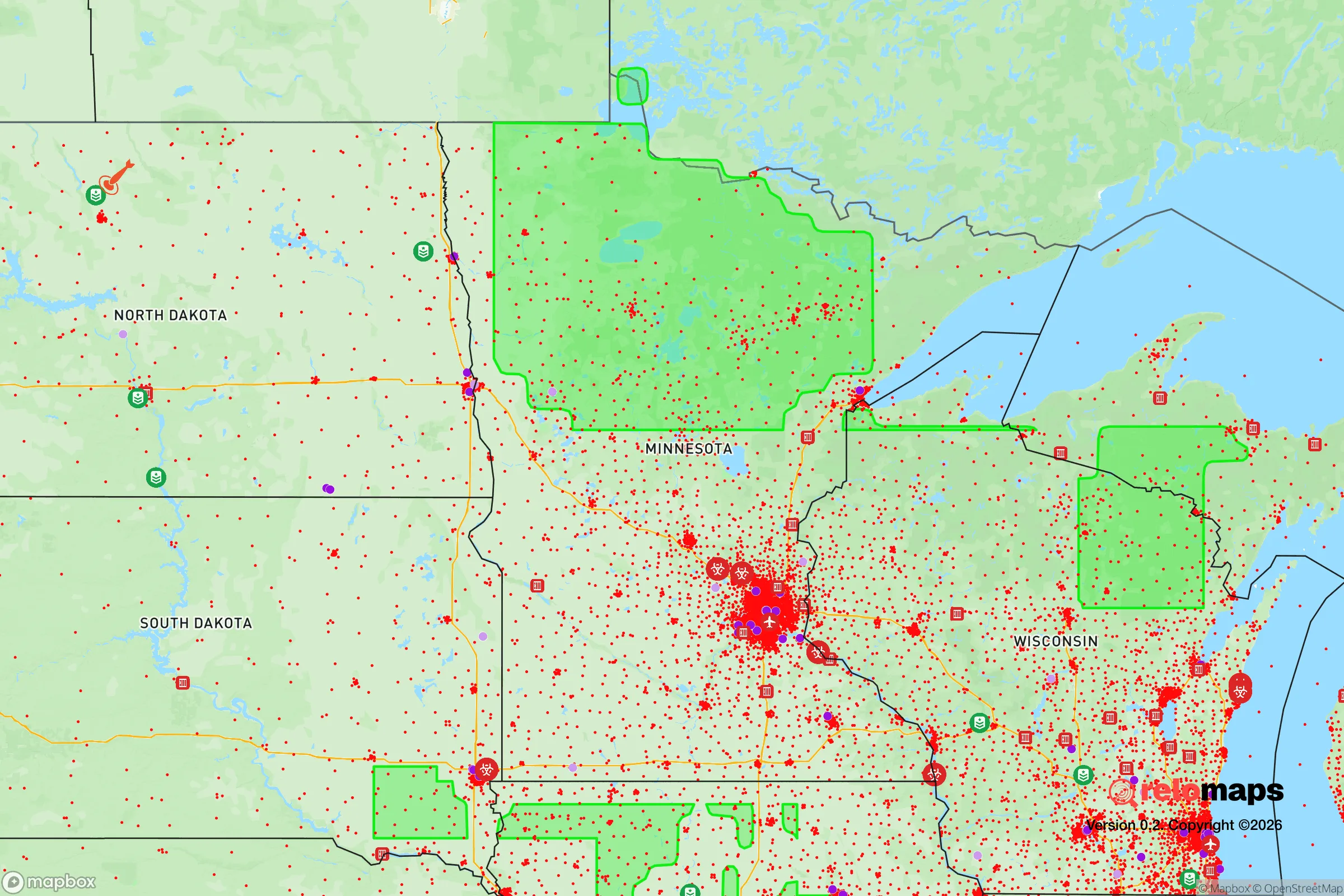
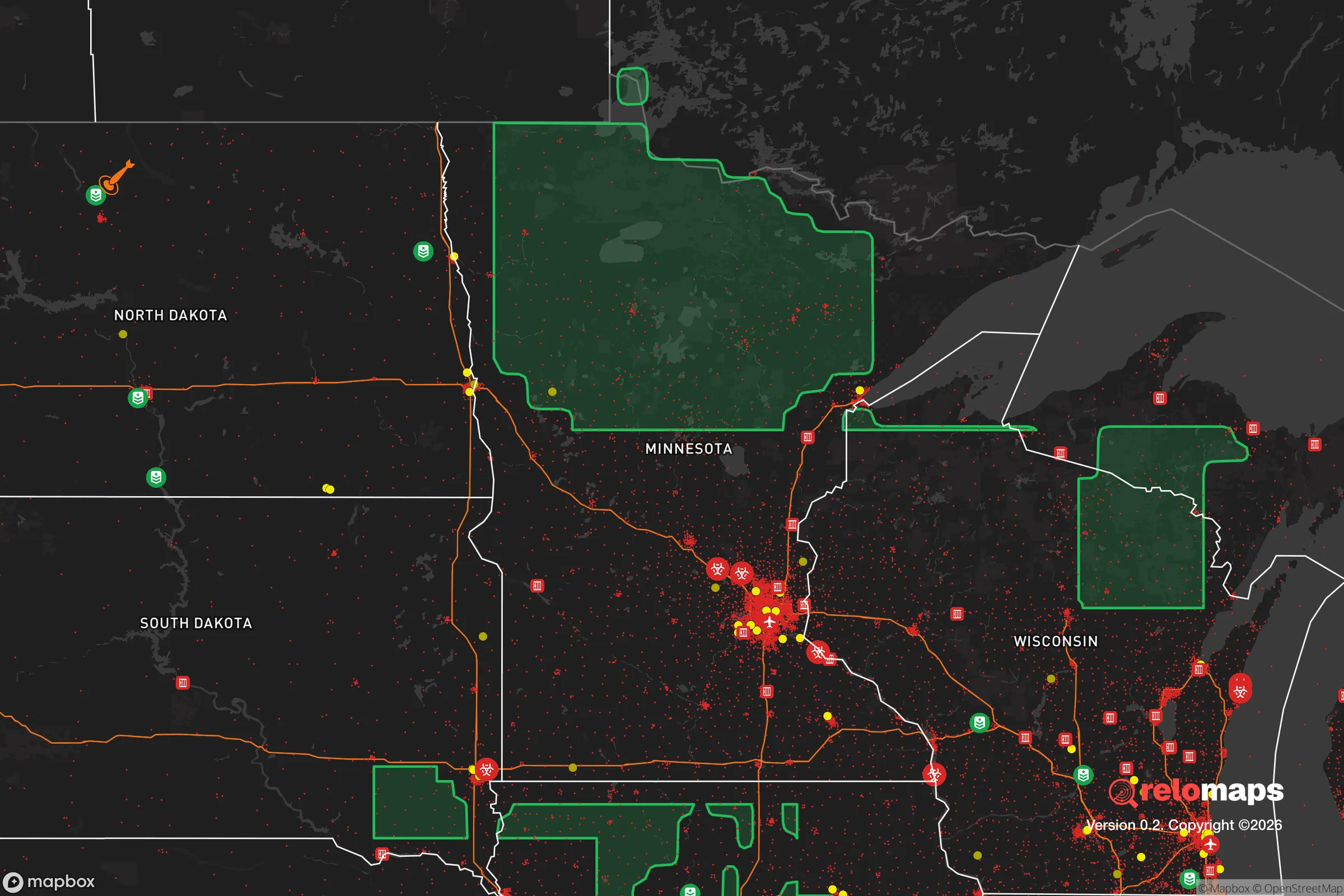


Important Note: For informational purposes only. This does not mean nothing bad ever happens in the green zones. Please use common sense. This is based on public data and modeled with AI. We tried to take a conservative approach but mistakes happen. We update this regularly as new information becomes available.
Solar Generator Recommendations
Backup power matters more here than in safer locations. We've picked three solar generators across budgets and capacity tiers — start with the budget unit if you only need a few essentials, or step up if you want to run a fridge and HVAC for days at a time.

Jackery Portable Power Station Explorer 300
Budget OptionPower on the Go: Weighing only 11 lbs, it's convenient to set up and store with book-sized foldable solar panels

BLUETTI Portable Power Station AC180
Designed for both indoor and outdoor scenarios, AC180 is highly capable as it has a robost capacity and continuous output power.

EF ECOFLOW DELTA Pro Ultra Power Station
Upgraded PickEcoFlow DELTA Pro Ultra is a whole-home energy system designed to grow with your family. Integrated with the Smart Home Panel 2, it scales to meet your evolving energy needs — keeping your home powered, intelligent, and secure through every stage of life.
We earn a commission, at no additional cost to you.
Strategic Assessment Analysis
Minneapolis presents a deeply contradictory picture for the strategic relocator. On one hand, its position as a major Upper Midwest hub offers genuine logistical advantages in terms of water access and supply chain connectivity. On the other, its status as a dense, politically charged urban core, coupled with its proximity to significant strategic targets, makes it a high-risk location for anyone prioritizing long-term security and self-sufficiency. This assessment weighs those factors for a conservative audience focused on resilience, not convenience.
Geographic position and natural advantages for long-term survival
Minneapolis sits at the head of navigation on the Mississippi River, a fact that has shaped its history and its strategic value. The city is part of a metro area of roughly 3.7 million people, which means it benefits from a concentration of medical infrastructure, including the world-renowned Mayo Clinic just 90 minutes south in Rochester. For a prepper, the region's most significant asset is water. The metro area is built around the Mississippi, the Minnesota River, and dozens of lakes, providing an almost limitless freshwater supply in a region that is not prone to drought. The surrounding farmland is some of the most productive in the world, with corn, soybeans, and wheat dominating the landscape. This means that, in theory, local food production capacity is high, though the reality is that most of it is shipped out of state. The city's location also places it roughly 300 miles from the Canadian border, offering a potential northern escape route that avoids the most densely populated corridors of the East Coast. However, this advantage is tempered by the fact that the city itself is a dense urban target.
Risks, exposures, and proximity to fallout-relevant landmarks
This is where the analysis turns sobering. Minneapolis is not a safe distance from high-value strategic targets. The city is home to the Minneapolis-St. Paul International Airport (MSP), a major civilian and military airlift hub, and the Minneapolis-St. Paul Joint Air Reserve Station, which hosts the 934th Airlift Wing. In a major conflict, this facility would be a primary target for stand-off weapons or sabotage. Furthermore, the city lies within 200 miles of Malmstrom Air Force Base in Montana (ICBM fields) and is roughly 350 miles from the Offutt Air Force Base near Omaha (US Strategic Command). While not a direct blast zone, the fallout patterns from a strike on these facilities could easily drift over the region depending on prevailing westerly winds. The city also has a significant industrial base, including 3M's headquarters in Maplewood and numerous chemical and manufacturing plants along the Mississippi. A major event—whether natural disaster, grid failure, or civil unrest—would create a cascading crisis in a city that has already demonstrated a capacity for large-scale civil disorder. The 2020 riots following the George Floyd incident, which resulted in over $500 million in property damage and multiple deaths, are a recent and relevant data point. The city's political leadership is overwhelmingly progressive, and the local police department has been subject to significant defunding and restructuring efforts. For a conservative relocator, the risk of being caught in a lawless environment during a crisis is a primary concern. The city's dense urban core, with its reliance on just-in-time logistics, means that a disruption to the food supply chain would lead to shortages within 72 hours.
Practical resilience for a relocator: food, water, energy, and defensibility
For a single individual or family looking to establish a resilient foothold, the practical challenges are substantial. Water is abundant but not safe without treatment. The Mississippi River, while a great resource, carries industrial and agricultural runoff. A good Berkey filter or a well-drilled on private property outside the city limits is essential. Energy is a vulnerability. The region's power grid is part of the Midcontinent Independent System Operator (MISO), which has faced reliability warnings during extreme cold snaps. The 2021 Texas-style freeze that hit the Upper Midwest in 2022 caused rolling blackouts. A home with a wood stove, a backup generator, and a supply of propane or diesel is not a luxury; it's a necessity. Food storage is complicated by the climate. The long, cold winters (average January high of 23°F) mean that a root cellar or a well-insulated basement is critical for storing bulk goods. The growing season is short (roughly 150 days), so a serious garden requires a greenhouse or cold frames. Defensibility is the hardest factor. The city itself is not defensible for a small group. The suburbs offer more space but are still within easy driving distance of the urban core. The most viable strategy for a prepper is to locate in the exurbs or rural areas within a 45-60 minute drive of the city—places like North Branch, Cambridge, or St. Croix Falls (Wisconsin). These areas offer lower population density, more land, and a more politically conservative demographic. However, they also mean a longer commute to jobs and services, and the property tax burden in Minnesota is among the highest in the nation. The state's political climate is also a factor: Minnesota has a Democratic trifecta in state government, and policies on taxes, gun rights, and homeschooling are less favorable to a conservative lifestyle than in neighboring states like South Dakota or Wisconsin.
The overall strategic picture for Minneapolis is one of high risk with moderate reward. The natural advantages of abundant water and productive farmland are real, but they are outweighed by the city's status as a high-value target, its demonstrated vulnerability to civil unrest, and its political trajectory. For a relocator whose primary goal is to be prepared for civic collapse or major disaster, the city itself is a liability. The surrounding region, particularly the rural areas to the north and west, offers a more defensible and self-sufficient alternative, but it requires a significant investment in infrastructure and a willingness to accept a colder, more isolated lifestyle. If you are determined to be in the Upper Midwest, the smarter play is to look at smaller towns in western Wisconsin or the Dakotas, where the political climate is more aligned with self-reliance and the strategic targets are fewer. Minneapolis is a place to pass through, not to dig in.

* Values derived from national, state, county, city and local statistics and may differ in a specific area. Last updated: 2026-04-29T21:30:58.000Z
Narrative content on this page is AI-generated and may contain mistakes. Verify any details that matter before acting on them.
ReloMaps may earn a commission from affiliate links at no extra cost to you.

