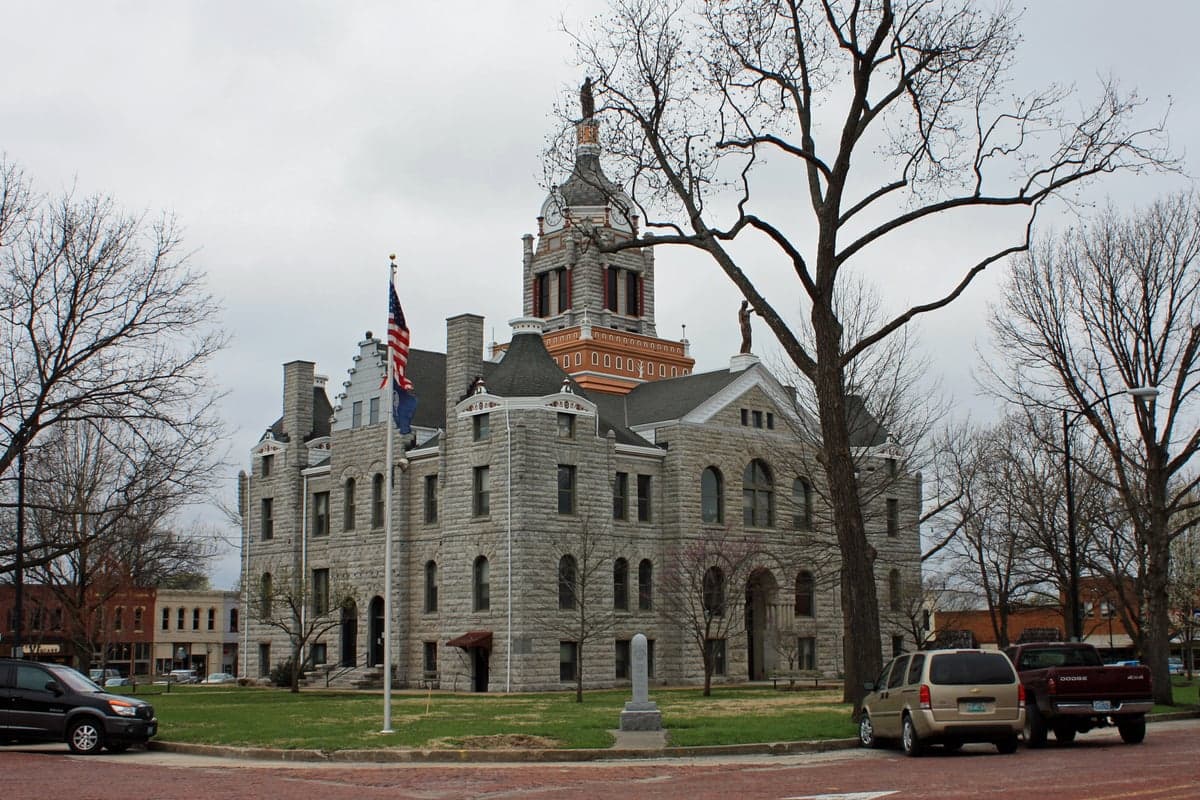
Photo: Wikipedia
Demographics of Bates County
Affluence Level in Bates County
A below-average socioeconomic profile. Incomes, home values, and educational attainment trail the U.S., with higher poverty and unemployment.
People of Bates County
Bates County, Missouri, today is a deeply rural, predominantly white community of 16,121 residents, where the population density hovers at just over 18 people per square mile. The county’s character is defined by its agricultural roots, a strong sense of local independence, and a demographic profile that has remained remarkably stable for decades: 92.2% white, with a foreign-born population of only 0.3% and a college attainment rate of 15.3%. Residents are concentrated in the county seat of Butler (pop. ~4,200), along with the smaller towns of Rich Hill, Adrian, Drexel, and Amsterdam, where family farms, manufacturing jobs, and a quiet, low-cost lifestyle anchor daily life.
Settlement & growth (pre-1960)
Before American settlement, the land that is now Bates County was part of the traditional territory of the Osage Nation, who controlled much of western Missouri and Arkansas. The Osage were forcibly removed through a series of treaties in the early 1800s, culminating in the 1825 Treaty of St. Louis, which ceded their claims to the area. The first permanent American settlers—overwhelmingly Scots-Irish and English migrants from Kentucky, Tennessee, and Virginia—arrived in the 1830s and 1840s, drawn by cheap land under the Preemption Act of 1841 and later the Homestead Act of 1862. They established the earliest communities along the Marais des Cygnes River, including the original county seat of Papinville (founded 1841), which served as a trading post and river crossing.
The county’s growth was violently interrupted by the Bleeding Kansas conflict and the Civil War. Bates County sat on the Missouri-Kansas border, a flashpoint for guerrilla warfare between pro-slavery and free-state factions. In 1863, Union General Thomas Ewing Jr. issued General Order No. 11, which forcibly depopulated Bates, Cass, and Jackson counties to deny support to Confederate bushwhackers. The order expelled nearly all residents, and much of the county was burned. After the war, settlers returned slowly, and the population did not recover its pre-war level until the 1880s.
The next major wave came with the expansion of the Missouri Pacific Railroad in the 1870s and 1880s. Railroad construction brought a modest influx of German and Irish laborers, though these groups never formed large ethnic enclaves in Bates County as they did in St. Louis or Kansas City. Instead, the railroad spurred the founding of new towns along its route: Butler (platted 1854, but rebuilt after the war), Rich Hill (1880), and Adrian (1880). These towns became commercial hubs for the surrounding agricultural economy, which centered on corn, wheat, and livestock. By 1900, the county’s population peaked at 30,141, driven by the expansion of coal mining in the Rich Hill area, which attracted a small number of Italian and Eastern European miners. However, the mines played out by the 1920s, and the population began a long decline.
The Dust Bowl and Great Depression of the 1930s hit the county hard, accelerating out-migration to Kansas City and the West Coast. No significant new immigrant groups arrived during this period. The post-World War II era saw a modest stabilization, as returning veterans took advantage of the GI Bill to buy farms, but the county’s population continued to drift downward as agricultural consolidation reduced the number of family farms. By 1960, the population stood at roughly 17,600, a figure that has remained nearly flat for the past 65 years.
Modern era (post-1965)
The 1965 Hart-Cellar Act, which transformed U.S. immigration by eliminating national-origin quotas, had virtually no effect on Bates County. The county’s foreign-born population today is just 0.3%, compared to 3.6% for Missouri as a whole and 13.7% nationally. The few immigrants who have arrived since 1965 are primarily Hispanic (now 2.4% of the population), working in agricultural labor, meatpacking, or construction. They are concentrated in Butler and Rich Hill, though no formal ethnic enclave has formed.
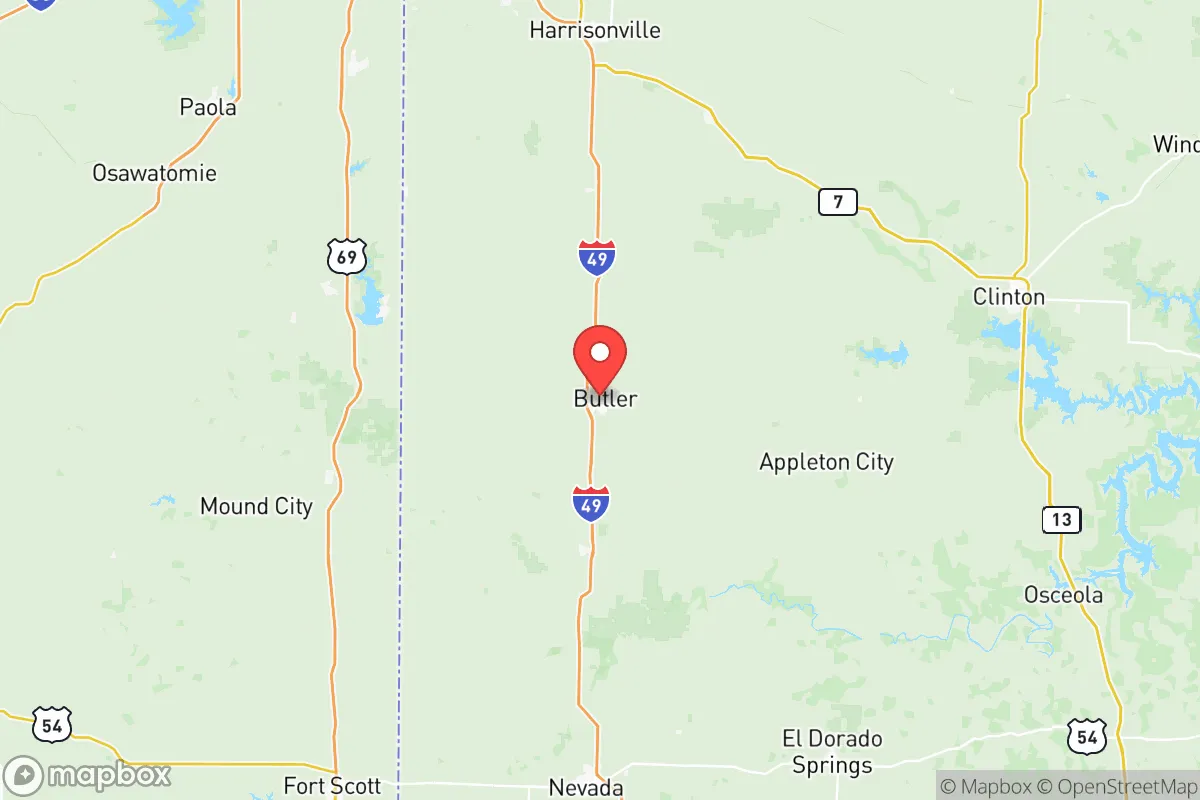
Domestic migration has been the dominant demographic force, and it has been largely negative. Bates County has experienced a steady net out-migration of young adults to the Kansas City metro area (about 60 miles north) and to the Sun Belt states of Texas, Arizona, and Florida. The county’s population has aged significantly: the median age is now 43.2, compared to 38.5 for Missouri. The Black population (2.1%) and East/Southeast Asian population (0.4%) are small and dispersed, with no distinct neighborhoods or cultural institutions. The Indian-subcontinent population is effectively zero.
Suburbanization has bypassed Bates County. Unlike neighboring Cass County, which has seen significant exurban development from Kansas City, Bates County remains too distant for daily commuting. The largest employer is the Bates County Memorial Hospital in Butler, followed by manufacturing firms like Bates County Manufacturing and Hughes Brothers (a utility pole producer in Adrian). Agriculture—primarily row crops (corn, soybeans) and cattle—still employs a significant share of the workforce, though farm consolidation means fewer people work the land than in previous generations.
The future
Bates County’s population is projected to continue its slow decline, falling to roughly 15,000 by 2040, according to the Missouri State Demographer. The county is becoming less diverse, not more: the white share has actually increased slightly since 2000 as minority populations (especially young Hispanics) have moved to larger cities for better opportunities. The Hispanic share may grow modestly if agricultural labor demand holds, but the overall foreign-born population is unlikely to exceed 1% in the next decade.
The cultural identity of the county is likely to remain deeply rooted in its rural, agricultural, and conservative character. There is no significant trend toward new immigrant communities or ethnic enclaves forming. The most notable demographic shift is the aging of the population: the share of residents over 65 is expected to rise from 20% to 28% by 2040, straining local healthcare and social services. The small towns of Amsterdam, Drexel, and Foster may see further population loss, while Butler and Rich Hill will likely retain their roles as service centers for the surrounding farm population.
For someone moving in now, Bates County offers a stable, low-cost, and safe environment—property crime rates are below the national average, and the pace of life is unhurried. However, it is a place where the population is shrinking and aging, where economic opportunities are limited, and where the demographic future looks very much like the present: overwhelmingly white, rural, and rooted in the land. It is not a place of rapid change or new arrivals, but rather a community that values continuity and self-reliance above all else.

* Values derived from national, state, county, city and local statistics and may differ in a specific area. Last updated: 2026-10-18T11:28:49.000Z
Narrative content on this page is AI-generated and may contain mistakes. Verify any details that matter before acting on them.
ReloMaps may earn a commission from affiliate links at no extra cost to you.

