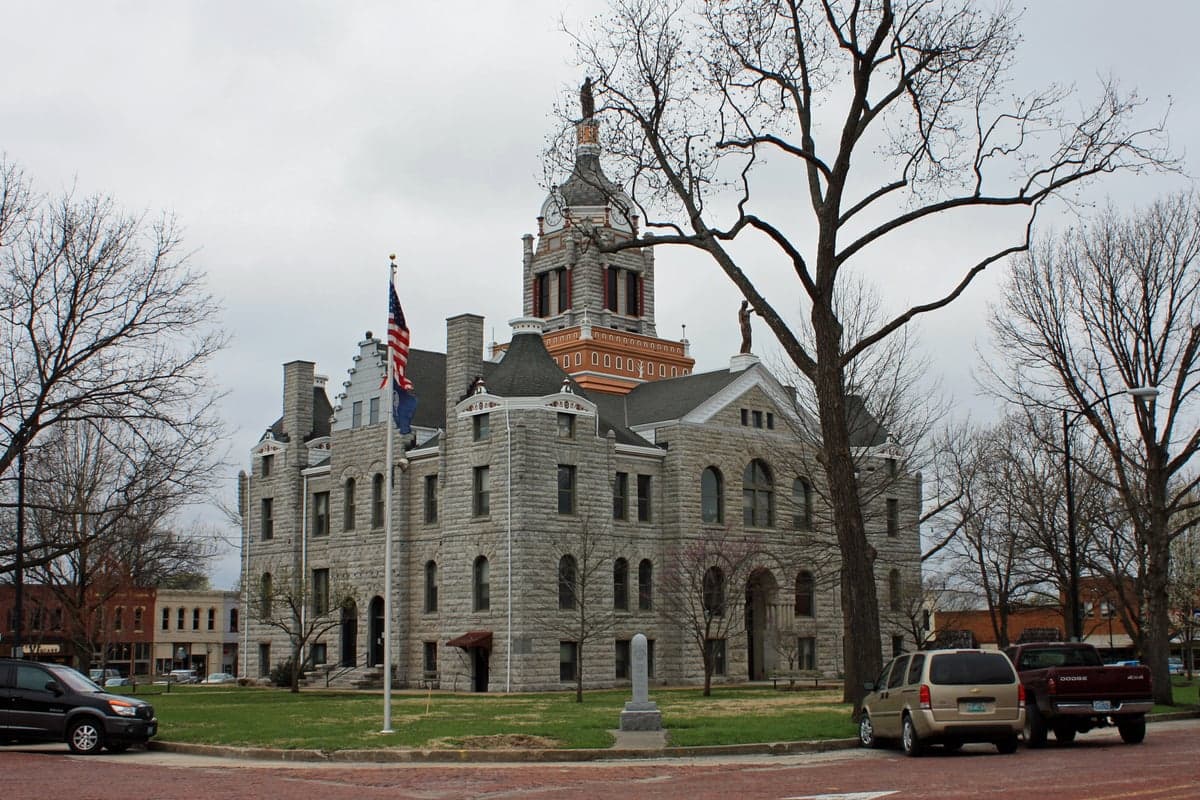
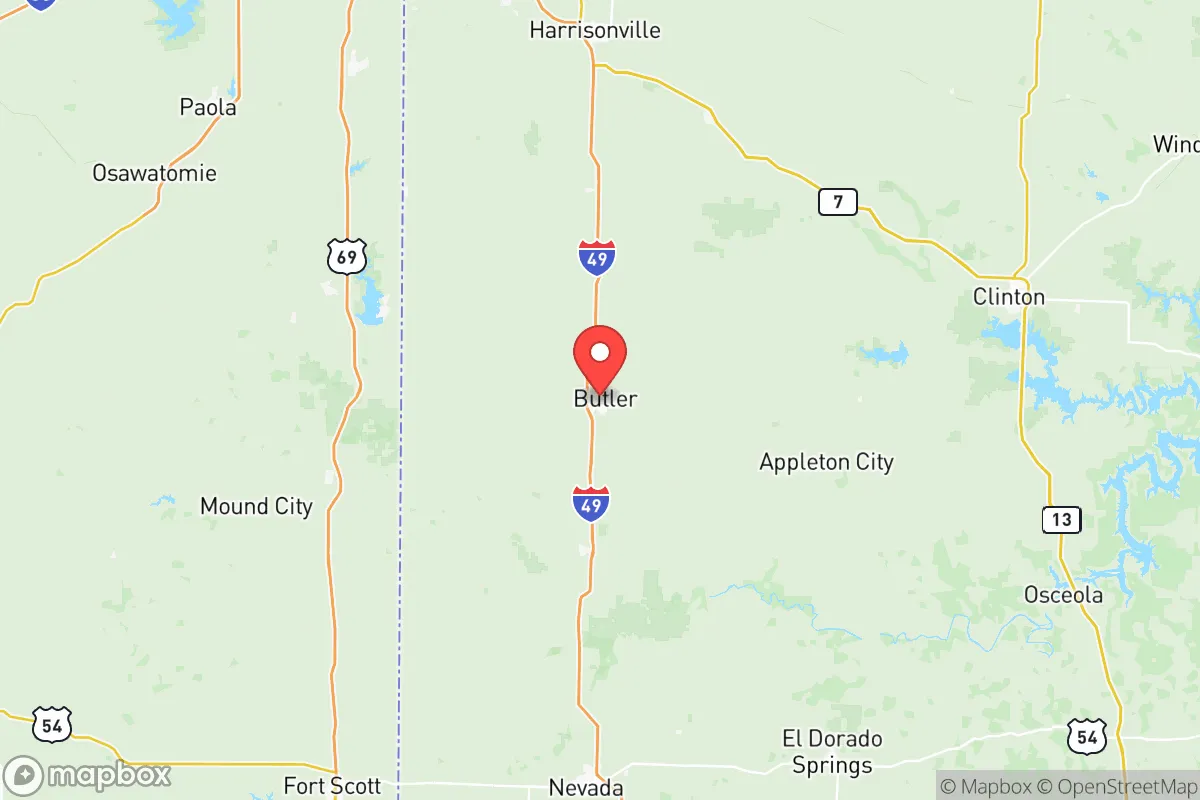
Photo: Wikipedia
Political ClimatePolitical Climate in Bates County
Showing district-level results — no local-only data available.
Local Political AnalysisPolitical Analysis of Bates County
Bates County, Missouri, is a reliably conservative stronghold, with a Cook Partisan Voting Index (PVI) of R+21, making it significantly more Republican than the state of Missouri as a whole, which sits at R+8. This isn't a recent shift; the county has voted for the GOP presidential candidate by wide margins for decades, and that trend has only solidified in the last two cycles. While the state has been moving rightward, Bates County has moved faster and further, creating a distinct political culture that feels more akin to neighboring Kansas than to urban Missouri.
How it compares
The gap between Bates County and the state average is stark. In 2024, while Missouri went for the Republican candidate by roughly 8 points, Bates County delivered a margin closer to 30 points. This isn't uniform across the county, though. The county seat, Butler, is the most reliably red town, often delivering 75%+ of its vote to GOP candidates. In contrast, the small town of Adrian shows a slightly more moderate profile, with a handful of precincts occasionally breaking 60% for Republicans rather than 70%. The only real pocket of blue is around the Drexel area, where a few precincts near the Cass County line can dip into the high 40s for Democrats, largely driven by commuters who work in the Kansas City metro. Still, these are outliers; the county's rural character and agricultural base create a deep-seated conservative consensus that overshadows any local variation.
What this means for residents
For conservative residents, Bates County offers a political environment where their views are the clear majority. Local government, school boards, and county commissions are uniformly Republican, and policy debates tend to focus on tax rates, road maintenance, and agricultural regulations rather than social issues, which are largely settled in the conservative direction. For liberal residents, the reality is more isolating. They are a distinct minority, and while there's no open hostility, they often find their political views are simply not part of the public conversation. A Democrat running for county office would face an uphill battle, and progressive policy proposals rarely gain traction. The practical effect is that political engagement for liberals often happens at the state or national level, or through non-partisan community groups, rather than through local party politics.
Culturally, Bates County's political lean translates into a strong emphasis on self-reliance, limited government, and Second Amendment rights. Gun ownership is nearly universal, and the county has a "Second Amendment Sanctuary" resolution on the books. There's a palpable skepticism of state-level mandates from Jefferson City, even when the state government is Republican-led, reflecting a deep-seated localism. The county's economy is heavily tied to agriculture and small manufacturing, so policy discussions often center on property taxes, crop insurance, and the cost of diesel. For newcomers, the most noticeable distinction isn't the partisan divide itself, but how thoroughly it shapes everyday life—from the signs in front of churches to the conversations at the local diner. It's a place where political identity is less a matter of debate and more a shared assumption, for better or worse.

State Political ClimatePolitical Climate in Missouri
State Political AnalysisPolitical Environment in the State
Missouri is a solidly Republican state with a Cook PVI of R+8, meaning it typically votes about eight points more conservative than the national average. Over the past 20 years, the state has shifted rightward, driven by the exodus of rural and suburban voters from the Democratic coalition and the near-total collapse of the party’s once-dominant position in the Ozarks and the Bootheel. However, this isn’t a monolithic red wall — the state’s two major metros, St. Louis and Kansas City, remain reliably blue, creating a sharp urban-rural split that defines nearly every statewide election.
Urban vs. rural divide
The political map of Missouri is essentially a tale of two islands of blue surrounded by a sea of red. St. Louis City and County, along with Kansas City’s Jackson County, consistently deliver Democratic margins of 20-40 points in statewide races. In 2024, St. Louis County alone accounted for roughly a quarter of all Democratic votes cast in the governor’s race. Meanwhile, the rest of the state — from the sprawling suburbs of St. Charles and Jefferson County to the rural strongholds of Christian County (outside Springfield) and Cape Girardeau — votes overwhelmingly Republican. The most dramatic shift has been in the exurbs: St. Charles County, once a swing area, now votes +30 R in presidential elections. The Bootheel (Dunklin, Pemiscot counties) and the Ozarks (Greene, Taney, Stone counties) are deep red, with some precincts hitting 80% Republican. The only other notable blue pocket is Boone County, home to Columbia and the University of Missouri, which votes about +15 D.
Policy environment
Missouri’s policy environment is broadly conservative, with a few notable exceptions. The state has a flat income tax of 4.8% (down from 5.4% in 2022, with a trigger to drop to 4.5% if revenue targets are met), and no estate or inheritance tax. Sales tax is around 4.225% at the state level, but local add-ons push it to 8-10% in many cities. Property taxes are among the lowest in the nation, averaging about 0.85% of assessed value. The state is a right-to-work state (though voters repealed the law in 2018 via referendum, the legislature later passed a weaker version), and it has a strong preemption law that prevents local governments from raising the minimum wage or enacting paid leave mandates. Education policy is a battleground: Missouri has a robust charter school sector in St. Louis and Kansas City, but rural districts are struggling with enrollment declines. The state’s school funding formula is notoriously complex and underfunded, leading to frequent lawsuits. Healthcare policy is mixed: Missouri expanded Medicaid in 2021 via ballot initiative (despite legislative opposition), but the state has some of the most restrictive abortion laws in the country (a near-total ban with no exceptions for rape or incest, only medical emergencies). Election laws are moderately restrictive: voter ID is required, absentee voting requires an excuse (though no-excuse absentee was passed in 2022 but struck down by the courts), and the state has a 27-day early voting period.
Recent policy direction
The last five years have seen a sharp conservative turn in Jefferson City. In 2023, the legislature passed a permitless carry law (HB 562), allowing any adult who can legally possess a firearm to carry a concealed weapon without a permit. The same year, the state enacted a sweeping education bill (SB 727) that expanded charter schools, created a school choice tax credit program (the MOScholars program), and banned the teaching of “critical race theory” in K-12 classrooms. On parental rights, Missouri passed a law requiring schools to notify parents of any changes to a student’s health or well-being (HB 2414, the “Parental Bill of Rights”). On speech and privacy, the state has no broad surveillance law, but local police have access to license plate readers and facial recognition — though a 2023 law (SB 26) restricted the use of automated license plate readers by law enforcement. Medical and bodily autonomy is sharply divided: abortion is banned, but medical marijuana is legal (since 2018), and recreational marijuana was legalized by voters in 2022 (Amendment 3). Property rights are generally strong, with no statewide rent control and a relatively low property tax burden. Voting access has tightened: the 2022 voter ID law (HB 1878) requires a photo ID to vote, and the state purged over 100,000 inactive voters from the rolls in 2023. On the whole, the direction is toward fewer regulations on guns and education, more restrictions on abortion and voting, and a slow but steady reduction in income taxes.
Civil unrest & political movements
Missouri has a history of high-profile civil unrest, most notably the 2014 Ferguson protests after the shooting of Michael Brown, which sparked the Black Lives Matter movement nationally. Since then, protests have been smaller but persistent, particularly in St. Louis and Kansas City around police accountability and racial justice. On the right, the state has a strong Second Amendment sanctuary movement — over 60 counties have passed resolutions declaring themselves “Second Amendment Preservation Counties,” vowing not to enforce federal gun laws. Immigration politics are relatively quiet compared to border states, but there have been flashpoints: in 2023, the legislature considered a bill to ban sanctuary cities (though none exist in Missouri), and the state has a law requiring local law enforcement to cooperate with ICE. Election integrity has been a major issue since 2020: the state conducted an audit of the 2020 election (finding no widespread fraud), but the legislature passed several bills tightening voting rules. There is no serious secession or nullification movement, though some rural counties have floated the idea of joining neighboring states (e.g., the “Greater Idaho” movement has no Missouri equivalent). A new resident would notice the political divide most in the suburbs: in St. Charles County, you’ll see “Let’s Go Brandon” flags and Trump signs; in St. Louis City, you’ll see Black Lives Matter banners and pride flags. The two worlds rarely mix.
Projection
Over the next 5-10 years, Missouri is likely to become more Republican, but not uniformly. The St. Louis and Kansas City suburbs are slowly diversifying and trending left, but the rural and exurban areas are growing faster and voting more Republican. The biggest demographic shift is the influx of retirees and remote workers from Illinois and California into the Ozarks (Branson, Springfield, Lake of the Ozarks area), who tend to be conservative. The state’s population is aging and stagnating — Missouri grew only 0.3% between 2020 and 2024 — so the political balance will be determined by which side turns out more reliably. The legislature will likely continue to push tax cuts, school choice, and gun rights, while the courts may strike down some of the more aggressive laws (the abortion ban is already facing legal challenges). A new resident moving in now should expect a state that is reliably red in statewide elections, with a conservative policy agenda that moves incrementally rightward, but with persistent blue islands in the cities that will keep the culture war alive.
For a new resident, the bottom line is this: if you’re conservative, you’ll find a state that generally aligns with your values on taxes, guns, and education, with a legislature that is actively pushing those priorities. If you’re liberal, you’ll find a state where your vote in statewide races is largely symbolic, but you’ll have strong local representation in St. Louis, Kansas City, or Columbia, and you can still access legal marijuana and expanded Medicaid. The practical takeaway is that Missouri is a place where your day-to-day life is shaped more by your county than by the state — a conservative family in St. Charles County will have a very different experience than a liberal family in St. Louis City, even though they’re 30 minutes apart. Choose your location carefully, and you’ll find a community that fits.
* Values derived from national, state, county, city and local statistics and may differ in a specific area. Last updated: 2026-10-18T11:28:49.000Z
Narrative content on this page is AI-generated and may contain mistakes. Verify any details that matter before acting on them.
ReloMaps may earn a commission from affiliate links at no extra cost to you.

