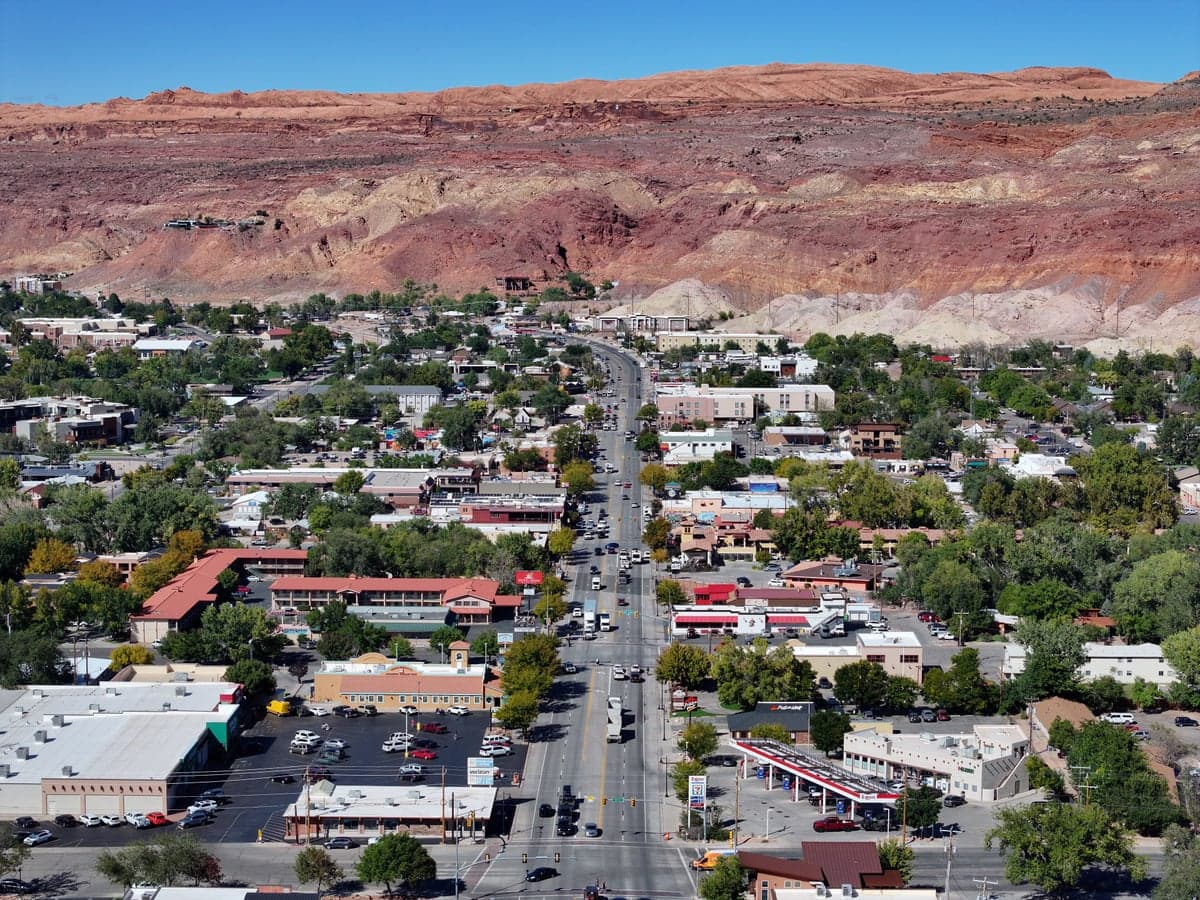
Photo: Wikipedia
Demographics of Moab, UT
Affluence Level in Moab, UT
A middle-class area roughly in line with national averages across income, home values, education, and employment.
People of Moab, UT
The people of Moab, Utah, today number 5,316, forming a compact, tourism-driven community where 71.5% of residents identify as White and 19.7% as Hispanic or Latino. The city’s character is shaped by a blend of longtime Mormon families, outdoor-recreation transplants, and a growing Latino workforce, giving it a distinctive identity as a red-rock hub that is both conservative-leaning and increasingly diverse. With 35.4% of adults holding a college degree—above the state average—Moab attracts educated professionals drawn to its national-park economy, while its foreign-born population of 5.6% reflects a steady but modest immigrant presence.
How the city was settled and grew
Moab’s human history begins with the Ancestral Puebloans and later the Ute people, who used the Colorado River corridor for seasonal travel and hunting. Permanent Euro-American settlement started in the late 1870s, when Mormon pioneers from the Church of Jesus Christ of Latter-day Saints arrived under the direction of Brigham Young to establish an agricultural outpost. These early settlers built irrigation ditches from Mill Creek and the Colorado River, founding the original townsite around Center and Main streets, an area now known as Historic Downtown Moab. By 1880, the population was roughly 200, almost entirely Mormon families from the Wasatch Front. A second wave came in the 1890s with the discovery of uranium and vanadium deposits, drawing miners and prospectors—many non-Mormon—who settled in what became the Mill Creek neighborhood, east of downtown, where modest homes and boarding houses sprang up near the creek. The uranium boom of the 1950s brought a third wave: transient miners, engineers, and speculators, who clustered in the Pack Creek area south of town, building simple ranch-style homes. By 1960, Moab’s population had grown to roughly 4,000, but the bust that followed left the city in decline until the rise of tourism in the 1980s.
Modern era (post-1965)
The post-1965 era reshaped Moab’s population through two major shifts: the collapse of mining and the rise of outdoor recreation. After the uranium market cratered in the early 1970s, many mining families left, and the city’s population dropped to around 3,800 by 1980. The void was filled by a new wave of domestic in-migrants—rock climbers, river runners, and mountain bikers—drawn by the red-rock landscape. These newcomers, predominantly White and college-educated, settled in the Rim Village subdivision on the city’s west side, a planned community of single-family homes built in the 1990s and 2000s. Simultaneously, a growing Latino population—largely from Mexico and Central America—arrived to work in construction, hospitality, and landscaping, supporting the tourism boom. This community concentrated in the Spanish Valley area south of town, along U.S. Highway 191, where mobile-home parks and rental duplexes house many families. The 2020 census data shows that Moab’s Hispanic share (19.7%) is nearly double the state average of 15.1%, while the Black population remains at 0.0% and East/Southeast Asian communities at 0.6%, reflecting the city’s limited racial diversity beyond the White-Hispanic axis. The Indian-subcontinent population is 0.0%, and no Arab community is recorded. The foreign-born share of 5.6% is below the national average of 13.7%, indicating that immigration is a secondary factor compared to domestic migration.
The future
Moab’s population is heading toward continued growth driven by tourism and remote work, but the city is not homogenizing—it is tribalizing into distinct enclaves. The White, college-educated cohort is expanding in the Rim Village and new subdivisions on the north side, where homes sell for $600,000 or more, pricing out many locals. The Latino community, meanwhile, is growing in absolute numbers but plateauing as a share of the population, as housing costs push families into the Spanish Valley corridor and unincorporated Grand County. The Mormon population, once dominant, is shrinking as a proportion, though it remains influential in local politics and the school board. Over the next 10–20 years, Moab will likely see modest overall growth—perhaps reaching 6,500 by 2040—but with increasing economic stratification: a wealthy, White, transient population of second-home owners and retirees, and a working-class, Latino, service-sector population with fewer pathways to homeownership. The city’s character will remain that of a tourism gateway, but the social fabric is becoming more divided by income and geography.
For someone moving to Moab now, the bottom line is this: the city is becoming a place of two worlds—one affluent, educated, and transient, the other working-class, rooted, and increasingly Latino. The conservative-leaning culture persists in local governance and the Mormon remnant, but the daily life of the city is shaped by the tension between preservation and growth. New arrivals should expect a tight housing market, a strong outdoor community, and a population that is friendly but increasingly aware of its own divides.

* Values derived from national, state, county, city and local statistics and may differ in a specific area. Last updated: 2026-05-14T04:51:50.000Z
Narrative content on this page is AI-generated and may contain mistakes. Verify any details that matter before acting on them.
ReloMaps may earn a commission from affiliate links at no extra cost to you.

