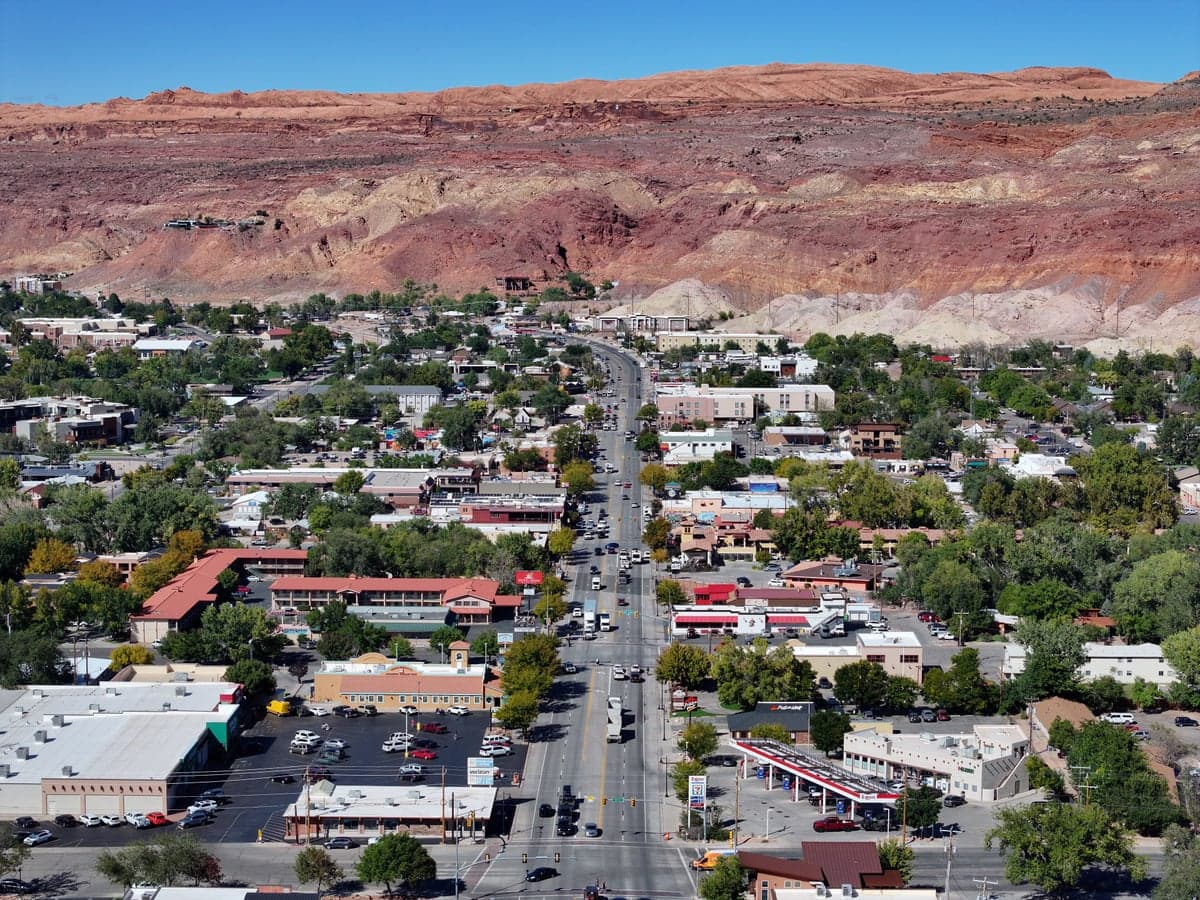
Photo: Wikipedia
Personal Sovereignty in Moab, UT
Viable for self-reliance. Generally workable, though some barriers may limit total independence.
What does Personal Sovereignty tell us?
Personal Sovereignty measures your capacity for self-reliance and independence with minimal government friction. Higher scores mean fewer barriers between you and the way you want to live... but it assumes you have the space you need and good neighbors.
What does this tell us?
Personal Sovereignty measures your capacity for self-reliance and independence with minimal government friction. Higher scores mean fewer barriers between you and the way you want to live... but it assumes you have the space you need and good neighbors.
State Policy
Energy independence: Self-sufficient (80% of energy produced in-state)
Personal Liberty
Homesteading

Personal Liberty Analysis
Moab, Utah offers a notably high degree of personal sovereignty compared to many Western towns, largely due to Utah’s state-level preemption laws and a local culture that still values self-reliance over government dependency. While the town itself leans more progressive than the surrounding Grand County, the state’s constitutional framework—including strong Second Amendment protections, low property taxes, and limited zoning in unincorporated areas—creates a buffer against the kind of municipal overreach seen in Colorado or California. For a survivalist or prepper, Moab represents a strategic balance: remote enough to avoid urban chaos, yet legally structured to allow significant personal autonomy in daily life.
Tax burden and regulatory posture in Grand County
Utah’s tax structure is a major draw for those seeking to keep more of their own income. There is no state income tax on retirement income, and the flat state income tax rate is a competitive 4.85%. Property taxes in Grand County are among the lowest in the state, with the effective rate hovering around 0.5% of assessed value—far below the national average. Moab itself does not levy a city income tax, and sales tax is roughly 8.1%, which is moderate. More importantly, Utah is a strong Dillon’s Rule state, meaning local governments only have powers explicitly granted by the state legislature. This limits Moab’s ability to impose burdensome local regulations on businesses or property owners. For a prepper, this means fewer surprise fees, less red tape on home-based enterprises, and a regulatory environment that generally respects private property rights. The state’s business climate ranks in the top ten nationally, and occupational licensing is less restrictive than in coastal states, making it easier to operate a small farm, repair shop, or remote consulting business without drowning in bureaucracy.
Self-defense and gun law specifics in Utah
Utah is a constitutional carry state for anyone 21 or older who can legally possess a firearm—no permit required for open or concealed carry. This is a bedrock freedom for anyone serious about self-defense. The state also has a stand-your-ground law with no duty to retreat, and Castle Doctrine protections extend to vehicles and occupied structures. Moab’s local government cannot override these state preemptions; Utah law explicitly prohibits cities from enacting gun ordinances stricter than state law. For parents, this means no fear of local bans on certain firearm types or magazine capacities. The state also offers a concealed carry permit for reciprocity with other states, which is useful for travel. Background checks are required for commercial sales but not for private transfers between individuals—a key point for those who value privacy in transactions. The sheriff’s office in Grand County is generally pro-Second Amendment, and there are no local “red flag” laws beyond the state’s narrow extreme risk protective order statute, which requires clear evidence of imminent threat. For a survivalist, this legal landscape provides a solid foundation for personal and family defense without constant worry about shifting local politics.
Self-reliance and homesteading viability in Moab
Moab’s geography and zoning create both opportunities and constraints for self-reliance. Within the city limits, lot sizes are typically small—often a quarter-acre or less—and city water and sewer are required, limiting off-grid potential. However, the unincorporated areas of Grand County tell a different story. Outside Moab, you can find parcels ranging from 1 to 40 acres, with minimal zoning restrictions. The county allows rainwater catchment without a permit, and while Utah water rights are complex, a well permit is obtainable for domestic use on larger parcels. Solar is viable: Moab averages over 300 sunny days per year, and net metering is available through Rocky Mountain Power. Off-grid living is legal in unincorporated areas, though you’ll need to comply with state health codes for septic systems. The growing season is short (about 150 days) and arid, so serious food production requires irrigation or greenhouse investment. But for a prepper, the ability to own land, drill a well, install solar panels, and keep livestock (chickens, goats, even small cattle) without a city inspector’s approval is a major sovereignty win. The county’s agricultural zoning allows for farm stands and direct sales, supporting a degree of economic independence.
Personal liberties: parental rights, medical autonomy, speech, and property
Utah has some of the strongest parental rights laws in the nation. The state’s “Parents’ Bill of Rights” (HB 243) explicitly affirms that parents have the fundamental right to direct their children’s education, healthcare, and moral upbringing. This includes the right to opt out of any school curriculum or activity, and to access all school records. Moab’s school district, while small, is subject to these state mandates. On medical autonomy, Utah does not have a state vaccine mandate for adults, and while school vaccine requirements exist, religious and personal exemptions are available. The state has also passed laws limiting the enforcement of federal public health orders at the state level, a nod to medical freedom. Free speech is protected by the Utah Constitution, and there are no local “hate speech” ordinances that go beyond state law. Property rights are further secured by Utah’s private property rights protection act, which requires government to prove a compelling interest before restricting land use. For a parent concerned about government overreach into family decisions, Moab’s legal environment is far more protective than what you’d find in blue states like Oregon or Washington.
Overall, Moab offers a high degree of personal sovereignty relative to most towns in the Intermountain West, especially when considering the state-level protections that insulate residents from local progressive impulses. The tax burden is low, gun rights are robust, homesteading is feasible on larger parcels outside city limits, and parental and medical freedoms are codified in state law. The trade-offs are real: the town’s economy is heavily tourism-dependent, which brings seasonal crowds and some transient crime, and the local government occasionally pushes environmental regulations that can affect property use. But for a survivalist or prepper who values autonomy over convenience, Moab provides a legal and cultural foundation that respects individual choice—something increasingly rare in the United States. If you’re looking for a place where the state has your back against local overreach, and where you can live largely on your own terms, this red desert town deserves a serious look.

* Values derived from national, state, county, city and local statistics and may differ in a specific area. Last updated: 2026-05-14T04:51:50.000Z
Narrative content on this page is AI-generated and may contain mistakes. Verify any details that matter before acting on them.
ReloMaps may earn a commission from affiliate links at no extra cost to you.

