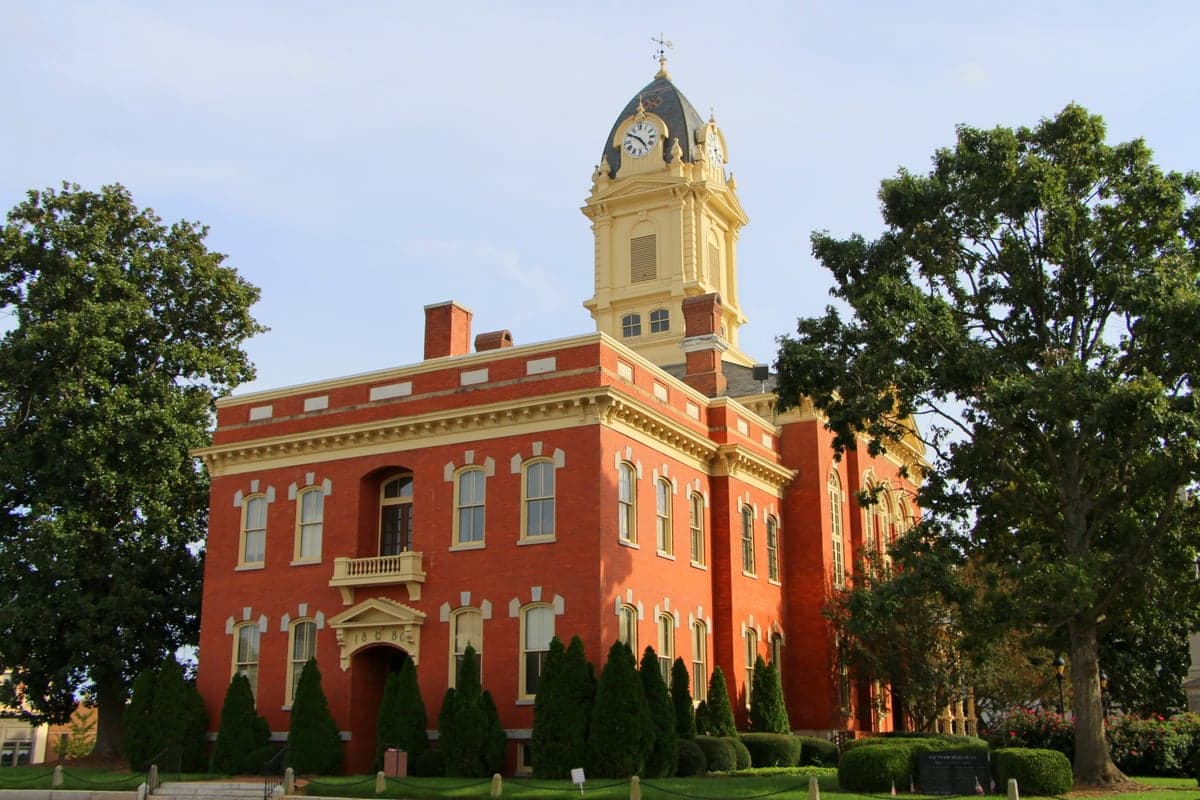
Photo: Wikipedia
Demographics of Monroe, NC
Affluence Level in Monroe, NC
A middle-class area roughly in line with national averages across income, home values, education, and employment.
People of Monroe, NC
Monroe, North Carolina, is a city of roughly 35,600 residents with a distinctly diverse and evolving character, shaped by waves of migration from the rural South, Latin America, and the broader Sun Belt. Today, it is a majority-minority city where no single ethnic group holds a numerical majority, with a White population of 42.5%, a Hispanic population of 31.0%, and a Black population of 21.5%. The city’s identity is a blend of its historic role as a textile and agricultural hub, its modern role as a Charlotte exurb, and a growing Hispanic community that is reshaping its cultural and economic landscape.
How the city was settled and grew
Monroe was founded in 1844 as the seat of Union County, named after President James Monroe, and its early growth was driven by agriculture—primarily cotton—and the arrival of the railroad in the 1870s. The original population consisted of Scots-Irish and English settlers who moved west from the coastal plain, establishing farms and small businesses. The post-Civil War era brought a significant Black population, many of whom were formerly enslaved people who settled in neighborhoods like Hallsboro and East Monroe, working as sharecroppers and later as laborers in the city’s growing textile mills. The early 20th century saw a boom in cotton milling, drawing rural White families from the surrounding countryside into mill villages such as Millbrook and Belkton, where company housing and company stores defined daily life. These neighborhoods remain predominantly Black and White, respectively, and retain a strong sense of historic identity.
Modern era (post-1965)
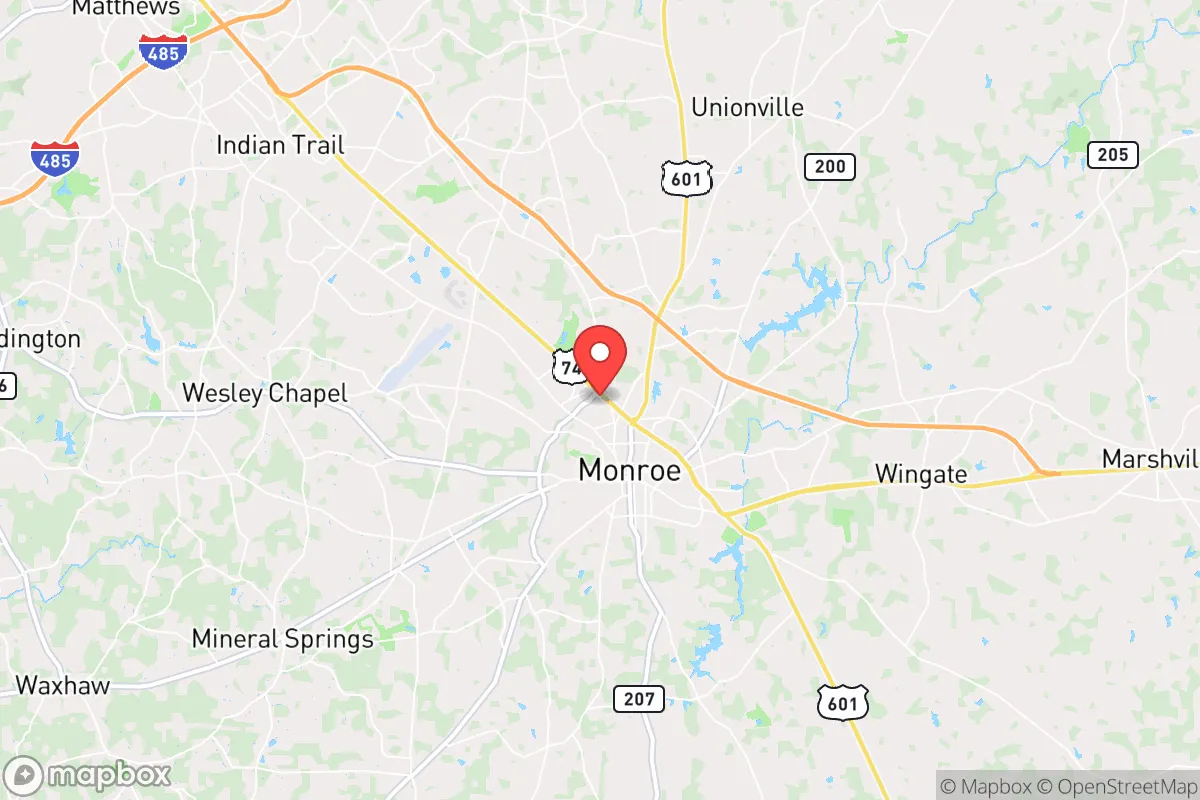
The 1965 Hart-Cellar Act had a delayed but profound effect on Monroe, as the city’s agricultural and light-industrial sectors began attracting immigrant labor. The most dramatic shift began in the 1990s and accelerated after 2000, as Monroe’s proximity to Charlotte (roughly 25 miles north) made it an affordable destination for Hispanic immigrants, primarily from Mexico and Central America, who found work in construction, poultry processing, and landscaping. This wave settled heavily in the Downtown Monroe area and along the Roosevelt Boulevard corridor, where Hispanic-owned businesses—taquerias, grocery stores, and churches—now anchor a vibrant commercial strip. The Black population, which had been stable for decades, saw a slight relative decline as White and Hispanic in-migration outpaced growth. The Asian population remains very small (0.5% East/Southeast Asian, 0.2% Indian subcontinent), concentrated in professional households near the Weddington Road area, a newer suburban fringe. The city’s college-educated share (21.6%) is below the national average, reflecting its working-class roots and the influx of less-educated immigrant labor.
The future
Monroe’s population is trending toward a tri-ethnic balance, with the Hispanic share likely to continue rising as family reunification and secondary migration from other U.S. cities bring new arrivals. The White population, while still the largest single group, is aging and slowly declining in share as younger White families move to newer exurban developments in neighboring Waxhaw and Indian Trail. The Black population is stable but not growing rapidly, with younger Black residents often leaving for Charlotte’s more diverse job market. The city is not tribalizing into rigid enclaves—Hispanic and Black families increasingly live in the same neighborhoods, particularly in the East Monroe and Hallsboro areas—but economic stratification is visible, with newer subdivisions like Lake Park attracting higher-income White and Hispanic families. The foreign-born share (13.4%) is likely to plateau as second-generation Hispanics assimilate and English proficiency rises, but the cultural imprint of the Hispanic community will deepen.
For someone moving in now, Monroe offers a working-to-middle-class environment with genuine diversity, a strong sense of local identity, and a cost of living that remains lower than Charlotte’s. The city is becoming a place where Hispanic culture is not a niche but a mainstream presence, and where the historic Black and White communities are adapting to a new demographic reality. It is not a homogenizing suburb but a city where distinct waves of settlement have layered on top of each other, creating a complex but stable social fabric.

* Values derived from national, state, county, city and local statistics and may differ in a specific area. Last updated: 2026-05-03T20:25:02.000Z
Narrative content on this page is AI-generated and may contain mistakes. Verify any details that matter before acting on them.
ReloMaps may earn a commission from affiliate links at no extra cost to you.

