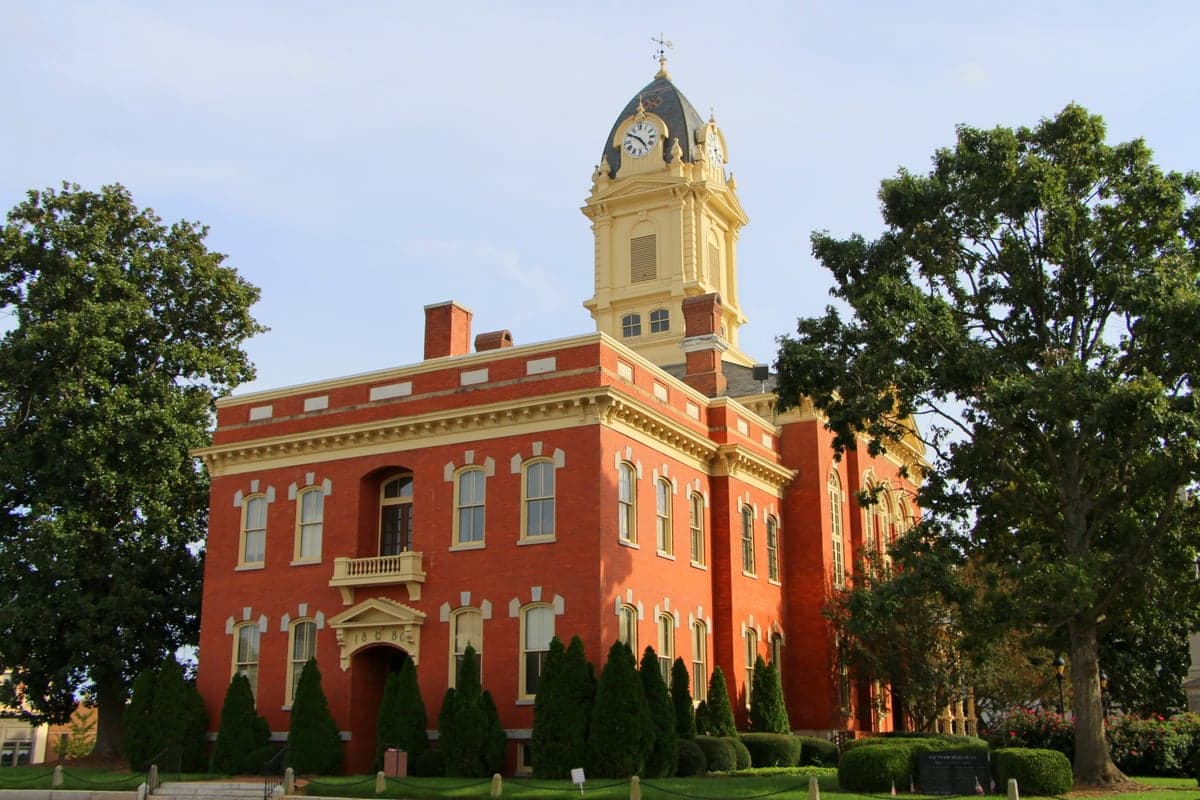
Photo: Wikipedia
Personal Sovereignty in Monroe, NC
Viable for self-reliance. Generally workable, though some barriers may limit total independence.
What does Personal Sovereignty tell us?
Personal Sovereignty measures your capacity for self-reliance and independence with minimal government friction. Higher scores mean fewer barriers between you and the way you want to live... but it assumes you have the space you need and good neighbors.
What does this tell us?
Personal Sovereignty measures your capacity for self-reliance and independence with minimal government friction. Higher scores mean fewer barriers between you and the way you want to live... but it assumes you have the space you need and good neighbors.
State Policy
Energy independence: Importer (15% of energy produced in-state)
Personal Liberty
Homesteading

Personal Liberty Analysis
Monroe, North Carolina, offers a notably high degree of personal sovereignty compared to many urban and suburban areas in the Northeast and West Coast, largely due to North Carolina’s status as a Dillon’s Rule state with a strong preemption framework. This means the state government generally limits the ability of local municipalities like Monroe to impose their own restrictive ordinances on firearms, land use, and business operations, creating a more predictable and liberty-respecting environment for individuals and families. For a survivalist or prepper mindset, the key takeaway is that Monroe sits within a legal ecosystem that prioritizes state-level protections over local overreach, though the city itself is growing and some tensions exist between rural traditions and suburban expansion. The overall autonomy environment here is solid, but requires active engagement to maintain.
Tax burden and regulatory posture in Union County
North Carolina’s tax structure is a clear advantage for those seeking to maximize personal financial sovereignty. The state levies a flat income tax rate of 4.75% as of 2026, with no local income tax, and the state sales tax is 4.75%, with Union County adding a local 2.25% for a combined 7% — lower than many neighboring counties. Property taxes in Monroe are also relatively modest, with a rate of approximately $0.71 per $100 of assessed value, which is well below the national average for cities of comparable size. The regulatory posture is equally favorable: North Carolina is a right-to-work state, meaning no forced union membership, and it has no state-level occupational licensing requirements for many trades that other states heavily regulate. For a prepper, this means less bureaucratic friction when starting a side business, building a workshop, or engaging in barter and trade. However, Monroe’s city government has shown some inclination toward zoning and development regulations that can complicate off-grid or non-standard property uses, so buyers should scrutinize local ordinances carefully before purchasing land within city limits.
Self-defense and gun law specifics in Monroe
Monroe is located in Union County, which is part of North Carolina’s strong Second Amendment environment. The state has permitless carry for concealed handguns as of 2023, meaning law-abiding adults 18 and older can carry a concealed firearm without a permit, though a permit is still required for purchasing handguns from dealers. North Carolina also has a Castle Doctrine law with no duty to retreat in one’s home, vehicle, or workplace, and it extends to public places where a person has a lawful right to be. For those concerned about government overreach, it’s worth noting that Monroe’s local government cannot pass its own gun control ordinances due to state preemption — a critical protection that prevents cities like Charlotte or Raleigh from imposing magazine bans or registration schemes that would affect Monroe residents. The sheriff’s office in Union County is known for being pro-Second Amendment, and concealed carry permits (still useful for reciprocity in other states) are issued on a shall-issue basis with no subjective “good cause” requirement. For a survivalist, this legal framework means you can maintain a well-stocked armory and carry for self-defense without fear of local politicians changing the rules overnight.
Self-reliance and homesteading viability in the area
Monroe’s position on the edge of the Charlotte metro area creates a mixed landscape for self-reliance. Within city limits, standard residential lots range from 0.25 to 0.5 acres, which is sufficient for a substantial garden, small livestock like chickens or rabbits, and rainwater collection systems, but not for larger animals or significant off-grid infrastructure. Zoning in Monroe’s urban core restricts things like outdoor wood boilers, composting toilets, and non-permitted structures, so true homesteading is more viable in the unincorporated areas of Union County, where lot sizes of 1 to 5 acres are common and zoning is far more permissive. The county’s agricultural districts allow for farming, beekeeping, and even limited hunting on private land with proper permits. Off-grid feasibility is moderate: North Carolina has no state-level ban on solar panels or rainwater harvesting, but Monroe’s building codes require grid-tied electrical systems for new construction, and well water permits are subject to county health department approval. For a prepper, the best strategy is to buy land in the rural parts of Union County, outside Monroe’s extraterritorial jurisdiction, where you can build a self-sufficient setup with fewer bureaucratic hurdles. The local soil is generally good for gardening, and the climate supports a long growing season, but water availability can be an issue during droughts, so a backup well or cistern is advisable.
Personal liberties: parental rights, medical autonomy, speech, and property
North Carolina has a strong track record on parental rights, with state law affirming that parents have the fundamental right to direct the upbringing, education, and healthcare of their children. This means Monroe parents can opt their kids out of public school curricula they find objectionable, homeschool without excessive state oversight (just a simple notice of intent and annual standardized testing), and choose private or religious schools without government interference. Medical autonomy is more nuanced: North Carolina does not have a state-level vaccine mandate for adults, and there is no general emergency powers law that allows the governor to unilaterally impose lockdowns or medical mandates without legislative approval — a lesson learned from the COVID-19 era. However, the state does require certain vaccines for school attendance, with a religious exemption available but no philosophical exemption. Free speech is robustly protected under the First Amendment and North Carolina’s own constitution, and there are no state-level “hate speech” laws that criminalize political or religious expression. Property rights are generally strong, with North Carolina being a “measure of damages” state that compensates landowners fairly in eminent domain cases, though Monroe’s city council has occasionally used zoning powers to restrict short-term rentals and home-based businesses. For those concerned about government overreach, the key is to stay informed about local ordinances and participate in city council meetings, as Monroe’s small-town governance structure means individual voices can still have an impact.
Overall, Monroe offers a level of personal sovereignty that is significantly higher than what you’ll find in deep-blue states like California, New York, or Illinois, but it’s not a libertarian utopia. The city’s growth is bringing more regulation and higher taxes, and the proximity to Charlotte means some urban progressive policies occasionally seep into local discourse. For a survivalist or prepper, the smart move is to establish yourself in the rural parts of Union County, where the regulatory burden is lighter and the community is more aligned with self-reliance values. Compared to other areas in the Southeast, Monroe sits in a sweet spot: close enough to a major city for economic opportunity and medical access, but far enough to maintain a degree of independence. The state-level protections on guns, taxes, and parental rights provide a solid foundation, but the ultimate sovereignty of your household will depend on how carefully you navigate local zoning and building codes. If you’re willing to put in the work to understand and engage with the local political landscape, Monroe can be a strong base for a life of personal freedom and preparedness.

* Values derived from national, state, county, city and local statistics and may differ in a specific area. Last updated: 2026-05-03T20:25:02.000Z
Narrative content on this page is AI-generated and may contain mistakes. Verify any details that matter before acting on them.
ReloMaps may earn a commission from affiliate links at no extra cost to you.

