Political ClimatePolitical Climate in Mount Juliet, TN
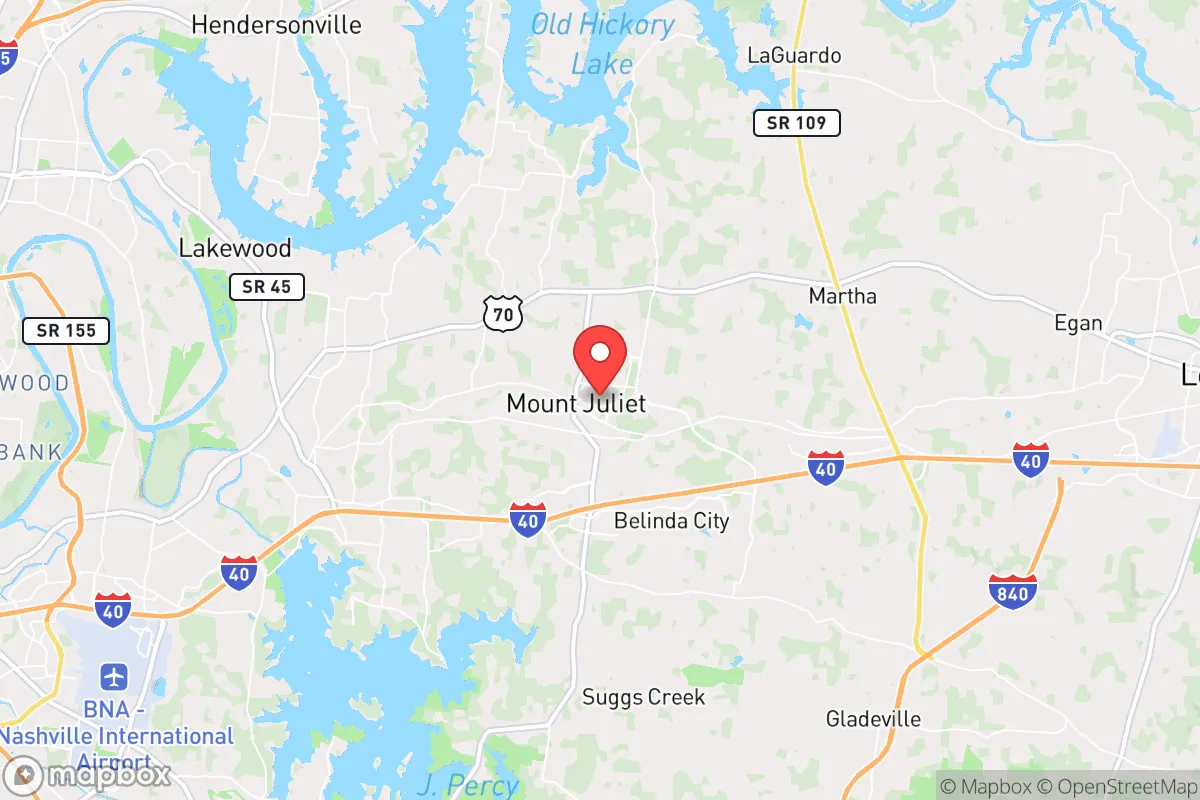
District shown is the primary district for this city’s centroid. Cities may span multiple districts.
Inherited from parent state — no local data available.
Local Political AnalysisPolitical Analysis of Mount Juliet, TN
Mount Juliet has long been a solidly conservative community, and that hasn't changed much even as the town has exploded in size. The Cook PVI rating of R+8 tells you the bones of the story—this is a place where Republican candidates can expect to win by a comfortable margin, and where the local culture still prizes personal responsibility and limited government. But if you’ve been here as long as I have, you’ve noticed the winds shifting a little, especially as Nashville’s sprawl pushes east and brings in folks who aren’t used to the way we do things. The trajectory is still red, but it’s a more complicated shade than it was a decade ago.
How it compares
To understand Mount Juliet’s politics, you have to look at the neighbors. Head west into Nashville proper, and you’re in a deep-blue urban core where progressive policies on taxes, zoning, and policing are the norm. Drive south to Franklin or Brentwood, and you’ll find a more polished, country-club conservatism that’s still reliable but sometimes leans moderate on social issues. Mount Juliet, by contrast, feels more like the working-class and middle-class backbone of Wilson County—closer in spirit to Lebanon or even rural Watertown than to the glitzy suburbs of Williamson County. We don’t have the same kind of activist energy you see in Davidson County, and that’s a good thing. The local commission and school board have stayed mostly conservative, though there have been a few close races in recent years that would have been unthinkable in the 2000s. That’s the part that gives me pause.
What this means for residents
For the average family here, the political climate translates into a few concrete realities. Property taxes are still reasonable compared to Nashville or Franklin, and the county government hasn’t gone on a spending spree. You won’t see the kind of overreach like mask mandates or business shutdowns that plagued other parts of the state during the pandemic—Wilson County pushed back hard on that, and Mount Juliet was part of that resistance. The schools are good, but there’s a growing tension as new developments bring in families from more progressive areas who want to change curriculum or push diversity initiatives that feel more like indoctrination. So far, the school board has held the line, but it’s something to watch. If you value your Second Amendment rights, you’re in good company—this is still a place where concealed carry is common and nobody blinks. The biggest concern I hear from neighbors is that as the population grows, the county commission might start acting more like a city council, with all the zoning restrictions and fee hikes that come with it. That’s the slow creep of government overreach, and it’s the fight we’ll be having for the next decade.
Culturally, Mount Juliet still feels like a small town that happens to have a lot of people. You’ll see Trump signs in yards and American flags on porches, and the local churches are full on Sunday. There’s no appetite for the kind of social engineering you see in bigger cities—no talk of defunding the police, no push for high-density housing mandates, no effort to turn our parks into venues for political activism. The biggest policy distinction is probably the lack of a city income tax (Tennessee doesn’t have one) and a general attitude that the government that governs least governs best. That said, the long-term trend is the real worry. If Nashville keeps bleeding east, and if the transplants keep coming without absorbing the local values, we could see a slow shift toward the kind of progressive policies that have ruined other once-great suburbs. For now, Mount Juliet is still a refuge for people who want to live free and be left alone. But I’d keep an eye on those school board elections if I were you.

State Political ClimatePolitical Climate in Tennessee
State Political AnalysisPolitical Environment in the State
Tennessee has been a reliably red state for decades, but the nature of that conservatism has shifted significantly. The state’s overall partisan lean is solidly Republican, with a +14-point margin for Donald Trump in 2024, but the coalition driving that majority has changed. Over the last 10-20 years, the GOP’s dominance has deepened in rural areas and exurbs, while the state’s major metros—Nashville, Memphis, and Knoxville—have become more Democratic. The result is a state that votes red statewide but is increasingly polarized between a conservative countryside and liberal-leaning cities, with the suburbs of places like Franklin and Brentwood acting as the decisive battleground.
Urban vs. rural divide
The political map of Tennessee is a study in contrasts. Nashville (Davidson County) is the state’s liberal anchor, voting +30 for Biden in 2020 and +25 for Harris in 2024, driven by a booming creative class, transplants from California and New York, and a large Black population. Memphis (Shelby County) is even more Democratic, routinely voting +40 or more for Democrats, powered by a majority-Black electorate and deep union roots. Knoxville (Knox County) is more moderate but trending left, with Harris winning the city proper by 8 points in 2024, though the surrounding county still leans red. Meanwhile, the rest of the state is deeply Republican. Chattanooga (Hamilton County) is a bellwether: it voted for Trump by 12 points in 2024, but the city itself is a purple island in a sea of red. The rural counties of West Tennessee—like Crockett, Gibson, and Weakley—routinely vote +40 to +50 Republican. The Tri-Cities area (Johnson City, Kingsport, Bristol) is a GOP stronghold, with Washington County (Johnson City) being the only blue speck in a region that votes +30 red. The divide is stark: the three major metros (Nashville, Memphis, Knoxville) account for roughly 40% of the state’s population but produce nearly all of the Democratic votes. The rest of the state, from the Mississippi River to the Smoky Mountains, is solidly conservative.
Policy environment
Tennessee’s policy environment is aggressively conservative, with a few notable exceptions. The state has no personal income tax—a major draw for relocators—and a relatively low sales tax rate of 7% (though local add-ons can push it to 9.75% in places like Nashville). The regulatory posture is business-friendly: Tennessee is a right-to-work state, and the legislature has consistently blocked any attempts at a state minimum wage above the federal floor. Education policy is a flashpoint: the state has a robust school voucher program (the Education Savings Account pilot, expanded in 2023) that allows parents in Memphis and Nashville to use public funds for private school. However, the state’s public schools rank near the bottom nationally in funding per pupil, and teacher pay is below the regional average. Healthcare is a mixed bag: Tennessee did not expand Medicaid under the Affordable Care Act, leaving a coverage gap for roughly 300,000 low-income adults. Election laws are strict: the state requires a photo ID to vote, has limited early voting windows, and passed a 2021 law that bans private funding for election administration (a response to the 2020 “Zuckerbucks” controversy). The legislature is currently considering a bill to require hand-counting of ballots in all elections, which would be a major shift. On social issues, the state has a near-total abortion ban (triggered in 2022) with no exceptions for rape or incest, and a 2023 law banning gender-affirming care for minors. The state’s constitutional carry law (passed in 2021) allows permitless carry of handguns, making Tennessee one of the most gun-friendly states in the country.
Trajectory & freedom
Tennessee is becoming more free in some areas and less free in others, depending on your definition. On the plus side for conservatives: the 2021 permitless carry law expanded gun rights significantly, and the 2023 “Tennessee Promise” scholarship program (which covers community college tuition) has been expanded to include adult learners. The state also passed a 2023 law that bans COVID-19 vaccine mandates by private employers, a direct response to federal overreach. Parental rights have been strengthened: the 2022 “Parents’ Bill of Rights” (HB 2670) requires schools to notify parents of any changes to a student’s mental or physical health, effectively banning “Don’t Say Gay” style policies from the left. On the concerning side: the state’s property tax system is regressive and opaque, with reassessments often leading to sudden spikes in rural areas. The 2023 “Tennessee Works” law tied welfare benefits to work requirements, which some see as a freedom-limiting nanny-state move. The biggest red flag for liberty-minded relocators is the state’s eminent domain record: the Tennessee Valley Authority (TVA) and state highway department have aggressively used eminent domain for pipeline and road projects, particularly in rural Middle Tennessee around Lebanon and Murfreesboro. The legislature has also shown a willingness to preempt local control, overriding Nashville’s gun safety ordinances and Memphis’s minimum wage hikes—a double-edged sword for those who value both state and local freedom.
Civil unrest & political movements
Tennessee has seen its share of political flashpoints. The 2020 Nashville bombing (a lone-wolf attack on an AT&T building) was a bizarre, non-ideological event, but it exposed the city’s vulnerability to infrastructure attacks. The 2023 Nashville Covenant School shooting (where a transgender shooter killed six people) sparked massive protests from both gun control advocates and Second Amendment supporters, with the state legislature responding by passing a law to arm teachers (the “School Safety Act of 2024”). The “Tennessee Three” incident in 2023—where two Black Democratic state representatives were expelled for leading a gun control protest on the House floor—became a national story and galvanized progressive activism in Nashville and Memphis. Immigration politics are relatively quiet, but there’s a growing tension in rural West Tennessee where meatpacking plants (like the Tyson plant in Union City) have drawn a significant Latino workforce, leading to local debates about enforcement. The state has no sanctuary cities, and the 2023 “Truth in Immigration” law requires local law enforcement to cooperate with ICE. Election integrity remains a hot topic: the 2020 election in Tennessee was uneventful (Trump won by 23 points), but the legislature has passed multiple bills to tighten voting laws, including a 2024 law that bans ballot drop boxes and requires signature verification for absentee ballots. A small but vocal nullification movement exists in the eastern part of the state, with groups like the “Tennessee Constitutional Militia” advocating for state-level rejection of federal gun laws, but this remains fringe.
Projection
Over the next 5-10 years, Tennessee will likely become more Republican at the state level but more polarized internally. The in-migration wave—driven by people fleeing high-tax states like California, Illinois, and New York—is overwhelmingly conservative, with transplants settling in the exurbs of Nashville (like Spring Hill and Nolensville) and the Chattanooga area. These newcomers are generally pro-gun, anti-tax, and culturally conservative, which will reinforce the GOP’s hold on the legislature and governor’s office. However, the urban cores of Nashville and Memphis will continue to trend left, driven by younger, more diverse populations and the creative economy. The key battleground will be the suburbs of Nashville—places like Williamson County (Franklin, Brentwood) and Rutherford County (Murfreesboro)—which are currently red but are seeing an influx of moderate professionals who may shift them purple over time. The state’s demographic future is also changing: the Hispanic population is growing fast (now 6% of the state), and while they lean conservative on social issues, they are not yet a reliable GOP voting bloc. The biggest wildcard is the education system: if the voucher program expands statewide and public schools continue to underperform, the state could see a brain drain of families who can afford private school, leaving a two-tiered society. For a relocator, expect the state to remain a conservative stronghold for the next decade, but with increasing cultural friction between the liberal cities and the conservative countryside.
Bottom line for a new resident: Tennessee offers a low-tax, gun-friendly, and culturally conservative environment that is ideal for families and individuals who value personal liberty and limited government. The state is moving in the right direction on most fronts—constitutional carry, school choice, and parental rights—but you’ll need to be strategic about where you settle. Avoid the urban cores of Nashville and Memphis if you want to avoid progressive politics and high crime; instead, look at the exurbs of Franklin, Brentwood, or Murfreesboro, or the smaller cities like Chattanooga and Johnson City. The state’s trajectory is positive for conservatives, but the cultural battles are only going to intensify, so choose your county wisely.
* Values derived from national, state, county, city and local statistics and may differ in a specific area. Last updated: 2026-05-01T14:10:21.000Z
Narrative content on this page is AI-generated and may contain mistakes. Verify any details that matter before acting on them.
ReloMaps may earn a commission from affiliate links at no extra cost to you.

