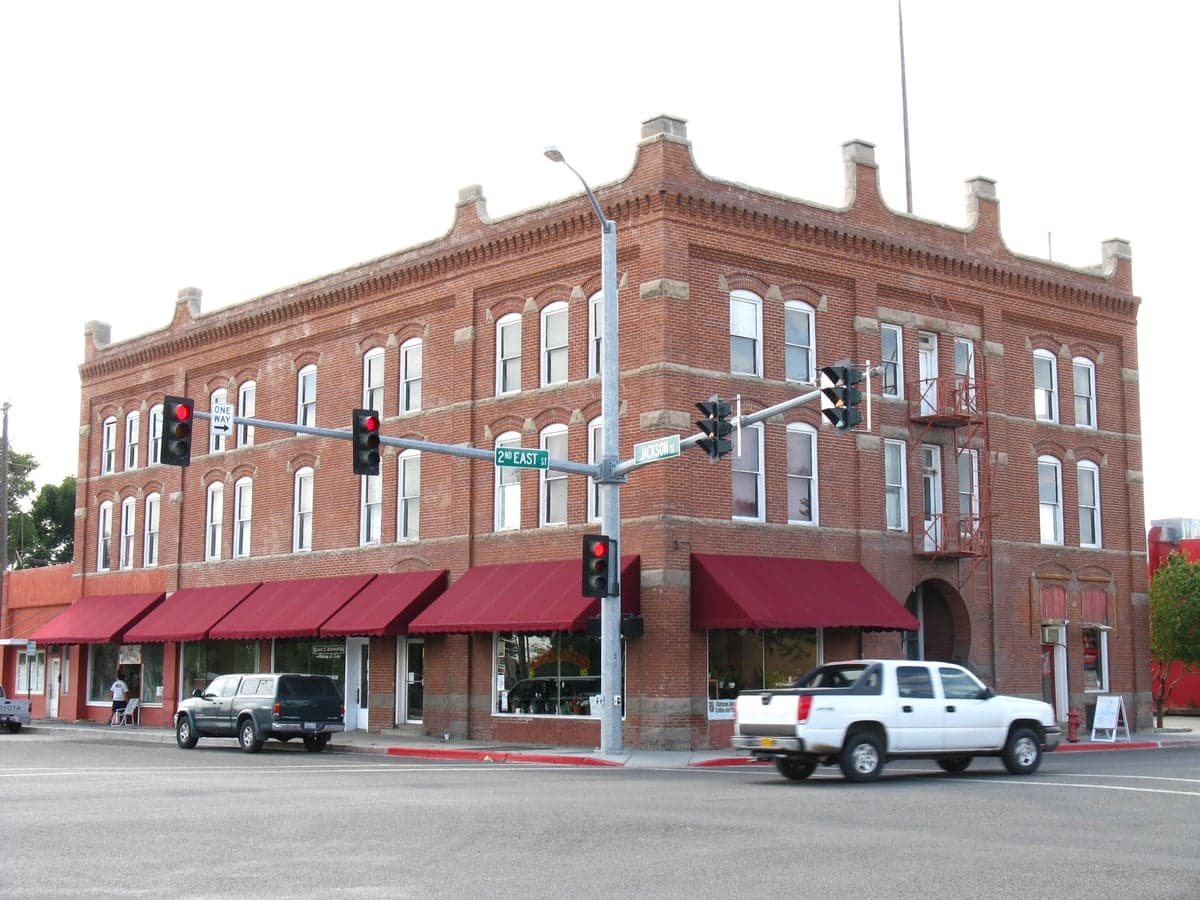
Photo: Wikipedia
Demographics of Mountain Home, ID
Affluence Level in Mountain Home, ID
A middle-class area roughly in line with national averages across income, home values, education, and employment.
People of Mountain Home, ID
Mountain Home, Idaho, is a working-class city of 16,265 residents with a distinctly Western character—predominantly white (71.4%) with a significant Hispanic minority (16.8%) and small but visible East/Southeast Asian (3.5%) and Black (2.6%) communities. The city’s population is less educated than the national average (18.9% college graduates) and overwhelmingly native-born (only 3.4% foreign-born), reflecting its roots as a railroad and Air Force town. Today, Mountain Home feels like a blue-collar anchor in a rapidly urbanizing region, with a demographic profile that has remained remarkably stable even as the broader Treasure Valley booms.
How the city was settled and grew
Mountain Home was founded in 1883 as a railroad town on the Oregon Short Line, a branch of the Union Pacific. The original settlers were a mix of Anglo-American homesteaders drawn by the 1862 Homestead Act and railroad workers, many of whom were Irish and German immigrants. The city’s first neighborhoods—Old Town (centered around the original depot at 2nd and Main) and Railroad Addition (the blocks immediately south of the tracks)—were built by these laborers, with simple wood-frame houses and boarding houses. A second wave came during the 1940s with the establishment of Mountain Home Air Force Base (now Mountain Home AFB), which brought military personnel and their families from across the country. The Air Base Addition neighborhood, just north of the base on the city’s west side, was platted in the 1950s to house these newcomers, featuring ranch-style homes and wide streets. By 1960, the population had reached roughly 6,000, and the city’s economy was split between agriculture (irrigated potato and hay farming) and the base.
Modern era (post-1965)
After the 1965 Immigration and Nationality Act, Mountain Home saw only modest demographic change compared to larger Idaho cities. The Hispanic population grew from a negligible presence in 1970 to about 16.8% today, driven by Mexican and Central American migrants who came for agricultural work—particularly in the potato and sugar beet fields of Elmore County. These families settled primarily in West Mountain Home, a working-class area west of the railroad tracks and south of the base, where older mobile home parks and modest single-family homes predominate. The East/Southeast Asian community (3.5%) is largely a product of military connections—Filipino and Korean spouses of service members, along with a small number of Vietnamese refugees who arrived after 1975. They cluster in Base Housing (the on-base family quarters) and the adjacent Pine Grove subdivision, a 1980s-era development of three-bedroom homes near the base’s main gate. The Black population (2.6%) is also primarily military-affiliated, with no distinct ethnic neighborhood. Notably, the Indian subcontinent population is 0.0%, and the Arab population is negligible—Mountain Home has not attracted the professional-class immigrant streams seen in Boise or Twin Falls. The city’s domestic in-migration since 2000 has been overwhelmingly white and native-born, drawn by low housing costs (median home value roughly $240,000 in 2025) and the base’s steady employment.
The future
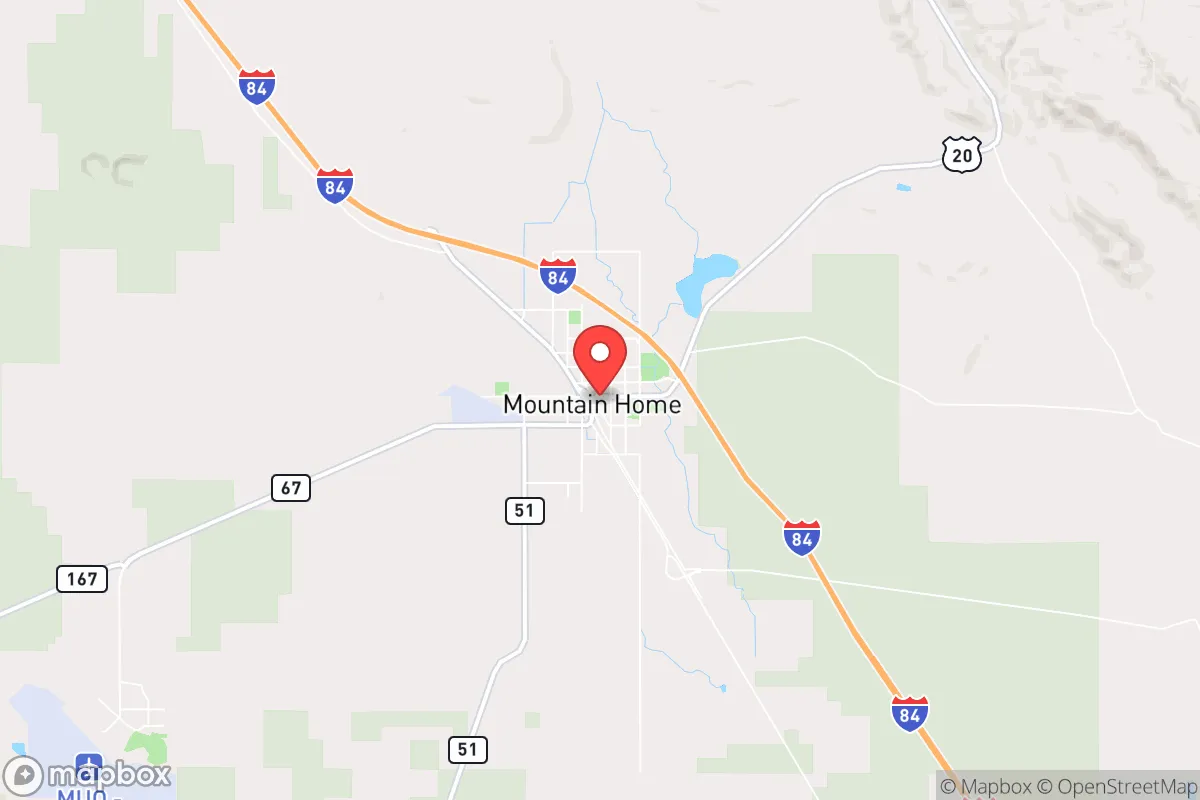
Mountain Home’s population is likely to grow slowly but remain demographically stable over the next 10–20 years. The Hispanic share may inch toward 20% as younger families age into childbearing years, but the foreign-born rate (3.4%) is so low that new immigration will not drive major change. The East/Southeast Asian and Black communities are expected to plateau or slightly decline as the Air Force reduces its presence (the base’s 366th Fighter Wing has seen periodic downsizing). The city is not tribalizing into distinct enclaves—neighborhoods like Old Town and West Mountain Home are becoming more mixed as older white residents age out and Hispanic families move in, but the overall pattern is one of gradual integration rather than segregation. The biggest wildcard is Boise’s suburban sprawl: if Mountain Home becomes a commuter town for the Treasure Valley (a 45-minute drive on I-84), it could attract younger, more educated white-collar workers, slowly raising the college-educated share above 20%. However, the city lacks the amenities (no four-year university, limited retail) to draw that crowd in large numbers.
For a conservative-leaning mover today, Mountain Home is a stable, affordable, and culturally traditional place—predominantly white, family-oriented, and rooted in military and agricultural life. It is not diversifying rapidly, nor is it stagnating; it is a slow-growth Western town where the population is quietly aging and the biggest change ahead is whether the Boise exurbs reach its doorstep. If you want a community that looks and feels much like it did in 1990, with low crime and a strong sense of local identity, Mountain Home delivers. If you seek ethnic diversity or a fast-changing urban scene, look elsewhere.

* Values derived from national, state, county, city and local statistics and may differ in a specific area. Last updated: 2026-04-19T06:36:43.000Z
Narrative content on this page is AI-generated and may contain mistakes. Verify any details that matter before acting on them.
ReloMaps may earn a commission from affiliate links at no extra cost to you.

