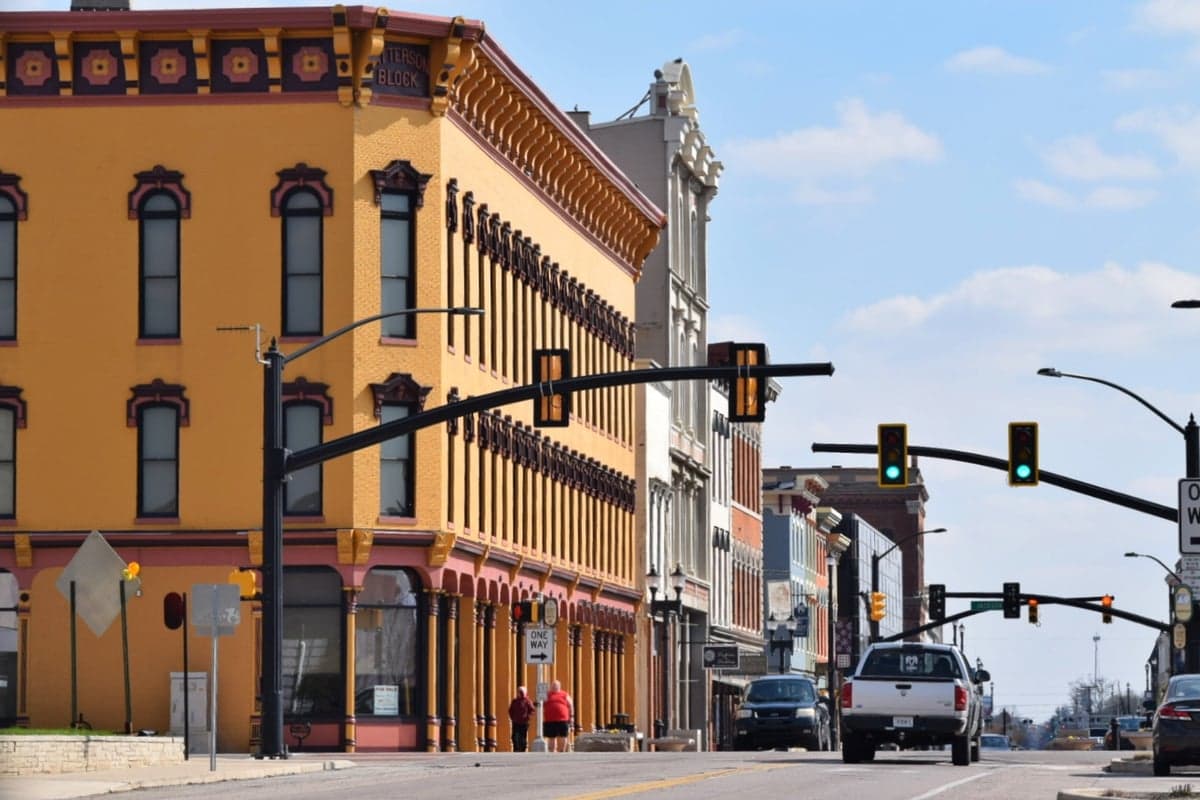
Photo: Wikipedia
Demographics of Muncie, IN
Affluence Level in Muncie, IN
A below-average socioeconomic profile. Incomes, home values, and educational attainment trail the U.S., with higher poverty and unemployment.
People of Muncie, IN
The people of Muncie, Indiana today number 64,739, forming a predominantly white (78.8%) and modestly diverse community with a distinctively low foreign-born share of just 2.0%. The city is characterized by a blue-collar and academic identity, anchored by Ball State University and a legacy of manufacturing decline, with a college-educated rate of 25.7% that reflects the university’s influence. Black residents make up 8.2% of the population, Hispanic residents 4.3%, East and Southeast Asian communities 1.6%, and Indian-subcontinent residents 0.6%, creating a demographic profile that is less diverse than the national average but more varied than much of rural east-central Indiana.
How the city was settled and grew
Muncie was originally inhabited by the Lenape (Delaware) people, who were forcibly removed by the 1820s under federal Indian removal policies. The city was platted in 1827 and grew slowly as an agricultural trading post until the discovery of natural gas in the 1880s triggered a manufacturing boom. The Ball family of glass-jar fame relocated their operations here in the 1880s, establishing Ball Corporation and transforming Muncie into a company town. This industrial wave drew a largely white, native-born workforce from the surrounding countryside and from other Midwestern states, settling in neighborhoods like Industry (near the Ball plants) and Westside, where factory workers’ bungalows still stand. A smaller wave of European immigrants—primarily German and Irish—arrived in the 1890s, clustering in the Old West End near the industrial corridor along the White River. By 1920, Muncie’s population had surged past 36,000, and the city became famous as the subject of the “Middletown” sociological studies, which portrayed it as a quintessentially white, Protestant, middle-American community.
Modern era (post-1965)
The post-1965 era brought gradual demographic change, though Muncie remained less affected by immigration than larger Midwestern cities. The collapse of Ball Corporation’s local manufacturing in the 1990s and 2000s triggered a population decline from a peak of nearly 80,000 in 1970 to 64,739 today. White flight to suburban townships—particularly Yorktown and Eaton—accelerated after 1980, leaving the city core more racially diverse. Black residents, who had been a small minority since the Great Migration, concentrated in the Whitely neighborhood on the east side, a historically Black district that formed around the 1920s and remains the center of Muncie’s African American community. Hispanic growth has been modest but steady, with families settling in the Southside near the industrial parks and along McGalliard Road. East and Southeast Asian residents, many connected to Ball State University’s international programs, cluster near campus in the University neighborhood. Indian-subcontinent residents, though small in number (0.6%), are almost entirely university-affiliated professionals living in the Northwest area near the university’s research facilities. The foreign-born share of 2.0% is among the lowest for any Indiana city of comparable size, reflecting limited recent immigration.
The future
Muncie’s population is projected to continue a slow decline, with the white population shrinking and minority groups growing incrementally. The Hispanic share is expected to rise modestly as families move from larger Indiana cities like Indianapolis for lower housing costs, likely settling in the Southside and along the 35th Street corridor. The Black population is plateauing, with younger residents often leaving for Indianapolis or Chicago after college. East and Southeast Asian and Indian communities will remain small and tied to Ball State’s academic cycles, with little permanent settlement. The city is not tribalizing into distinct enclaves so much as homogenizing into a lower-density, older, and less diverse population overall, as the university’s student body becomes the primary driver of any demographic churn. The next 10-20 years will likely see Muncie become whiter and older outside of the campus area, with the Whitely and Southside neighborhoods retaining their current racial character but shrinking in absolute numbers.
For someone moving in now, Muncie is a stable but contracting community where the university provides the main economic and demographic anchor. The low foreign-born share and modest diversity mean that newcomers will find a predominantly native-born, white population with distinct, historically rooted neighborhoods—Whitely for Black residents, the Old West End for older white families, and the University area for academic professionals. The city is becoming quieter and more homogeneous, not more diverse, which may appeal to those seeking a slower pace and lower cost of living but less cultural variety.

* Values derived from national, state, county, city and local statistics and may differ in a specific area. Last updated: 2026-04-22T09:08:19.000Z
Narrative content on this page is AI-generated and may contain mistakes. Verify any details that matter before acting on them.
ReloMaps may earn a commission from affiliate links at no extra cost to you.

