
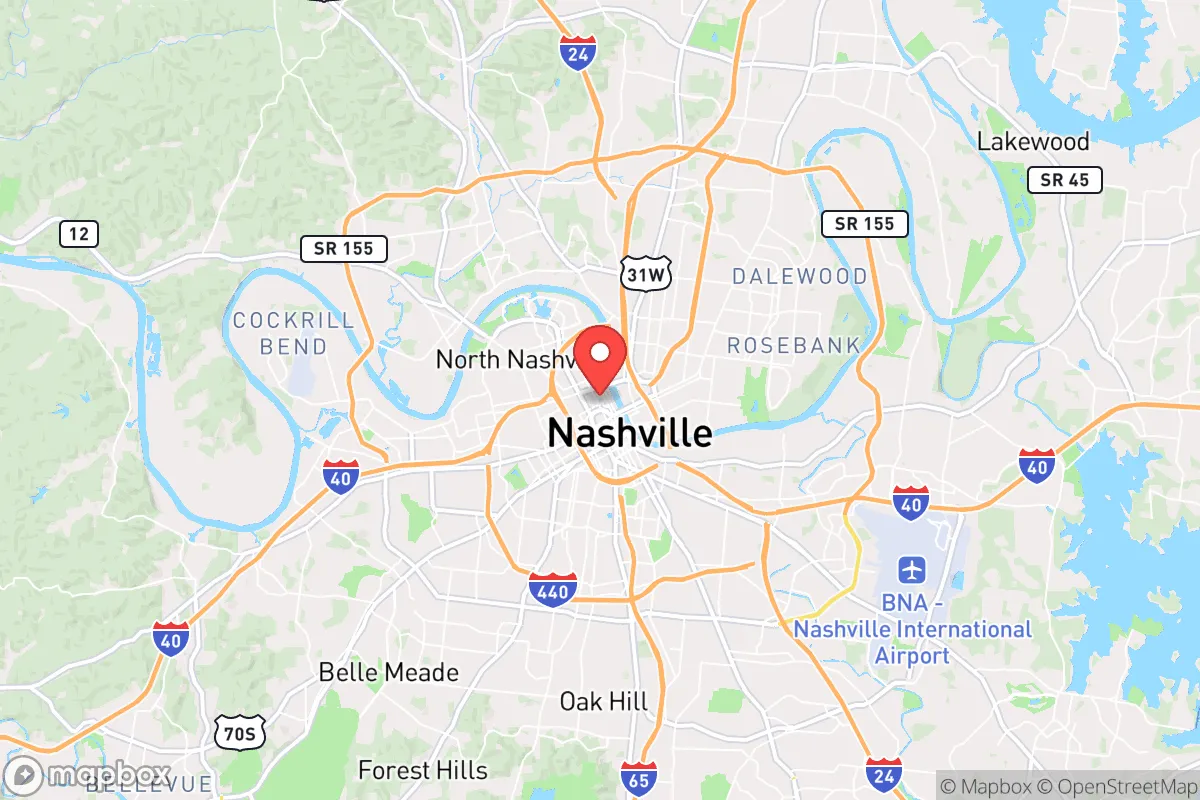
Photo: Wikipedia
Personal Sovereignty in Nashville, TN
Moderate friction. Expect trade-offs in some aspect of personal liberty and independence.
What does Personal Sovereignty tell us?
Personal Sovereignty measures your capacity for self-reliance and independence with minimal government friction. Higher scores mean fewer barriers between you and the way you want to live... but it assumes you have the space you need and good neighbors.
What does this tell us?
Personal Sovereignty measures your capacity for self-reliance and independence with minimal government friction. Higher scores mean fewer barriers between you and the way you want to live... but it assumes you have the space you need and good neighbors.
State Policy
Energy independence: Importer (25% of energy produced in-state)
Personal Liberty
Homesteading

Personal Liberty Analysis
Nashville, Tennessee, offers a notably high degree of personal sovereignty compared to many major U.S. cities, particularly for those who prioritize minimal government interference in daily life. The state’s political culture, rooted in a deep-seated skepticism of federal overreach, creates an environment where individual autonomy—from financial decisions to self-defense—is legally protected. For the strategic relocator, especially one with a survivalist or prepper mindset, Nashville represents a rare urban enclave within a state that actively pushes back against the creeping normalization of government control. However, the city’s rapid growth and blue-leaning local governance mean this sovereignty is not absolute; it requires constant vigilance and strategic navigation.
Tax burden and regulatory posture: How Tennessee’s fiscal policy protects your autonomy
Tennessee’s tax structure is a cornerstone of its pro-sovereignty posture. The state has no personal income tax on wages, a fact that immediately puts more money back into your hands rather than into government coffers. This is a direct check on state-level overreach, as it limits the government’s ability to fund expansive programs that often come with strings attached. Property taxes in Davidson County (Nashville) are moderate, with an effective rate around 0.7% of assessed value, though they have been creeping upward to fund infrastructure and schools. The state’s sales tax is high—9.25% in Davidson County—which is a regressive burden but one that you can partially control through consumption choices. From a regulatory standpoint, Tennessee is a right-to-work state with minimal business licensing hurdles, making it easier to start a side hustle, a homesteading operation, or a small preparedness supply business without drowning in red tape. The state’s regulatory environment is generally hostile to new federal mandates, and local zoning in Nashville, while more restrictive than rural areas, still allows for considerable personal property use compared to cities like Portland or Seattle.
Self-defense and gun law specifics: What the Second Sanctuary means for your rights
Tennessee is a constitutional carry state, meaning no permit is required to carry a concealed handgun for anyone 21 or older who is legally allowed to possess a firearm. This is a direct assertion of individual sovereignty over the state’s ability to regulate self-defense. Nashville, despite its urban character, falls under this state preemption, which means local officials cannot pass stricter gun laws than the state allows—a critical safeguard against city-level overreach. The state also has a strong “Stand Your Ground” law, with no duty to retreat in any place you are lawfully present. For the prepper, this means your vehicle, home, and even your campsite are legally defensible spaces. Magazine capacity is not restricted, and there is no state-level firearm registry. However, be aware that Nashville’s Metro Council has occasionally pushed symbolic resolutions against state preemption, and the city’s police department has been known to enforce federal firearm regulations more aggressively than rural counties. The practical takeaway: your right to keep and bear arms is robust, but you should stay informed about local enforcement trends and avoid federal gun-free zones like federal buildings.
Self-reliance and homesteading viability: Lot sizes, zoning, and off-grid feasibility in Davidson County
True off-grid homesteading within Nashville’s urban core is challenging due to zoning density and utility requirements. Most residential lots in the city are under 0.25 acres, and the Metro code mandates connection to municipal water and sewer in most areas, making complete independence from city utilities difficult. However, the picture changes dramatically as you move to the county’s periphery. Areas like Antioch, Joelton, and the far reaches of Bellevue offer lots of 1 to 5 acres, where you can keep chickens, maintain a substantial garden, and even raise small livestock under agricultural zoning. Rainwater collection is legal but must not interfere with municipal drainage, and solar panels are permitted without excessive permitting hurdles. The state’s right-to-farm laws provide some protection against nuisance complaints from new neighbors, a common issue in growing areas. For the serious prepper, the best strategy is to buy land in adjacent counties like Cheatham or Williamson, where zoning is far more permissive and property taxes are lower, while maintaining a Nashville address for work and community access. The city’s building codes are modern but not draconian; you can build a pole barn or a workshop without a lengthy approval process as long as it meets basic structural standards.
Personal liberties: Parental rights, medical autonomy, speech, and property protections
Tennessee has been a battleground for parental rights, with recent legislation affirming that parents have the fundamental right to direct the upbringing, education, and healthcare of their children. This includes the ability to opt out of school curricula, vaccine mandates, and mask requirements without government interference. Nashville’s public schools, while generally left-leaning, are subject to state laws that limit the teaching of critical race theory and gender ideology in K-8 classrooms, a direct check on local school board overreach. Medical autonomy is strong: Tennessee has no state-level vaccine passport system, and the state has passed laws protecting healthcare workers who refuse to participate in procedures they find morally objectionable. However, the state’s medical marijuana program is extremely limited (only CBD oil for specific conditions), so those seeking full cannabis access will be disappointed. Free speech is robustly protected under the Tennessee Constitution, and the state has a specific law prohibiting the “cancellation” of speakers at public universities. Property rights are reinforced by a strong eminent domain statute that requires “public use” and just compensation, though Nashville’s rapid development has seen some controversial takings for stadiums and transit projects. The key vulnerability is that local ordinances can still infringe on property use through historic preservation overlays and tree protection rules, so always check the specific zoning for any property you consider.
In the broader landscape of American cities, Nashville stands out as a place where personal sovereignty is not just tolerated but actively defended by state law. The combination of no income tax, constitutional carry, strong parental rights, and a regulatory environment that favors individual action over collective mandates creates a rare urban refuge for those who value self-reliance. The trade-offs are real: high sales tax, a growing local government that sometimes chafes against state preemption, and a housing market that makes land ownership expensive. But for the strategic relocator who understands that sovereignty is a spectrum, not a binary, Nashville offers a solid foundation. It is not a libertarian utopia, but it is a city where a determined individual can live largely on their own terms, with the state acting as a shield against federal overreach rather than a sword of control. If you are looking for a base of operations in a volatile world, Nashville’s balance of urban opportunity and constitutional protections makes it a serious contender.

* Values derived from national, state, county, city and local statistics and may differ in a specific area. Last updated: 2026-04-22T01:24:46.000Z
Narrative content on this page is AI-generated and may contain mistakes. Verify any details that matter before acting on them.
ReloMaps may earn a commission from affiliate links at no extra cost to you.

