Photo: Wikipedia
Demographics of Nebraska City, NE
Affluence Level in Nebraska City, NE
A middle-class area roughly in line with national averages across income, home values, education, and employment.
People of Nebraska City, NE
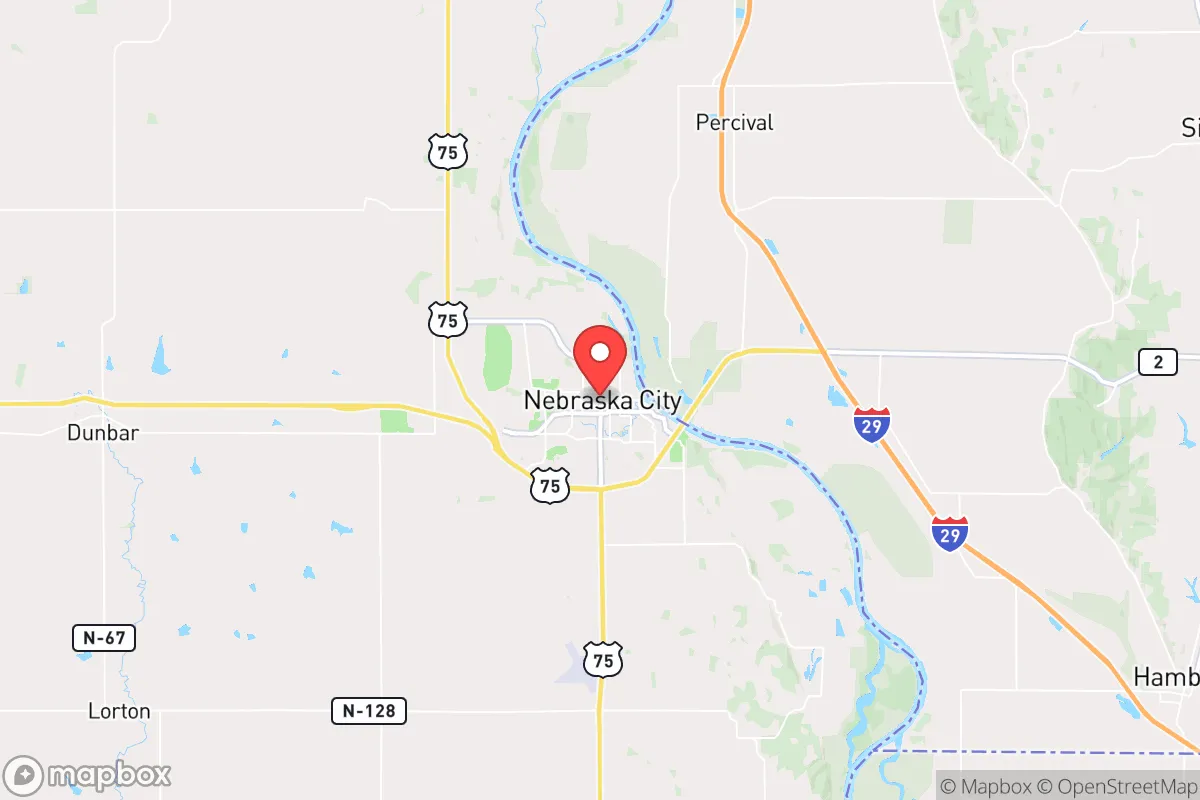
Nebraska City, Nebraska, is a community of 7,287 residents that blends deep-rooted pioneer heritage with a growing Hispanic presence, creating a demographic profile distinct from the state’s larger urban centers. The city is predominantly white (79.4%) but has a notable Hispanic population (14.2%) and a foreign-born share of 10.8%, well above the Nebraska average of 7.6%. With a college attainment rate of 25.5%, the population is less formally educated than the state average, reflecting its historical role as an agricultural and manufacturing hub. The city’s character is one of stability and modest growth, where established families and newer immigrant communities coexist in a setting that remains culturally conservative and community-oriented.
How the city was settled and grew
Nebraska City’s population history begins with its founding in 1854 as a Missouri River port and a key supply point for westward expansion. The original settlers were predominantly white Anglo-Saxon Protestants from the Upper Midwest and New England, drawn by the promise of fertile farmland and the economic opportunities of river trade. The city’s early growth was fueled by the establishment of the Nebraska City-Fort Kearny Cutoff, a major overland route, and the arrival of the Burlington and Missouri River Railroad in the 1870s. The Old Town district, centered around Central Avenue and the riverfront, became the initial residential and commercial core, housing merchants, steamboat workers, and railroad laborers. By the late 19th century, German and Czech immigrants arrived to work in the city’s growing flour mills and brick yards, settling in the South Side neighborhood along South 11th Street, where modest frame homes and ethnic churches still stand. The city’s population peaked at around 7,500 in the 1890s, then plateaued as agricultural mechanization reduced the need for farm labor and the river trade declined.
Modern era (post-1965)
After the 1965 Immigration and Nationality Act, Nebraska City saw a gradual but significant demographic shift. The white population, which was over 95% in 1970, began a slow decline as younger residents moved to Lincoln or Omaha for college and white-collar jobs. Meanwhile, the Hispanic population grew from a negligible share to 14.2% by the 2020s, driven by Mexican and Central American immigrants recruited for work in the city’s meatpacking plants and agricultural processing facilities. The West Hills subdivision, developed in the 1980s and 1990s west of Highway 75, absorbed many of the new Hispanic families, while the North Park area near the Arbor Day Farm became a mixed-income zone where white and Hispanic residents live in close proximity. The Black population remains very small at 1.6%, and East/Southeast Asian and Indian subcontinent communities are essentially absent (0.0% each), making Nebraska City’s diversity almost entirely a story of white and Hispanic coexistence. The foreign-born share of 10.8% is notably high for a city of this size, indicating that immigration continues to be a primary driver of population stability.
The future
Nebraska City’s population is likely to remain stable or grow modestly over the next 10–20 years, with the Hispanic share continuing to rise as younger white residents leave for larger cities. The city is not homogenizing into a single cultural bloc; rather, it is developing distinct enclaves. The Sunset Heights neighborhood, a newer development on the city’s western edge, is attracting white families seeking larger lots and newer homes, while the South Side and West Hills are becoming increasingly Hispanic. The immigrant community appears to be growing rather than plateauing, as the foreign-born share (10.8%) is higher than the national average for non-metro areas. However, assimilation is occurring: many second-generation Hispanic residents are bilingual and participate in local civic life, including school boards and city council. The college attainment rate of 25.5% is unlikely to rise sharply unless the city attracts more remote workers or retirees, which would require improved broadband and housing stock.
For someone moving in now, Nebraska City is becoming a more culturally layered place than its pioneer-era reputation suggests. The city offers a stable, low-crime environment with a strong sense of local identity, but the demographic trajectory points toward a future where Hispanic residents will constitute a larger share of the population, potentially reaching 20–25% by 2040. This is not a rapidly diversifying city in the urban sense, but a small, conservative community where the primary cultural dynamic is the integration of a growing Hispanic workforce into a historically white, agricultural society. New residents should expect a place where neighborly familiarity remains the norm, but where the language and traditions of the town are gradually broadening.

* Values derived from national, state, county, city and local statistics and may differ in a specific area. Last updated: 2026-09-21T19:02:29.000Z
Narrative content on this page is AI-generated and may contain mistakes. Verify any details that matter before acting on them.
ReloMaps may earn a commission from affiliate links at no extra cost to you.

