Photo: Wikipedia
Demographics of Hitchcock County
Affluence Level in Hitchcock County
A middle-class area roughly in line with national averages across income, home values, education, and employment.
People of Hitchcock County
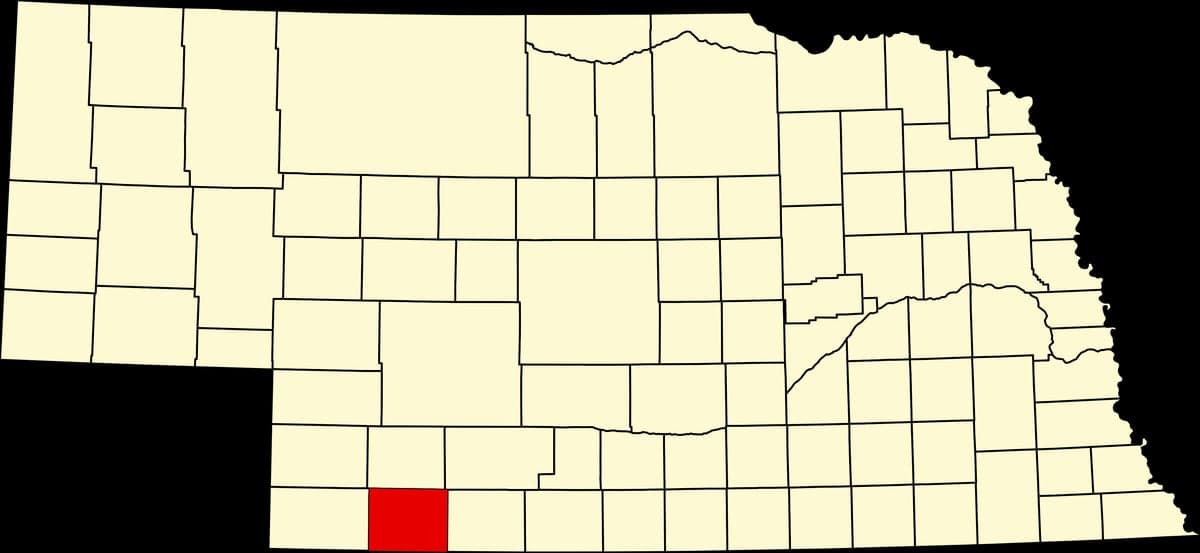
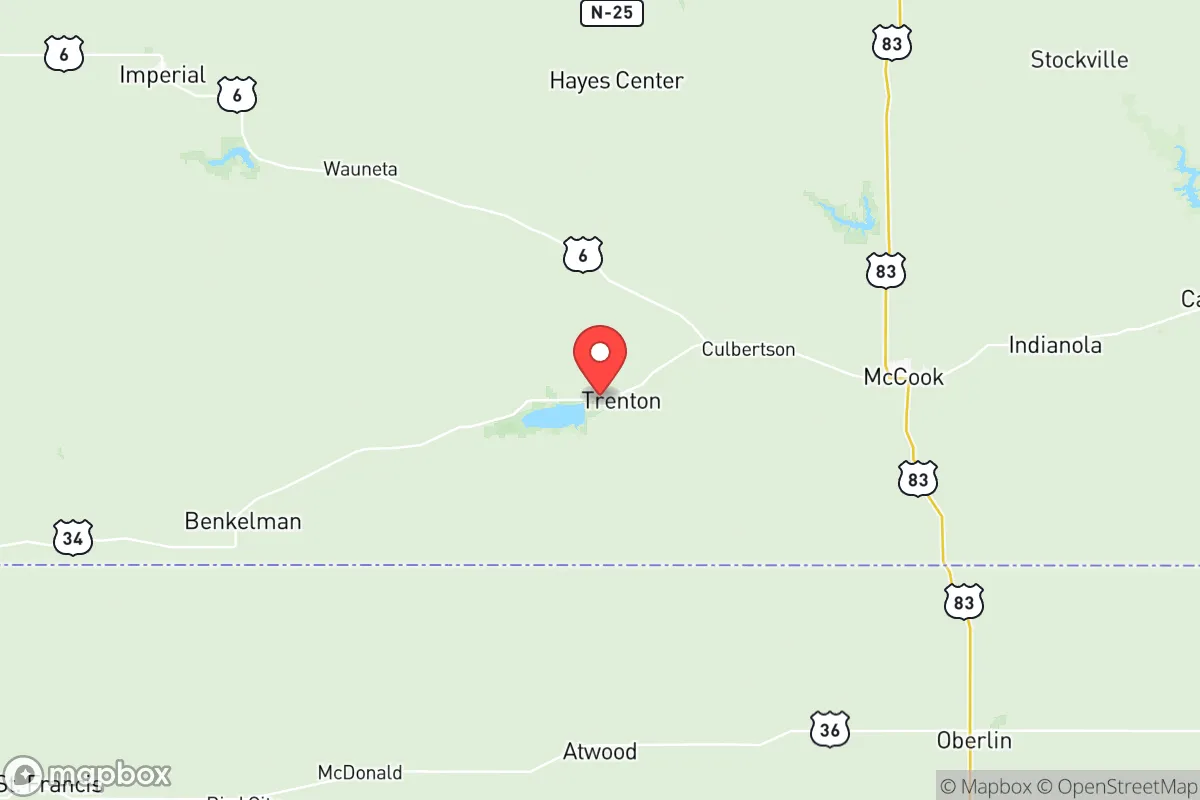
Hitchcock County, Nebraska, is a sparsely populated rural county where the population today is overwhelmingly white (92.6%) and native-born (99.7% U.S.-born), with a small Hispanic minority of 3.9%. With just 2,601 residents spread across the county's 710 square miles, the population density is under four people per square mile, and the largest town, Trenton, serves as the county seat with fewer than 600 residents. The county's identity is rooted in its agricultural heritage, with a population that is older (median age around 47) and less college-educated (19.8%) than the national average, reflecting a community shaped by generations of farming and ranching on the High Plains.
Settlement & growth (pre-1960)
Before American settlement, the area that is now Hitchcock County was part of the traditional territory of the Pawnee and, later, the Lakota Sioux, who used the Republican River valley for hunting bison. The region was largely bypassed by early European exploration, with no permanent Spanish or French settlements established in the immediate area. The first permanent American settlers arrived in the 1870s and 1880s, drawn by the Homestead Act of 1862, which offered 160 acres of land to anyone willing to farm it for five years. These early settlers were predominantly of Northern European stock — families from Germany, Sweden, and Denmark, along with a smaller number of English and Scots-Irish migrants moving west from earlier settlements in Iowa and Illinois.
The arrival of the Burlington and Missouri River Railroad in the 1880s spurred the founding of the county's towns. Trenton was platted in 1885 and became the county seat after a contentious election in 1886. Culbertson, located along the Republican River, grew as a railroad and trading center, while Stratton and Palisade (the latter straddling the Hitchcock-Hayes county line) emerged as agricultural service towns. The county's population peaked at 5,049 in the 1910 census, reflecting the peak of homesteading and dryland farming. German immigrants and their descendants formed the largest ethnic bloc, with many settling on farms around Swissvale (a now-unincorporated hamlet named for its Swiss settlers) and in the river valleys near Lamar.
The Dust Bowl of the 1930s hit Hitchcock County hard, as severe drought and wind erosion devastated the wheat and corn fields that had been plowed from native sod. Many families abandoned their homesteads during this period, and the county's population declined by nearly 30% between 1930 and 1940. Those who stayed shifted from wheat farming to more sustainable cattle ranching and irrigated agriculture, a transition that stabilized the economy but did not reverse the population loss. By 1960, the county's population had fallen to 3,229, a decline that would continue for decades as younger residents left for urban jobs in Denver, Omaha, and Lincoln.
Modern era (post-1965)
The 1965 Hart-Cellar Act, which dramatically reshaped U.S. immigration patterns, had virtually no impact on Hitchcock County. The county's foreign-born population today stands at just 0.3%, meaning that the demographic shifts that transformed urban and suburban America — large-scale immigration from Latin America, Asia, and the Middle East — largely passed this corner of Nebraska by. The small Hispanic population (3.9%) is primarily composed of Mexican-American families who moved into the area for agricultural work, particularly in the feedlots and irrigated cornfields around Trenton and Culbertson, but this community remains a modest minority rather than a growing enclave.
Domestic migration patterns have been the dominant force shaping the county since 1965, and that force has been overwhelmingly one of out-migration. The county's population dropped from 3,229 in 1960 to 2,601 by 2020, a decline of nearly 20% over six decades. Young adults have consistently left for college and urban employment, while the remaining population has aged in place. The county has not experienced the suburbanization or exurban growth seen in Nebraska's eastern counties; instead, the small towns of Stratton (population 310) and Palisade (population 320) have seen their main streets shrink as retail and services consolidated in larger regional centers like McCook, 30 miles to the east. The county's racial composition has remained remarkably stable: 92.6% white, with no significant Black (0.1%), Asian (0.3%), or Indian-subcontinent (0.0%) populations, reflecting the absence of both international immigration and domestic migration from more diverse regions.
The future
Hitchcock County's population is projected to continue its slow decline over the next 10-20 years, driven by an aging demographic structure and limited economic opportunities for younger families. The county's birth rate is below replacement level, and the small number of in-migrants — typically retirees returning to family land or a handful of remote workers seeking cheap rural property — is unlikely to offset natural decrease. The Hispanic population may grow modestly as agricultural labor needs persist, but the county is not positioned to become significantly more diverse; the foreign-born share is likely to remain below 1% for the foreseeable future.
The cultural identity of the county will remain rooted in its agricultural heritage and small-town values, with community life centered on churches, school sports, and county fairs in Trenton and Culbertson. The consolidation of school districts — Hitchcock County High School serves the entire county from its campus in Trenton — reflects both the population decline and the community's determination to maintain local institutions. The county is not becoming a destination for newcomers in any meaningful numbers; it is a place where families stay because they have deep roots, not because they are arriving from elsewhere.
For someone moving in now, Hitchcock County offers a quiet, affordable rural lifestyle with very low crime rates and strong community ties, but it also means accepting limited job opportunities, a long drive to major services, and a population that is older and less diverse than almost anywhere else in the United States. The county is becoming more, not less, homogeneous as it shrinks, and the next decade will likely see further consolidation of schools, churches, and businesses into the remaining towns. A move here is a choice for solitude, space, and tradition — not for growth, diversity, or economic dynamism.

* Values derived from national, state, county, city and local statistics and may differ in a specific area. Last updated: 2026-10-13T19:27:52.000Z
Narrative content on this page is AI-generated and may contain mistakes. Verify any details that matter before acting on them.
ReloMaps may earn a commission from affiliate links at no extra cost to you.

