Photo: Wikipedia
Political ClimatePolitical Climate in Hitchcock County
Showing district-level results — no local-only data available.
Local Political AnalysisPolitical Analysis of Hitchcock County
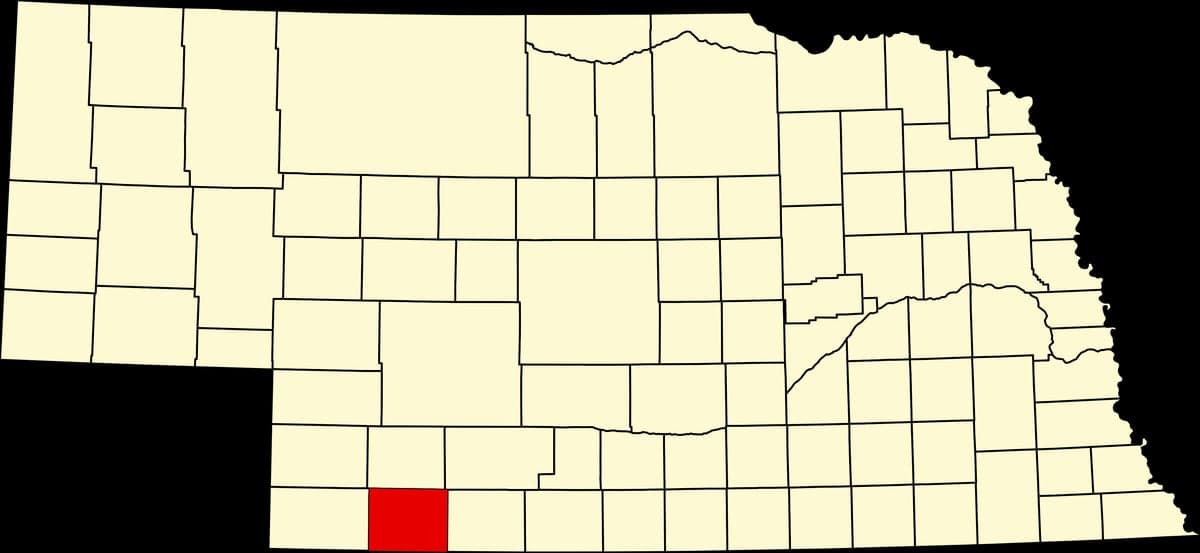
Hitchcock County, Nebraska, is one of the most reliably Republican areas in the state, carrying a Cook Partisan Voting Index (PVI) of R+27. That’s a deep red rating, meaning the county consistently votes about 27 points more Republican than the national average. For context, the state of Nebraska as a whole sits at R+10, so Hitchcock County is significantly more conservative than the state average. This isn’t a recent shift; the area has been a Republican stronghold for generations, and there’s little sign of that changing in the near future. The county’s political identity is deeply tied to its agricultural roots, small-town values, and a general skepticism of federal government overreach.
How it compares
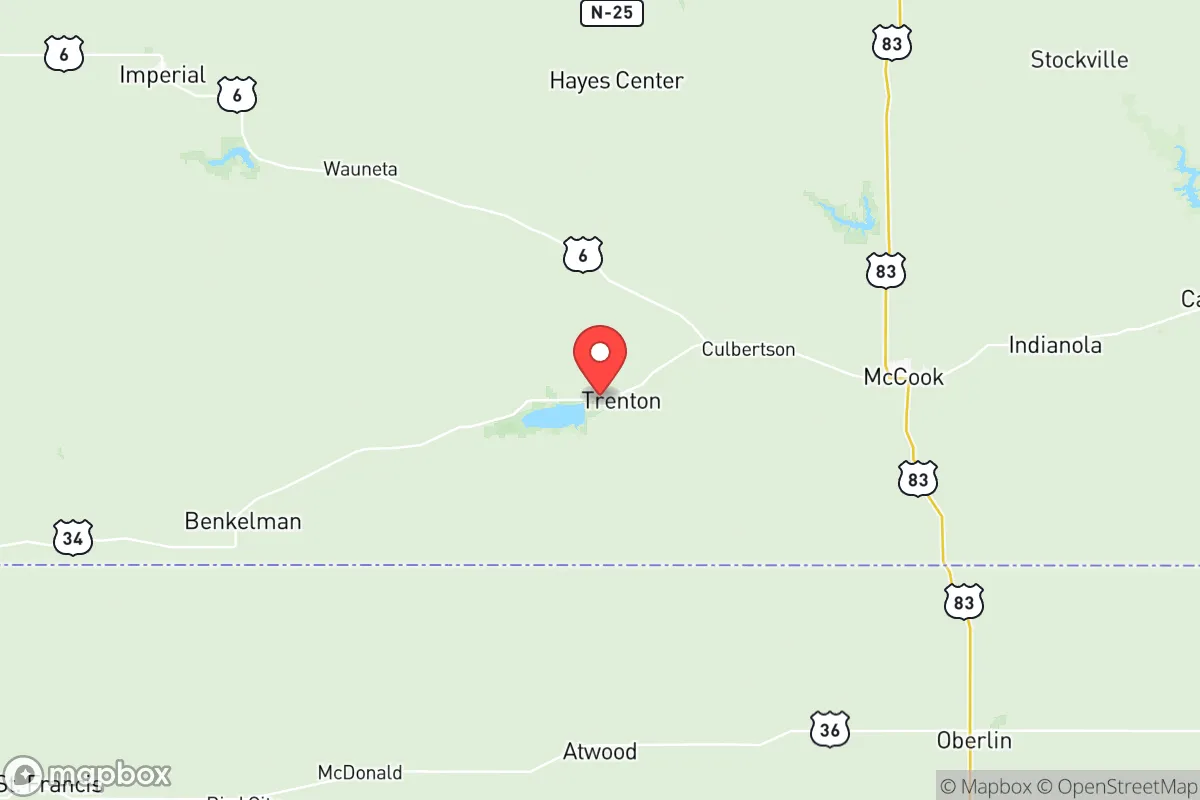
To understand how deep R+27 really is, compare it to Nebraska’s overall R+10. That 17-point gap is substantial. While Nebraska is already a reliably red state in presidential elections, Hitchcock County is in a different league entirely. Within the county, the political landscape is not entirely uniform. The county seat, Trenton, tends to be the most reliably Republican precinct, often delivering margins well above the county average. In contrast, the village of Culbertson, which sits along the Republican River and has a slightly more diverse economic base, can show a few more competitive precincts, though it still votes heavily Republican. The small community of Stratton is similar to Trenton in its deep red lean. There are no precincts in Hitchcock County that lean Democratic; the variation is between "very Republican" and "extremely Republican." This is a far cry from the more competitive areas of Nebraska, like the Omaha metro area (Douglas County, which leans Democratic) or even the more moderate suburbs of Lincoln. In Hitchcock County, a Democrat winning a local election would be a historic anomaly.
What this means for residents
For conservative residents, the political climate is comfortable and affirming. Local elected officials, from the county board to the school board, are almost universally Republican. Policy debates tend to focus on property taxes, agricultural regulations, and water rights—issues that resonate with the local base. For liberal residents, the reality is more isolating. They are a distinct minority, and their political views are rarely represented in local government or even in casual conversation. There is no organized Democratic party presence in the county, and progressive candidates rarely bother to campaign here. This doesn't mean open hostility, but it does mean that liberal residents often keep their political views private to avoid social friction. The practical effect is that the county’s policies—on everything from land use to public health—reflect a consistently conservative worldview, with little pushback from the left.
Culturally, Hitchcock County’s political lean is reinforced by its strong ties to agriculture, hunting, and outdoor recreation. The county is home to the Swanson Reservoir State Recreation Area, a popular spot for fishing and boating, and the local economy is heavily dependent on farming and ranching. This rural, self-reliant lifestyle naturally aligns with a conservative, limited-government philosophy. There are no major policy distinctions that set Hitchcock County apart from other deep-red rural Nebraska counties, but its extreme PVI rating does mean it is often cited as a bellwether for the most conservative elements of the state’s electorate. For anyone moving here, understanding that the political spectrum is narrow is essential—this is not a place where political debate is common or where moderate voices often hold sway.

State Political ClimatePolitical Climate in Nebraska
State Political AnalysisPolitical Environment in the State
Nebraska is a solidly Republican state with a Cook PVI of R+10, but its politics are far from monolithic. The state has a unique, nonpartisan unicameral legislature and a history of pragmatic, independent-minded governance, though the last decade has seen a sharp rightward shift on cultural and social issues. While the state hasn't flipped in a presidential race since 1964, the growing divide between its two major metro areas—deep-red Omaha suburbs and the reliably blue Lincoln—along with the overwhelming conservative dominance of its vast rural expanse, defines the real political landscape a new resident would experience.
Urban vs. rural divide
The political map of Nebraska is a story of three distinct regions. The eastern third is dominated by the Omaha metro (Douglas and Sarpy Counties) and Lincoln (Lancaster County). Omaha itself is a competitive swing area; Douglas County has voted for the Democratic presidential candidate in three of the last four cycles, while the fast-growing suburban communities of Papillion, La Vista, and Gretna in Sarpy County are reliably Republican and have become a key driver of the state's overall red lean. Lincoln, home to the University of Nebraska, is the state's most reliably Democratic stronghold, consistently voting blue by double digits. The rest of the state—from the Sandhills to the Panhandle—is deeply Republican. Counties like Scotts Bluff (home to Gering and Scottsbluff) and Buffalo (Kearney) routinely vote 70-80% Republican. The 2nd Congressional District, which covers the Omaha metro, is the only competitive federal seat in the state and has split its tickets in recent years, awarding one electoral vote to Barack Obama in 2008 and Joe Biden in 2020.
Policy environment
Nebraska's policy environment is defined by fiscal conservatism and a recent shift toward cultural conservatism. The state has no personal or corporate income tax on the horizon, but it does have a progressive income tax structure with a top rate of 6.84%, which the legislature has been slowly reducing. Property taxes are a perennial hot-button issue, consistently ranking among the highest in the nation relative to home values. The state is a "right-to-work" state and has a strong regulatory posture favoring agricultural and energy development, including the Keystone XL pipeline route. On education, Nebraska has seen a major push for school choice, including the passage of a controversial tax-credit scholarship program in 2023. Election laws are moderately restrictive: voters must show a valid photo ID (a law passed in 2023 and effective in 2024), and the state has no-excuse absentee voting but requires a notarized signature or witness for mail ballots. The state also has a unique "winner-take-all" system for its presidential electoral votes, though a 2023 bill to revert to a district-based system (which would make the 2nd District competitive) failed.
Recent policy direction
The last three years have seen a dramatic acceleration of conservative policy in Nebraska. In 2023, the legislature passed a near-total abortion ban after 12 weeks of pregnancy, with exceptions for rape, incest, and medical emergencies, overriding a gubernatorial veto. The same session saw the passage of a permitless concealed carry law, allowing any legal gun owner to carry a concealed firearm without a permit. On parental rights, the state passed a "Parents' Bill of Rights" in 2022, requiring schools to notify parents of curriculum changes and allowing them to opt their children out of certain materials. A 2023 law banned gender-affirming care for minors, a move that has drawn national attention and legal challenges. On the economic front, the state has aggressively cut taxes, including a 2023 bill that reduced the top individual income tax rate from 6.84% to 5.84% by 2027. Property tax relief remains a central but unresolved issue, with multiple proposals failing to gain traction. The state has also moved to restrict ballot initiatives, passing a law in 2024 that requires any initiative to gather signatures from 5% of registered voters in each of the state's 49 legislative districts, a significant hurdle for grassroots campaigns.
Civil unrest & political movements
Nebraska has not seen the kind of large-scale civil unrest seen in coastal states, but there have been notable flashpoints. The 2020 George Floyd protests in Omaha and Lincoln were largely peaceful, though Omaha saw some property damage and a heavy police presence. The most visible political movements in recent years have been around abortion rights and transgender rights. In 2024, a coalition of progressive and moderate groups successfully gathered enough signatures to put a constitutional amendment protecting abortion access on the November ballot, a direct response to the 12-week ban. This has energized both sides, with conservative groups like the Nebraska Family Alliance mobilizing heavily. Immigration politics are less volatile than in border states, but the issue flared up in Grand Island and South Sioux City, where meatpacking plants have drawn a significant immigrant workforce, leading to local debates over housing and social services. There is no sanctuary city movement of note; the state passed a law in 2021 requiring local law enforcement to cooperate with federal immigration authorities. Election integrity has been a recurring theme, with the 2020 and 2022 cycles seeing baseless claims of fraud from some local GOP figures, though the state's Republican Secretary of State, Bob Evnen, has consistently defended the security of Nebraska's elections.
Projection
Over the next 5-10 years, Nebraska's political trajectory is likely to continue its rightward shift on cultural issues while maintaining its fiscal conservatism. The key demographic driver is the growth of the Omaha suburbs—Papillion and Gretna are among the fastest-growing cities in the state—which will reinforce the Republican lean of the 2nd District. However, Lincoln's continued growth as a university and state government hub will keep the eastern I-80 corridor competitive. The biggest wildcard is the abortion ballot initiative in 2024; if it passes, it could signal a limit to the legislature's cultural conservatism and potentially moderate future policy. In-migration is modest compared to Sun Belt states, but the state is attracting some remote workers and retirees from high-tax states like California and Illinois, which could slightly moderate the tax-cut push. A new resident moving in now should expect a state that is reliably Republican but with a functioning, if increasingly partisan, unicameral legislature where a handful of moderate Republicans and Democrats can still wield significant influence.
For a new resident, the practical takeaway is that Nebraska offers a stable, low-regulation environment for business and a strong sense of community, but with a rapidly hardening conservative stance on social issues. If you're a conservative, you'll find a state that largely aligns with your values on taxes, guns, and parental rights, with a legislature that is actively pushing those priorities. If you're a liberal, you'll find a small but resilient progressive community in Lincoln and parts of Omaha, but you should be prepared for a state government that is increasingly hostile to your views on abortion, transgender rights, and public education. The state's unique nonpartisan legislature means that personal relationships and local issues often matter more than party labels, but that tradition is under strain as national polarization seeps into local politics. In short, Nebraska is a place where your vote matters less in statewide races but can still make a difference in local school board and city council elections, which is where the real battles over the state's future are being fought.
* Values derived from national, state, county, city and local statistics and may differ in a specific area. Last updated: 2026-10-13T19:27:52.000Z
Narrative content on this page is AI-generated and may contain mistakes. Verify any details that matter before acting on them.
ReloMaps may earn a commission from affiliate links at no extra cost to you.

