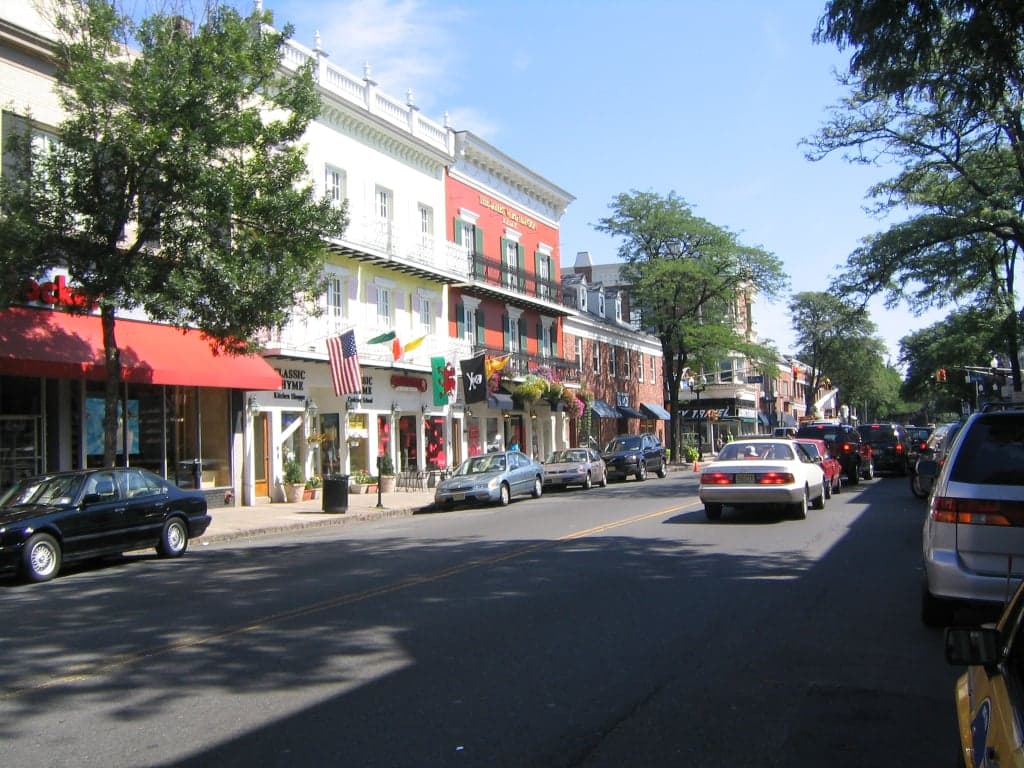
Photo: Wikipedia
Demographics of Union County
Affluence Level in Union County
An upper-middle-class area. Household wealth, education levels, and homeownership run ahead of national benchmarks.
People of Union County
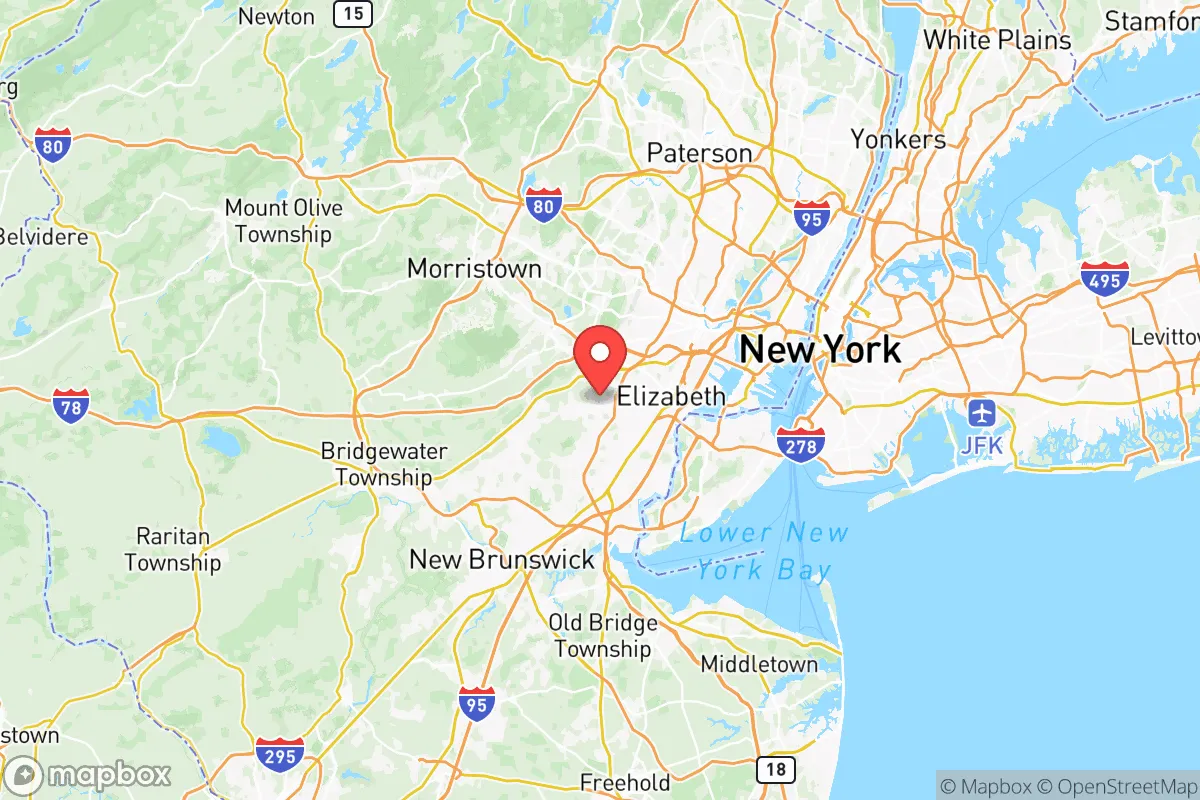
Union County, New Jersey, is one of the most densely populated and ethnically diverse counties in the United States, home to 572,549 residents packed into just over 100 square miles. Its character is defined by a dense patchwork of historic industrial cities and leafy suburbs, where a majority-minority population—36.3% White, 34.4% Hispanic, 19.6% Black, 3.4% East/Southeast Asian, and 2.2% Indian—lives in close proximity. The county’s identity is a layered story of successive immigrant waves, from German and Irish laborers building the railroads to Puerto Rican and Dominican families reshaping the urban core, creating a place where old ethnic enclaves coexist with new ones.
Settlement & growth (pre-1960)
Before European colonization, the area now known as Union County was the territory of the Lenape people, specifically the Unami and Munsee bands, who lived in seasonal villages along the Rahway and Elizabeth Rivers. Dutch and English settlers began arriving in the mid-1600s, with the first permanent European settlement established in 1664 as Elizabeth, named after the wife of Sir George Carteret, one of the colony’s proprietors. Elizabeth became the first capital of New Jersey and a key port and market town for the surrounding agricultural region.
The 19th century brought transformative waves of immigration. From the 1840s through the 1880s, German and Irish immigrants poured into Elizabeth and Newark (then part of Essex County, but closely tied to Union’s industrial growth) to work on the railroads, in the Singer Sewing Machine factory in Elizabeth, and in the burgeoning chemical and oil refining industries along the Arthur Kill. The county was officially formed in 1857 from portions of Essex County, with Elizabeth as the county seat. By the 1880s, Italian immigrants began arriving in large numbers, settling in Elizabeth’s First Ward and in Linden, where they found work in the Standard Oil refineries and the General Motors assembly plant. Polish and Eastern European Jewish immigrants followed between 1890 and 1920, establishing tight-knit communities in Hillside and Union Township, often working in the region’s textile mills, breweries, and shipyards along the Elizabeth River.
The Great Migration of African Americans from the rural South began in earnest during World War I and accelerated through the 1940s and 1950s. Black families moved into Elizabeth and Plainfield, drawn by industrial jobs in the Singer plant, the Merck pharmaceutical complex in Rahway, and the sprawling railroad yards. By 1960, Union County was a classic industrial-suburban mix: dense, working-class ethnic neighborhoods in the cities, and rapidly growing, predominantly white suburbs like Westfield and Summit, which attracted commuters to New York City via the newly expanded rail lines.
Modern era (post-1965)
The 1965 Hart-Cellar Act fundamentally reshaped Union County’s demographics. The first major post-1965 wave was Puerto Rican migration, which had begun in the 1950s but surged in the 1970s and 1980s as manufacturing jobs declined and families sought better opportunities. Puerto Ricans concentrated heavily in Elizabeth and Plainfield, where they replaced departing white ethnic populations. By the 1990s, Dominican, Colombian, and Ecuadorian immigrants arrived in significant numbers, further diversifying the Hispanic population. Today, Elizabeth is over 65% Hispanic, with a strong Dominican and Puerto Rican presence, while Plainfield has a large Colombian and Ecuadorian community.
Simultaneously, the 1970s and 1980s saw African American families move from the cities into inner-ring suburbs like Hillside and Roselle, driven by fair housing laws and the desire for better schools. Hillside is now roughly 60% Black, while Roselle is over 50% Black, with significant Afro-Caribbean populations from Haiti and Jamaica. The county’s Black population peaked at around 22% in the 1990s and has since stabilized near 20%.
The post-1965 era also brought East/Southeast Asian immigration, though on a smaller scale than in neighboring Middlesex County. Chinese and Korean families settled in Edison (just across the border in Middlesex) and in Union Township and Summit, where they are drawn to the strong school systems. The Indian population, while only 2.2% countywide, is concentrated in Scotch Plains and Fanwood, where families are attracted to the high-performing public schools and proximity to pharmaceutical and tech jobs in the I-78 corridor. The county’s foreign-born population stands at 16.0%, a figure that has remained relatively stable since 2000, as new immigration has been offset by the out-migration of established families to more affordable areas in Pennsylvania and the South.
The future
Union County is not homogenizing; rather, it is tribalizing into distinct ethnic and economic enclaves. The Hispanic population, now 34.4%, is projected to continue growing, particularly in Elizabeth and Plainfield, where it is already the majority. The White population, concentrated in Westfield, Summit, and New Providence, is aging and slowly declining, though these towns remain among the wealthiest and most politically influential in the county. The Black population is plateauing, with younger Black families increasingly moving to exurban counties like Union County’s own Berkeley Heights or further south to Monmouth and Ocean counties. East/Southeast Asian and Indian communities are growing modestly, driven by professional-class families seeking top-ranked school districts, but they remain a small share of the overall population.
The next 10-20 years will likely see continued Hispanic growth in the urban core, with Elizabeth becoming even more predominantly Hispanic, while the western suburbs remain predominantly White and affluent. The county’s overall population is expected to remain stable or grow slowly, as high housing costs and limited land constrain new development. The cultural identity of Union County is becoming more Latino-influenced, particularly in its politics, cuisine, and public life, but the county remains deeply fragmented by race and class, with each town maintaining its own distinct character.
For someone moving in now, Union County offers a choice: dense, diverse, and affordable urban life in Elizabeth or Plainfield, or quiet, expensive, and predominantly white suburban life in Westfield or Summit. The county is not becoming a melting pot, but a mosaic—each piece distinct, with its own history and trajectory. The bottom line: Union County is a place where the American immigrant story continues to unfold, but in separate streams, not a single river.

* Values derived from national, state, county, city and local statistics and may differ in a specific area. Last updated: 2026-05-18T12:37:20.000Z
Narrative content on this page is AI-generated and may contain mistakes. Verify any details that matter before acting on them.
ReloMaps may earn a commission from affiliate links at no extra cost to you.

