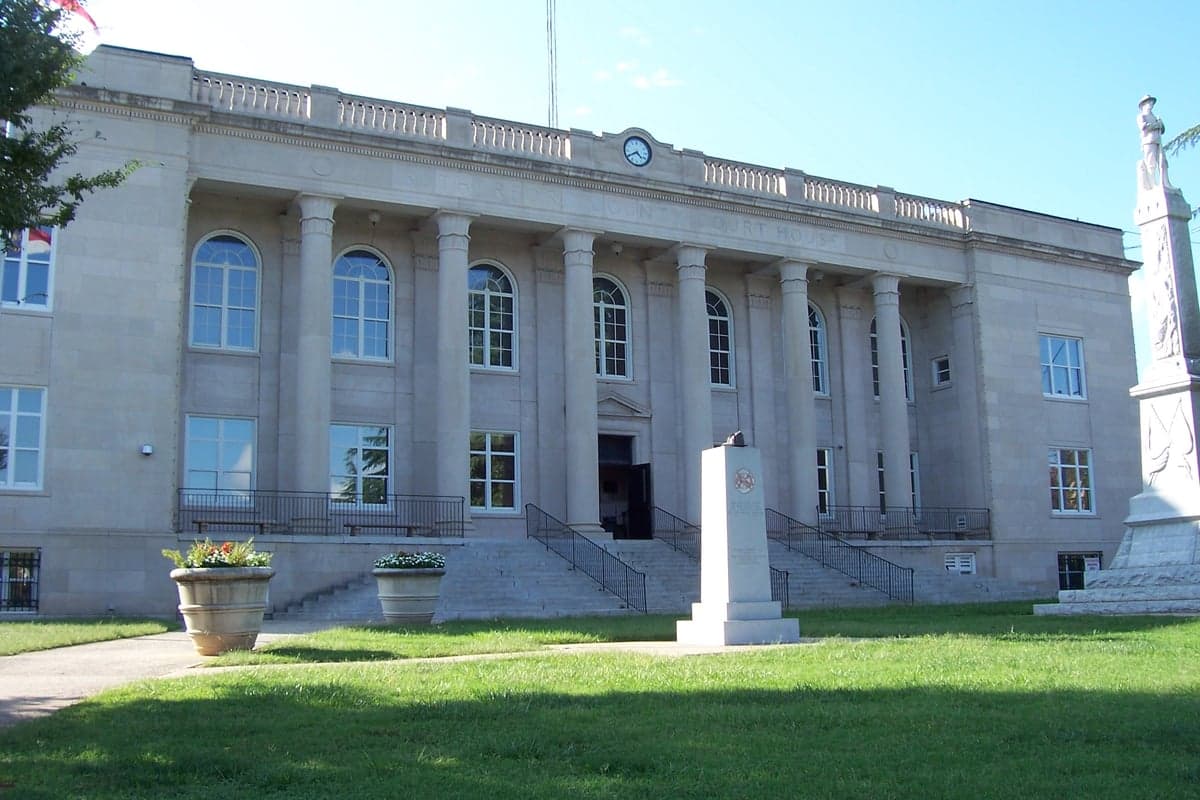
Photo: Wikipedia
Demographics of Rutherford County
Affluence Level in Rutherford County
A low-income area with significant economic hardship. Household wealth and educational attainment are well below national averages.
People of Rutherford County
Rutherford County, North Carolina, is home to roughly 64,850 people, a population that remains overwhelmingly white (81.1%) and native-born, with only 1.6% of residents born outside the United States. The county’s identity is rooted in a Scots-Irish and English pioneer heritage, a deep agricultural and textile-manufacturing history, and a distinctly rural, church-centered culture that still shapes daily life from Forest City to Spindale. This is not a county transformed by recent immigration; it is a place where the demographic story is one of persistence, out-migration of the young, and a slow, modest diversification led primarily by Hispanic families.
Settlement & growth (pre-1960)
Long before European settlers arrived, the area that is now Rutherford County was the hunting and trading ground of the Cherokee Nation, who used the Broad River and its tributaries as travel corridors. The Cherokee presence was decisively ended in the 1770s, when Anglo-American settlers, primarily of Scots-Irish and English descent, began pushing west from the Piedmont of Virginia and the Carolinas. These were not wealthy planters but subsistence farmers and frontiersmen, drawn by cheap land grants and the promise of the fertile valleys around the Broad River. The county itself was formed in 1779, and the town of Rutherfordton, established in 1787, became the political and commercial hub for these early pioneers.
Throughout the 19th century, the population remained remarkably homogeneous. The county seat of Rutherfordton and the surrounding rural areas were settled by the same Scots-Irish and English stock, with a small but significant population of enslaved African Americans working on larger farms and in the gold mines that briefly boomed in the 1830s. The post-Civil War era brought emancipation, and a freed Black community established itself in Rutherfordton and in the mill villages that began to spring up along the rivers. The arrival of the railroad in the 1880s and 1890s was the single most transformative event, sparking the creation of new towns like Forest City, Spindale, and Caroleen. These towns were built around textile mills, which recruited heavily from the surrounding countryside, pulling poor white farmers off the land and into the mill villages. This internal migration, not immigration, defined the county’s growth through the early 20th century.
The textile industry dominated the local economy and population patterns from 1900 through the 1960s. Mill villages like Henrietta and Ruth housed thousands of workers, and the county’s population peaked in the 1950s as the mills ran at full capacity. This was a closed, insular society; the foreign-born population was negligible, and the county’s few immigrant families—often Italian or Eastern European engineers or merchants—were scattered and quickly assimilated. The Great Depression and World War II saw some out-migration to Northern industrial cities, but the mills kept the county’s population stable and its cultural character firmly Southern, Protestant, and working-class.
Modern era (post-1965)
The 1965 Hart-Cellar Act, which reshaped American immigration, had almost no direct impact on Rutherford County. Unlike the booming Sun Belt metros of Charlotte or Raleigh, Rutherford County did not attract new immigrant communities. The foreign-born share of the population today stands at just 1.6%, a figure that has barely moved in decades. The county’s modern demographic story is instead one of domestic shifts and industrial decline. As the textile mills began closing in the 1970s and 1980s, the county experienced a steady out-migration of working-age residents seeking jobs elsewhere. The population stagnated, and the county became older and more economically distressed.
The most significant demographic change since 1965 has been the gradual growth of the Hispanic population, which now stands at 5.4% of the county’s residents. This community, which began arriving in the 1990s and 2000s, was drawn not by the dying textile mills but by agricultural work—primarily in the apple orchards around Edneyville and the nurseries and Christmas tree farms in the county’s western hills—and by construction and poultry processing jobs. Hispanic families have concentrated most visibly in Forest City and Spindale, where they have established small businesses and churches, but they remain a modest share of the population compared to neighboring counties. The Black population, at 8.1%, is largely descended from the county’s historic mill-village and rural communities, with the highest concentrations still found in Spindale, Forest City, and the older neighborhoods of Rutherfordton.
Domestic migration has been the other quiet force reshaping the county. Since the 1990s, Rutherford County has seen a slow but steady influx of retirees and remote workers from the Charlotte metro area, drawn by lower housing costs and the proximity to Lake Lure and the Blue Ridge Mountains. This has brought a small but noticeable wave of newcomers to the Lake Lure and Chimney Rock areas, as well as to the gated communities and lakefront developments that have sprung up along the Broad River. These newcomers are typically more affluent and more likely to be college-educated than the native population, but they are also overwhelmingly white, meaning they have reinforced rather than diversified the county’s racial makeup. The county’s college-educated share of 20.7% remains well below the national average, a reflection of the limited white-collar job market and the out-migration of younger residents who leave for college and do not return.
The future
Rutherford County is likely to remain one of North Carolina’s least diverse counties over the next two decades. The Hispanic population is projected to continue growing slowly, perhaps reaching 8-10% of the total by 2040, as existing families have children and a trickle of new workers arrives for agricultural and light manufacturing jobs. This growth will be dispersed rather than concentrated, spreading from Forest City and Spindale into the surrounding rural townships. The East/Southeast Asian population, at just 0.5%, and the Indian-subcontinent population, at effectively 0.0%, are not expected to change meaningfully; there is no economic engine or university presence to attract these groups.
The larger demographic question is whether the county can reverse its decades-long pattern of losing its young people. The aging of the native white population, combined with the continued arrival of retirees, will likely make the county older and more dependent on healthcare and service jobs. The growth of remote work may bring a new wave of younger families to the Lake Lure and Rutherfordton areas, but this will be a modest counterweight to the overall trend. The county’s cultural identity—Southern, rural, and politically conservative—is likely to persist, though the increasing Hispanic presence in the schools and churches of Forest City and Spindale will continue to introduce a new cultural layer to the community.
For someone moving to Rutherford County today, the bottom line is this: you are entering a community that is stable, historically rooted, and still overwhelmingly native-born and white. The county offers a low cost of living, a strong sense of local identity, and a slower pace of life, but it is not a place of rapid demographic change or cultural flux. The Hispanic community is growing and will continue to do so, but integration is gradual and largely unremarkable. The most significant change on the horizon is not who is moving in, but who is leaving—the county’s young people—and the steady, quiet aging of the population that remains. If you are looking for a place where the past is still present, and where the population is more likely to shrink than to transform, Rutherford County fits that description precisely.

* Values derived from national, state, county, city and local statistics and may differ in a specific area. Last updated: 2026-10-09T03:10:58.000Z
Narrative content on this page is AI-generated and may contain mistakes. Verify any details that matter before acting on them.
ReloMaps may earn a commission from affiliate links at no extra cost to you.

