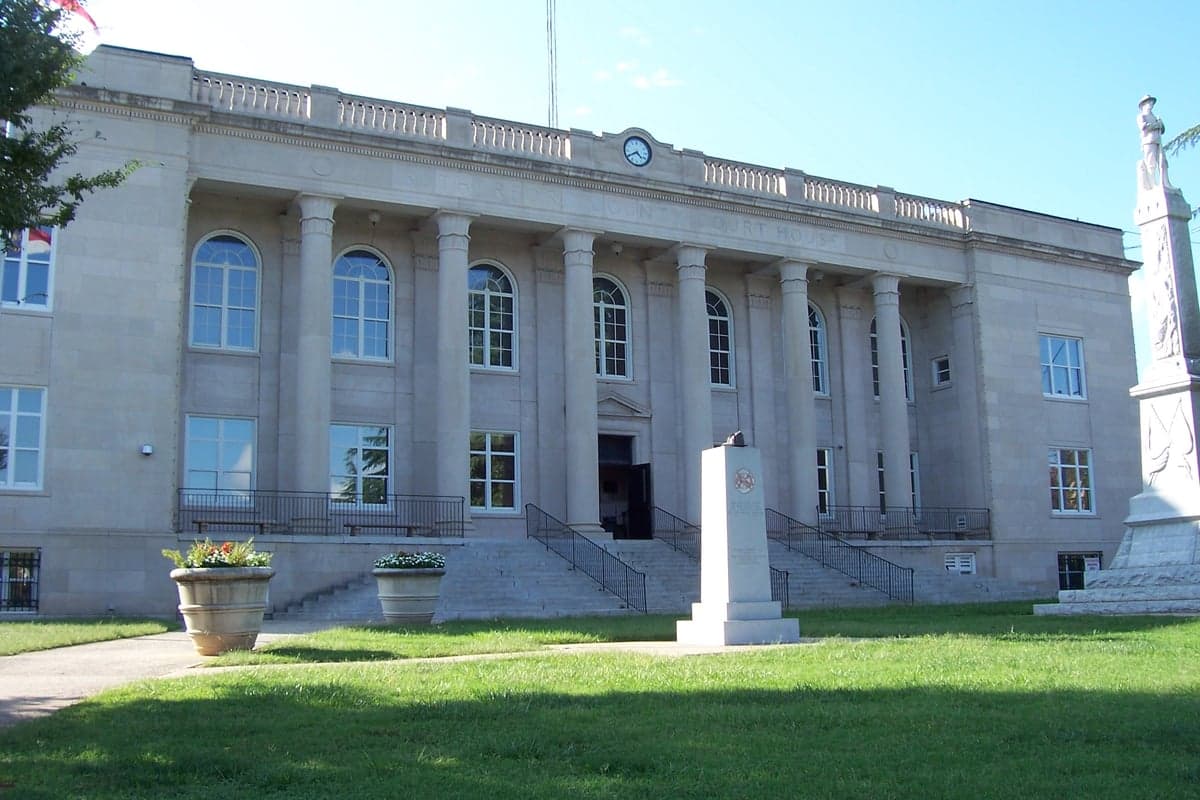
Photo: Wikipedia
Personal Sovereignty in Rutherford County
Viable for self-reliance. Generally workable, though some barriers may limit total independence.
What does Personal Sovereignty tell us?
Personal Sovereignty measures your capacity for self-reliance and independence with minimal government friction. Higher scores mean fewer barriers between you and the way you want to live... but it assumes you have the space you need and good neighbors.
What does this tell us?
Personal Sovereignty measures your capacity for self-reliance and independence with minimal government friction. Higher scores mean fewer barriers between you and the way you want to live... but it assumes you have the space you need and good neighbors.
State Policy
Energy independence: Importer (15% of energy produced in-state)
Personal Liberty
Homesteading

Personal Liberty Analysis
Rutherford County, North Carolina, offers a notably high degree of personal sovereignty compared to the urbanized Piedmont Crescent, with a regulatory environment that leans light-touch on property use, self-defense, and taxation. The county seat of Rutherfordton and the larger town of Forest City anchor a region where local governance is generally deferential to individual decision-making, though the autonomy picture shifts meaningfully between the county’s eastern industrial corridor and its western mountain towns like Lake Lure and Chimney Rock. For a single individual or family prioritizing independence, the practical question is less about whether Rutherford County is free — it is — and more about which specific township’s character matches your version of self-reliance.
How the tax burden and regulatory posture compare across the county
North Carolina’s statewide framework keeps Rutherford County’s tax load competitive, and the county itself does not pile on excessive layers of local control. The state’s flat income tax rate of 4.75% applies uniformly, but property taxes are where Rutherford stands out: the county’s rate hovers around 0.58 per $100 of assessed value, well below the state average and roughly half of what you would pay in Mecklenburg County (Charlotte) at about 0.79. Municipal rates add a modest increment — Forest City and Rutherfordton both stay under 0.50 — meaning a $250,000 home carries an annual bill near $1,450 in unincorporated areas versus over $2,000 in Charlotte’s suburbs.
Regulatory posture is equally restrained. Rutherford County operates under limited countywide zoning, with most land-use control concentrated in the municipalities. Unincorporated areas — the vast majority of the county’s 553 square miles — have no county-wide zoning ordinance, so building a workshop, keeping livestock, or running a small home business on your own acreage generally requires no special permit beyond basic state building codes. The towns of Spindale and Ruth are similarly permissive, while Lake Lure and Chimney Rock impose stricter shoreline and steep-slope restrictions due to their resort character and watershed protections. For a homesteader, the western towns’ scenic beauty comes with more oversight; the eastern and central unincorporated tracts offer the freest hand.
Self-defense and gun law specifics in Rutherford County
North Carolina is a shall-issue state for concealed carry, and Rutherford County’s sheriff’s office processes permits efficiently, typically within the statutory 45-day window. The county is culturally and practically gun-friendly: no local ordinances restrict firearm possession or open carry, and the state’s preemption statute prevents municipalities from enacting their own gun control measures. Open carry is legal without a permit for anyone 18 or older who can legally possess a firearm, and concealed carry requires a permit or a valid out-of-state license honored under reciprocity.
Stand-your-ground law applies fully in Rutherford County. North Carolina’s statute — G.S. 14-51.3 — removes any duty to retreat in any place where you have a lawful right to be, including public spaces, if you reasonably believe force is necessary to prevent death or great bodily harm. The castle doctrine extends to vehicles and workplaces, not just residences. For practical training, the county has several private ranges, including the Rutherford County Gun Range near Forest City, and local instructors offer the required 8-hour concealed carry course. The sheriff’s office in Rutherfordton is known for a pro-applicant posture, and renewal is a straightforward online process.
Self-reliance and homesteading viability: lot sizes, zoning, and off-grid feasibility
Rutherford County is one of western North Carolina’s most viable homesteading locations, largely because land prices remain accessible and the regulatory floor is low. Unincorporated parcels of 5–20 acres with water and power access run $8,000–$15,000 per acre, compared to $20,000+ in Henderson County to the west or $30,000+ near Asheville. The county’s soil quality varies — the eastern section around Ellenboro and Caroleen has productive clay-loam for gardens and pasture, while the western slopes near Green Hill and Union Mills are rockier but offer timber and spring water.
Off-grid feasibility is genuinely high, with caveats. North Carolina has no statewide ban on rainwater harvesting, and Rutherford County does not restrict it; a 1,000-square-foot roof captures roughly 600 gallons per inch of rain, and the county averages 50–55 inches annually. Solar panels require no county permit for rooftop or ground-mounted systems under 10 kW, and net metering is available through Duke Energy, the dominant provider. Composting toilets are permitted under state plumbing code for owner-occupied dwellings, and the county health department issues septic permits for conventional and alternative systems without the bureaucratic delays seen in more urban counties. The main constraint is the mountain terrain: steep slopes in the western townships may require engineered foundation work, and the Lake Lure watershed has stricter stormwater rules. For a self-reliant setup, the central and eastern unincorporated areas — around Harris, Gilkey, and Logan — offer the smoothest path.
Personal liberties: parental rights, medical autonomy, speech, and property
North Carolina’s legal climate in 2026 tilts toward parental authority and medical autonomy, and Rutherford County’s local culture reinforces that posture. The state’s Parents’ Bill of Rights (SB 49) requires schools to notify parents of any changes in a child’s physical or mental health, prohibits instruction on gender identity and sexual orientation through eighth grade, and mandates parental consent for any medical or mental health service provided by schools. Rutherford County Schools, which covers the entire county including Forest City and Rutherfordton, has implemented these provisions without local resistance, and school board meetings reflect a community that broadly supports parental oversight.
Medical autonomy is similarly protected. North Carolina does not mandate COVID-19 or other routine vaccinations for adults, and Rutherford County’s healthcare providers — including Atrium Health Rutherford in Forest City — do not impose vaccine requirements for outpatient care. The state’s conscience clause allows medical professionals to decline participation in procedures they object to, and the county has no local mandates overriding that. On speech, Rutherford County is unremarkable in the best way: no local ordinances restrict expressive activity, and the county’s public comment periods at commission meetings are open and substantive. Property rights are the strongest liberty pillar — North Carolina’s 2011 eminent domain reform prohibits taking private property for private economic development, and Rutherford County has not attempted any such action in recent memory. The county’s land records are searchable online, and title transfers are straightforward without the transfer taxes seen in some states.
Relative to the rest of North Carolina and the Southeast, Rutherford County ranks in the top tier for personal sovereignty. Its tax burden is roughly 20% below the state median, its gun laws are among the most permissive in the region, and its unincorporated areas offer a level of land-use freedom that is increasingly rare within a two-hour drive of Charlotte or Asheville. The trade-offs are real — the county’s healthcare infrastructure is thinner than a metro area’s, and the western resort towns impose more oversight — but for an individual or family that wants to live largely on their own terms, Rutherford County delivers a combination of low taxes, strong self-defense rights, and genuine homesteading viability that few comparably priced areas can match.

* Values derived from national, state, county, city and local statistics and may differ in a specific area. Last updated: 2026-10-09T03:10:58.000Z
Narrative content on this page is AI-generated and may contain mistakes. Verify any details that matter before acting on them.
ReloMaps may earn a commission from affiliate links at no extra cost to you.

