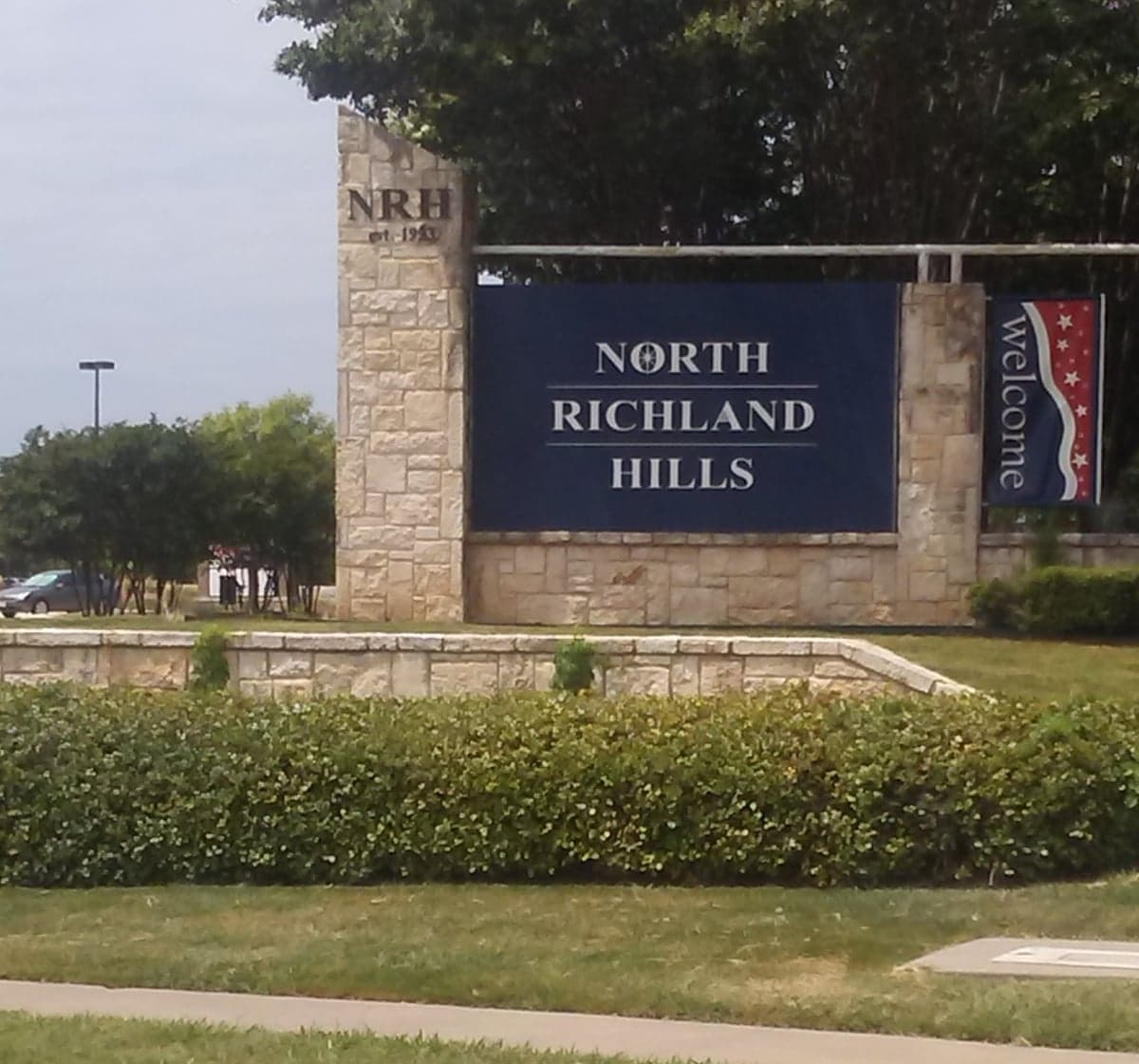
Photo: Wikipedia
Demographics of North Richland Hills, TX
Affluence Level in North Richland Hills, TX
An upper-middle-class area. Household wealth, education levels, and homeownership run ahead of national benchmarks.
People of North Richland Hills, TX
The people of North Richland Hills, Texas, today form a predominantly white, middle-class suburban population of 70,338, marked by a significant and growing Hispanic minority (19.3%) and smaller Black (6.6%) and East/Southeast Asian (2.3%) communities. The city is notably less diverse than the broader Dallas-Fort Worth metroplex, with a foreign-born share of just 5.7% and a college attainment rate of 36.2%. Its identity is rooted in post-war, family-oriented suburban development, with a population that is older and more established than many nearby suburbs, yet still experiencing steady, if slower, growth through new housing construction and infill development.
How the city was settled and grew
North Richland Hills is a purely 20th-century creation, with no pioneer or agrarian settlement phase. The land was originally part of the Peters Colony land grant, but remained sparsely populated ranchland until the mid-20th century. The city was incorporated in 1953, driven by the post-World War II housing boom and the expansion of defense and aviation industries in the region. The original population was almost entirely white, drawn by affordable single-family homes and proximity to the burgeoning General Dynamics (now Lockheed Martin) plant in neighboring Fort Worth. The earliest subdivisions, such as Richland Hills Estates and North Hills, were built in the 1950s and 1960s, attracting young families, many of them veterans and their spouses, who worked in manufacturing, aerospace, and the growing service economy of the Mid-Cities corridor. These neighborhoods remain predominantly white and older today, with many original homeowners aging in place.
Modern era (post-1965)
The post-1965 era brought gradual demographic change, though North Richland Hills remained less affected by immigration than many other DFW suburbs. The city’s growth through the 1970s and 1980s was driven by domestic in-migration from other parts of Texas and the Midwest, as families sought larger lots and newer schools. The Smithfield and Oakmont neighborhoods, developed in the 1970s and 1980s, attracted a slightly more diverse mix, including some upwardly mobile Hispanic and Black families, though the city remained overwhelmingly white. The Hispanic population began a steady increase in the 1990s and 2000s, concentrated in the eastern and southern parts of the city, particularly around the Haltom Road corridor and the Birdville area, where older, more affordable housing stock attracted first-time homebuyers and renters. The East/Southeast Asian population, while small, is clustered in newer subdivisions like Presidio and Villages of North Richland Hills, built in the 2000s and 2010s, which attracted professionals in healthcare and technology. The Indian-subcontinent population remains tiny at 0.7% and is not concentrated in any single neighborhood.
The future
North Richland Hills is not homogenizing, but it is slowly diversifying along predictable lines. The white share (67.3%) is declining gradually, while the Hispanic share (19.3%) is the primary driver of growth, a trend expected to continue as younger Hispanic families move into older, more affordable housing stock. The Black population (6.6%) and East/Southeast Asian population (2.3%) are stable or growing very slowly, with little evidence of rapid influx. The city is not tribalizing into distinct ethnic enclaves; rather, Hispanic growth is spreading across the eastern and southern neighborhoods, while newer subdivisions in the west and north remain predominantly white. The foreign-born share (5.7%) is low and unlikely to spike, as the city lacks the large immigrant-employer base or dense apartment stock that drives rapid immigration in other suburbs. Over the next 10–20 years, North Richland Hills will likely become a more Hispanic-influenced suburb, but it will remain a majority-white, middle-class community with a stable, aging population and modest new construction aimed at empty-nesters and young families.
For someone moving in now, North Richland Hills offers a stable, low-drama demographic environment: a predominantly white, family-oriented suburb with a growing but assimilating Hispanic population, low crime, and good schools. It is not a place of rapid change or ethnic friction, but rather a steady, middle-class community where the biggest shifts are generational, not cultural. New residents will find a city that is comfortable, predictable, and increasingly diverse in a measured, organic way.

* Values derived from national, state, county, city and local statistics and may differ in a specific area. Last updated: 2026-05-29T21:28:04.000Z
Narrative content on this page is AI-generated and may contain mistakes. Verify any details that matter before acting on them.
ReloMaps may earn a commission from affiliate links at no extra cost to you.

