
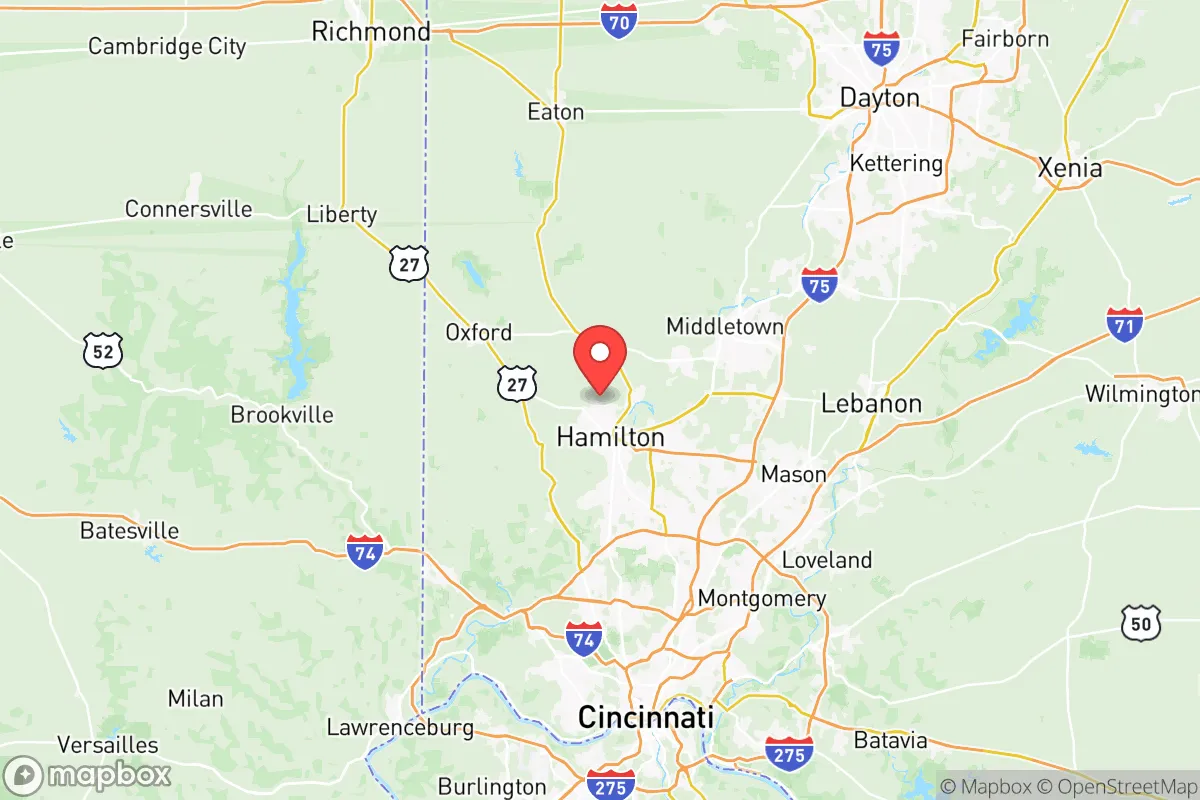
Photo: Wikipedia
Personal Sovereignty in Butler County
Viable for self-reliance. Generally workable, though some barriers may limit total independence.
What does Personal Sovereignty tell us?
Personal Sovereignty measures your capacity for self-reliance and independence with minimal government friction. Higher scores mean fewer barriers between you and the way you want to live... but it assumes you have the space you need and good neighbors.
What does this tell us?
Personal Sovereignty measures your capacity for self-reliance and independence with minimal government friction. Higher scores mean fewer barriers between you and the way you want to live... but it assumes you have the space you need and good neighbors.
State Policy
Energy independence: Importer (40% of energy produced in-state)
Personal Liberty
Homesteading

Personal Liberty Analysis
Butler County, Ohio, offers residents a notably high degree of personal sovereignty that aligns with a self-reliant, freedom-first lifestyle, particularly when compared to nearby urban centers like Cincinnati or Columbus. The area’s governing philosophy is grounded in the state’s strong preemption laws, which limit local government overreach in areas such as firearms regulation, property rights, and taxation. This creates a predictable legal environment where individuals and families can make decisions about their lives, property, and safety without excessive bureaucratic interference. For single adults and families who prioritize independence over convenience, Butler County’s mix of rural townships and smaller cities provides a tangible sense of personal control over daily affairs.
Tax burden and local regulatory posture compared to neighboring counties
Butler County’s tax burden is competitive, especially for those moving from high-tax states. Ohio’s state income tax is graduated, with a top rate of 3.99% as of 2025, and Butler County’s sales tax is 7.25% (state + county combined). Property taxes are moderate; the effective rate in townships like Liberty Township and West Chester Township typically ranges from 1.2% to 1.6% of assessed value, lower than comparable suburbs in Hamilton County (Cincinnati). The county’s regulatory posture is generally light-touch, with zoning variability across jurisdictions. Unincorporated areas such as Milford Township and Oxford Township allow more permissive land use than cities like Hamilton or Middletown, which have stricter building codes and permit requirements. Business licensing is straightforward, and home-based enterprises face few restrictions outside formal subdivisions. The county’s economic development office actively solicits small and medium businesses, emphasizing a "open for business" approach that extends to individual entrepreneurs and remote workers.
Self-defense laws and gun-friendly culture in Butler County
Butler County is deeply rooted in Ohio’s robust gun rights framework. Ohio is a constitutional carry state, meaning no permit is required to carry a concealed handgun legally since June 2022, and the county sheriff’s office in Hamilton issues permits for those who still want reciprocity with other states. Fairfield and Middletown have multiple indoor and outdoor shooting ranges, and gun ownership is common across all demographics. Local law enforcement, including the Butler County Sheriff’s Office, publicly supports Second Amendment rights; deputies do not enforce federal firearm laws that contradict state preemption (e.g., NFA restrictions on suppressors or short-barreled rifles). Stand-your-ground provisions apply statewide, removing any duty to retreat before using deadly force in self-defense. For residents moving from restrictive states like California, New York, or Illinois, the cultural shift toward firearm freedom is immediate and noticeable. Gun-related purchases, including private-party transfers, face minimal state interference beyond federal background checks required by the 1993 Brady Act.
Self-reliance and homesteading viability: lot sizes, zoning, off-grid feasibility
Homesteading and self-reliance are viable across much of Butler County, particularly in its rural eastern and northern townships. Minimum lot sizes vary: in unincorporated areas like Wayne Township and Reily Township, one-acre zoning is common, while Madison Township permits lots as small as two acres for single-family dwellings. Off-grid living faces no explicit county-wide ban, but practical constraints exist. Rainwater collection is legal; Ohio’s law allows rooftop harvesting without a permit. Solar panels are permitted on residential properties, though homeowners associations in subdivisions like those in West Chester may restrict visible installations. Septic systems are regulated by the Butler County General Health District, which requires permits for new installations but allows composting toilets with a variance. Chickens and small livestock are generally allowed in agricultural zones, with some townships having ordinances limiting roosters or requiring setbacks. The Oxford area, near Miami University, is less homestead-tolerant due to denser development, while Monroe’s newer subdivisions are more restrictive. For those seeking genuine self-sufficiency, the Ross Township area offers larger parcels at lower prices, with farmland still available under agricultural zoning.
Personal liberties: parental rights, medical autonomy, free speech, and property protections
Personal liberties in Butler County are strong across several fronts, shaped by state and local attitudes. Parental rights are explicitly protected under Ohio law, with schools required to notify parents of medical services and to obtain consent for non-emergency procedures. The Butler County Educational Service Center follows these state mandates, and school boards in Lakota Local Schools and Fairfield City Schools have adopted policies that limit instructional materials without advance parental review. Medical autonomy is generally respected; Ohio does not require proof of vaccination for public school enrollment (parents may claim philosophical exemption), and COVID-19 mandates were largely unenforced in the county after 2022. Free speech protections align with First Amendment standards, with local governments rarely restricting expressive activity on public property. Property rights are strongly defended; eminent domain actions are rare, and the county follows Ohio’s "quick-take" procedure, which requires providing just compensation. In cities like Hamilton, a 2022 zoning code update reduced parking minimums and eliminated minimum lot sizes in certain districts, signaling a move toward more flexible property use.
Overall, Butler County delivers a consistently high level of personal sovereignty that places it among the freest areas in the Cincinnati metropolitan region. Its combination of constitutional carry, light zoning in rural townships, moderate taxation, and strong preemption laws creates an environment where individual choice is the default, not the exception. Compared to states like New York or California, where local ordinances heavily circumscribe gun rights and property use, or even to more restrictive Ohio counties like Cuyahoga (Cleveland), Butler County’s regulatory posture is notably permissive. For single individuals and families seeking a place where independence is a given rather than a struggle, Butler County offers a practical, low-friction foundation for self-directed living.

* Values derived from national, state, county, city and local statistics and may differ in a specific area. Last updated: 2026-09-13T23:29:12.000Z
Narrative content on this page is AI-generated and may contain mistakes. Verify any details that matter before acting on them.
ReloMaps may earn a commission from affiliate links at no extra cost to you.

