Photo: Wikipedia
Demographics of Hamilton County
Affluence Level in Hamilton County
A middle-class area roughly in line with national averages across income, home values, education, and employment.
People of Hamilton County
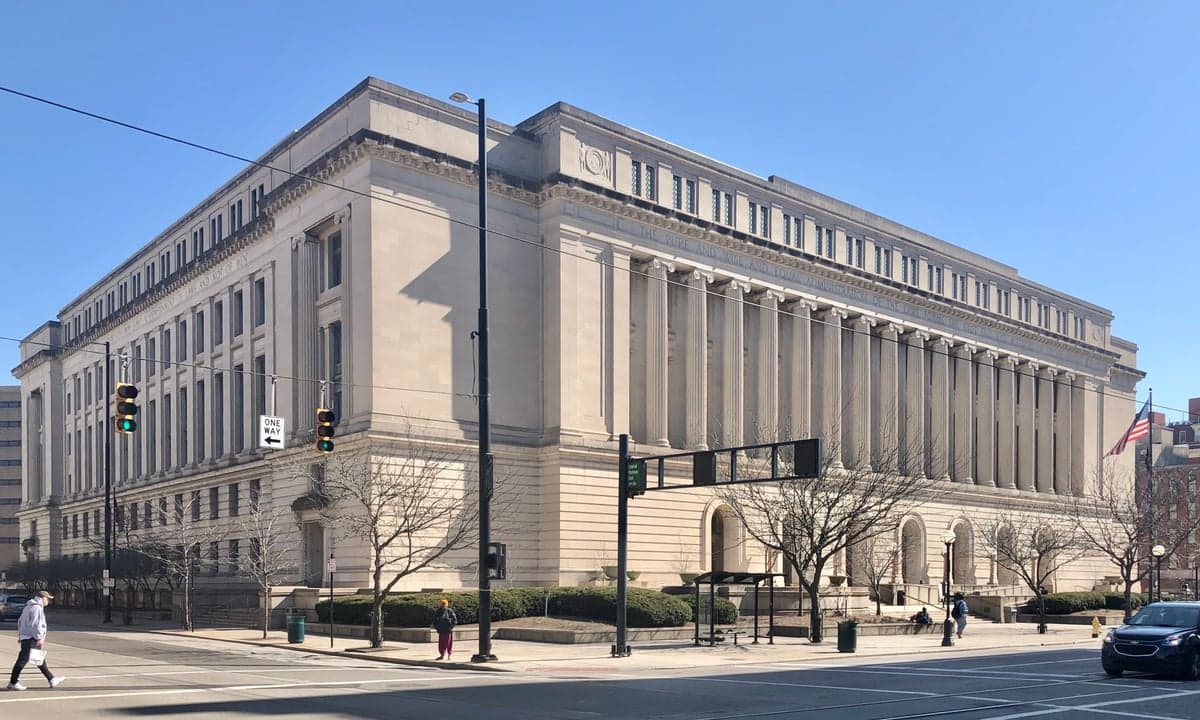
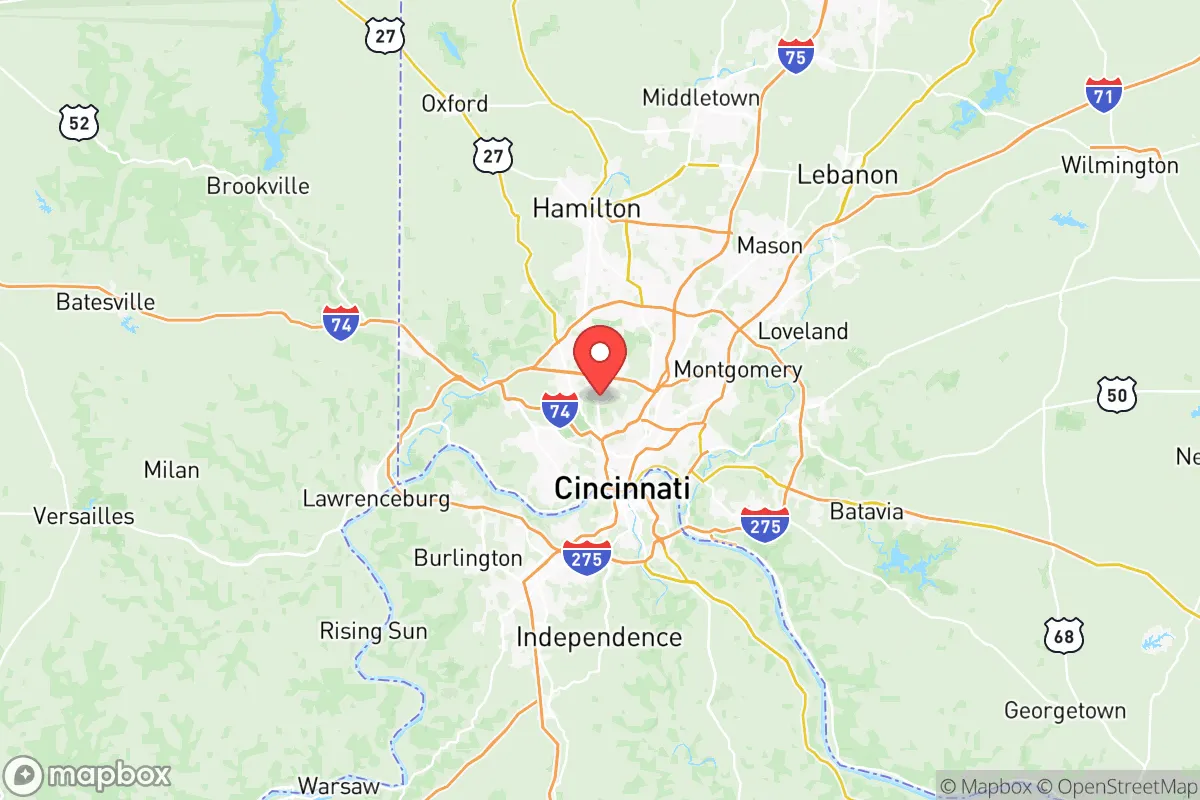
Hamilton County, Ohio, today is a dense, historically layered urban core of 827,878 residents, anchored by Cincinnati and its inner-ring suburbs. Its population is predominantly white (62.9%) with a significant Black minority (24.9%), a small but growing Hispanic community (4.5%), and modest East/Southeast Asian (1.5%) and Indian subcontinent (1.2%) populations. The county is notably well-educated, with 41.4% of adults holding a college degree, yet it retains a distinct Midwestern character shaped by waves of German, Irish, and Appalachian migration, now overlaid with a low foreign-born rate of just 3.6% that makes it less ethnically diverse than many peer urban counties.
Settlement & growth (pre-1960)
Before American settlement, the land now called Hamilton County was home to the Hopewell and later the Shawnee and Miami Native nations, who used the Ohio River as a trade and travel corridor. The first permanent European-American settlers arrived in the late 1780s, shortly after the Northwest Ordinance opened the territory. In 1788, a group of settlers from New Jersey and Pennsylvania founded Losantiville, which was renamed Cincinnati in 1790. These early arrivals were primarily of English, Scots-Irish, and German stock, drawn by cheap land and the strategic river location.
The defining demographic wave of the 19th century was German immigration. Between 1830 and 1860, tens of thousands of Germans settled in Hamilton County, transforming Cincinnati into one of America's great German cities. They established dense neighborhoods in Over-the-Rhine (named for the Rhine River), Mount Adams, and Pendleton, building breweries, churches, and social clubs. By 1850, German-born residents made up roughly a third of Cincinnati's population. A smaller but significant Irish wave arrived during the same period, settling in Fulton and parts of Price Hill, working on the Miami and Erie Canal and in the city's growing manufacturing sector.
The post-Civil War era brought a second major group: African Americans from the Upper South. Cincinnati's location just across the Ohio River from Kentucky made it a destination for freed slaves and their descendants, who established communities in the West End and later Avondale. By 1900, the Black population had grown to roughly 5% of the county total. Simultaneously, the industrial boom of the late 19th and early 20th centuries attracted a wave of Italian, Polish, and Jewish immigrants, who clustered in Mount Auburn, Walnut Hills, and Northside.
The most transformative domestic migration of the 20th century was the Appalachian influx. From the 1940s through the 1960s, hundreds of thousands of white migrants from eastern Kentucky, West Virginia, and Tennessee moved to Hamilton County seeking factory jobs in the region's booming machine tool, auto parts, and consumer goods industries. They settled heavily in Norwood, St. Bernard, Reading, and the Mill Creek Valley, creating a distinct Appalachian subculture that remains visible today in dialect, music, and family networks. By 1960, Hamilton County's population peaked at over 864,000, with a heavily white, native-born, and working-class character.
Modern era (post-1965)
The 1965 Hart-Cellar Act had a muted effect on Hamilton County compared to coastal metros. The foreign-born population remains low at 3.6%, reflecting the county's limited draw for post-1965 immigration. The most notable new immigrant group has been East/Southeast Asian communities, particularly Vietnamese and Chinese, who have established small enclaves in Evanston and parts of Clifton. The Indian subcontinent population (1.2%) is smaller but growing, concentrated in Mason and West Chester (just north of the county line) and within the city in Hyde Park and Montgomery, often tied to the healthcare and engineering sectors.
The Hispanic population, now 4.5%, has grown steadily since the 1990s, driven by Mexican and Central American immigrants working in construction, landscaping, and food processing. The largest concentrations are in Price Hill, Lower Price Hill, and Spring Grove Village, where Spanish-language churches and tiendas have appeared. This growth is modest by national standards but represents a significant shift for a county that was 95% white as recently as 1970.
The most dramatic modern demographic change has been suburbanization and racial sorting. From the 1970s onward, white and middle-class Black families moved to outer-ring suburbs like Anderson Township, Symmes Township, and Green Township, while the city of Cincinnati's population fell from 503,000 in 1950 to 309,000 in 2020. The Black population, which had been concentrated in the West End and Avondale, spread to Roselawn, Bond Hill, and Forest Park, creating a more dispersed but still residentially segregated pattern. The county's white share dropped from 80% in 1970 to 62.9% today, while the Black share rose to 24.9%.
The future
Hamilton County's population is projected to remain stable or decline slightly over the next decade, as out-migration to suburban counties like Butler and Warren offsets any urban revival. The county is not homogenizing; rather, it is tribalizing into distinct enclaves by race, class, and lifestyle. The city of Cincinnati is seeing a modest influx of young, college-educated whites and Asians into gentrifying neighborhoods like Over-the-Rhine and Pendleton, while the outer suburbs remain predominantly white and family-oriented. The Black population is increasingly suburban, with Forest Park and Springdale becoming majority-Black. The Hispanic and East/Southeast Asian communities are growing slowly but steadily, likely reaching 6-7% and 2-3% of the county respectively by 2040, but they are being absorbed into the existing cultural fabric rather than creating distinct ethnic enclaves.
The Indian subcontinent population, while small, is likely to grow faster than other immigrant groups due to the presence of major employers like Procter & Gamble, Kroger, and Cincinnati Children's Hospital, which recruit skilled professionals. This group tends to assimilate quickly into upper-middle-class suburbs like Montgomery and Madeira, contributing to the county's high college-educated rate.
The biggest unknown is whether the county can reverse its long-term population decline. The city of Cincinnati has added residents in recent years for the first time since 1950, but the county as a whole continues to lose households to surrounding counties. Without a significant increase in immigration or a reversal of domestic out-migration, the county's population will likely settle around 800,000-820,000 by 2035, with a slowly diversifying but still majority-white and majority-native-born character.
For someone moving in now, Hamilton County offers a stable, historically rooted urban environment with a well-educated workforce and a strong sense of place, but with limited ethnic diversity compared to other major metros. The county is becoming more fragmented by race and class, yet retains a shared Midwestern identity that newcomers are expected to absorb rather than reshape. It is a place where the past weighs heavily, and the future will be shaped more by who stays than by who arrives.

* Values derived from national, state, county, city and local statistics and may differ in a specific area. Last updated: 2026-05-14T04:57:29.000Z
Narrative content on this page is AI-generated and may contain mistakes. Verify any details that matter before acting on them.
ReloMaps may earn a commission from affiliate links at no extra cost to you.

