
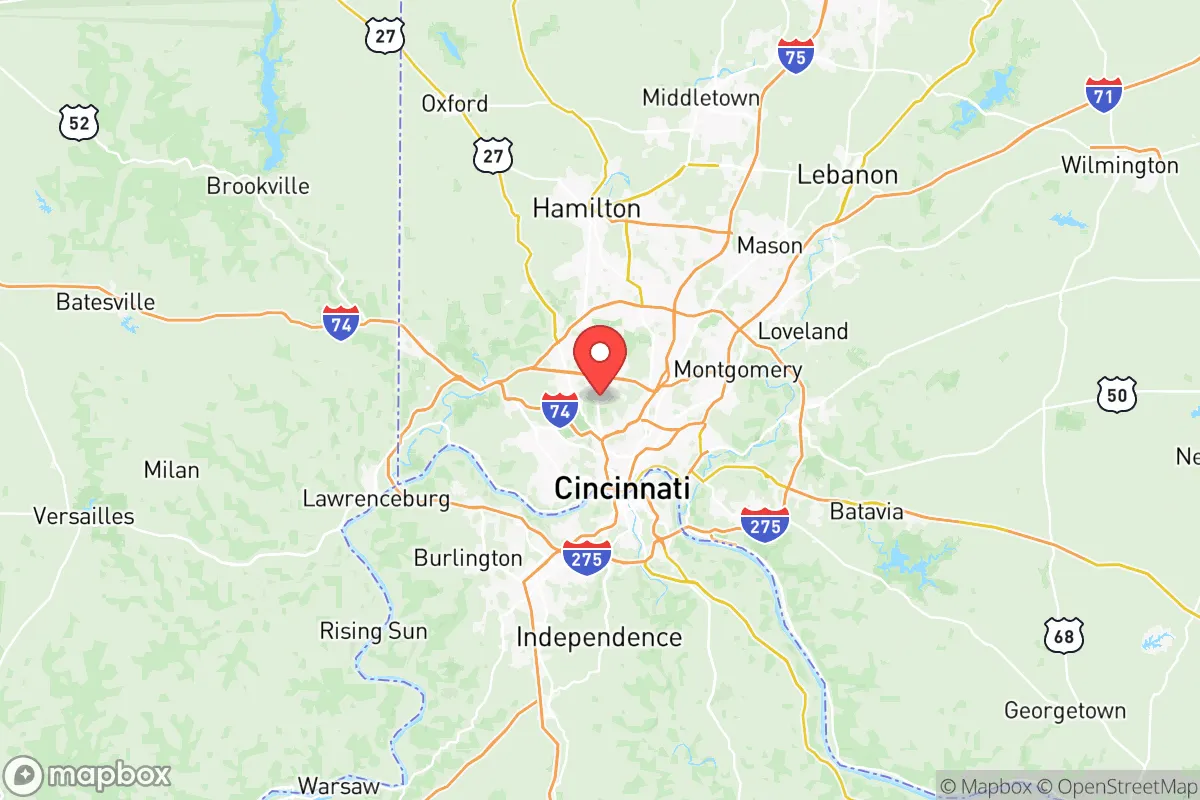
Photo: Wikipedia
Quality of Life in Hamilton County
A livable area that tracks near national norms for affordability, walkability, and neighborhood health.
What does Quality of Life tell us?
Quality of Life measures an area by evaluating factors like cost of living, nearby amenities, country club access, airport proximity, socioeconomic signals and neighborhood character. For large states, this is a general average — quality of life can vary dramatically between metro areas, suburbs, and rural communities within the same state.
What does this tell us?
Quality of Life measures an area by evaluating factors like cost of living, nearby amenities, country club access, airport proximity, socioeconomic signals and neighborhood character. For large states, this is a general average — quality of life can vary dramatically between metro areas, suburbs, and rural communities within the same state.
Cost of Living
16% below national average
110%
The Real Cost of Living in Hamilton County for 2026
| Tier | Individual | Family (4) |
|---|---|---|
| Survival | $16k | $30k |
| Comfortable | $44k | $64k |
| Luxury | $128k+ | $198k+ |
| Elite (Top 5%) | $178k+ | $276k+ |
Quality-of-Life Analysis
Hamilton County, Ohio offers a broad spectrum of living environments, from the dense urban core of Cincinnati to quiet, unincorporated rural pockets in its northern and western reaches. The county attracts a diverse mix of residents: young professionals and creatives drawn to the city’s walkable neighborhoods and cultural institutions, families seeking suburban school districts with commuter rail access, and long-time residents who prefer the slower pace and lower density of towns like Crosby Township or Colerain Township. With a cost-of-living index of 84 (well below the national average of 100), the county provides tangible financial breathing room across most of its communities, though the trade-offs in commute times, housing stock, and local amenities vary significantly by location.
Largest town(s) & population centers
Cincinnati is the county’s dominant population center, with roughly 309,000 residents as of 2024. Daily life here is defined by walkable historic districts like Over-the-Rhine and Mount Adams, a robust brewery and restaurant scene, and major employers such as Procter & Gamble, Kroger, and the University of Cincinnati Medical Center. The city’s median home value of $225,700 and median rent of $1,005 are significantly below national averages, making urban living accessible to a wider income range than in peer cities like Columbus or Indianapolis. The average commute across the county is 23.3 minutes, though residents living in Cincinnati’s core often have shorter trips, while those commuting from outer neighborhoods or suburbs may face 30–40 minutes. Beyond Cincinnati, the county includes the large suburban city of Norwood (pop. ~19,000), a dense, older suburb with its own downtown and strong local retail, and the city of Forest Park (pop. ~18,000), a more car-dependent community with larger lot sizes and a mix of mid-century homes and newer townhouses.
Smaller towns & rural pockets
Hamilton County’s smaller towns and unincorporated areas offer a markedly different pace. In the western part of the county, Crosby Township (pop. ~2,200) is a rural, agricultural area with large tracts of farmland, few sidewalks, and a strong sense of local history. Nearby Whitewater Township (pop. ~5,800) similarly features open space, a volunteer fire department, and a handful of small businesses along U.S. Route 50. To the north, Colerain Township (pop. ~58,000) is a large, unincorporated area that blends suburban subdivisions with significant wooded and agricultural land; it is the county’s most populous township and offers a middle ground between rural and suburban living. The village of Addyston (pop. ~1,000) sits along the Ohio River in the county’s southwest corner, a small river town with a historic downtown and a strong blue-collar identity. These areas typically lack the retail density and public transit options of Cincinnati or its inner suburbs, but they provide larger lots, lower property taxes, and quieter streets.
Cost & lifestyle range
The cost-of-living spread across Hamilton County is wide. At the lower end, neighborhoods in Cincinnati’s Avondale or Price Hill offer median home values around $80,000–$120,000, with rents often below $800 for a one-bedroom. These areas are close to downtown but may have higher crime rates and fewer amenities. At the upper end, the village of Indian Hill (pop. ~6,000) is one of the wealthiest communities in Ohio, with median home values exceeding $600,000, large estates, and top-rated public schools. The suburb of Montgomery (pop. ~10,000) also sits at the high end, with a median home value near $450,000 and a walkable village center with boutique shopping and fine dining. For families seeking a middle ground, Mason (partially in Warren County but with a Hamilton County presence) and Loveland offer strong schools and median home values around $300,000–$350,000, with commute times to downtown Cincinnati of 25–35 minutes. The lifestyle range means a single renter on a $40,000 salary can afford a comfortable apartment in Oakley or Hyde Park, while a family with a $150,000 income can choose between a historic home in Wyoming or a new build in Symmes Township.
Hamilton County works best for people who value geographic and economic diversity within a single county. Young professionals and empty-nesters thrive in Cincinnati’s urban core, where walkability and cultural density are high. Families with school-age children often gravitate toward the suburban ring—places like Madeira, Mariemont, or Sycamore Township—where school districts are strong and housing remains affordable relative to national averages. Rural-minded residents find their niche in the western townships, where land is cheaper and neighbors are few. The county’s below-average cost of living and 23-minute average commute make it a practical choice for a wide range of lifestyles, provided residents are willing to navigate the trade-offs between urban energy, suburban convenience, and rural quiet.

Crime in Hamilton County
Generally safer than 56% of comparable U.S. locations.
Violent CrimeViolent Crime Analysis
Property CrimeProperty Crime Analysis
Crime Analysis
Hamilton County, Ohio, which encompasses Cincinnati and its surrounding suburbs, presents a mixed safety picture. The county's violent crime rate of 257.1 per 100,000 residents is notably lower than the national average, but its property crime rate of 1,326.2 per 100,000 sits slightly above the national figure. However, these county-wide averages mask significant disparities, with progressive criminal justice policies in Cincinnati and the county's judicial system contributing to a more permissive environment that many residents find concerning.
Crime in context
Hamilton County's violent crime rate of 257.1 per 100,000 is roughly 27% lower than the U.S. national average of about 380 per 100,000, and it also undercuts the Ohio state average of approximately 290 per 100,000. This is a positive data point for the county as a whole. However, the property crime rate of 1,326.2 per 100,000 is about 10% higher than the national average of roughly 1,200 per 100,000, and significantly above the Ohio state average of around 1,100 per 100,000. This means residents face a heightened risk of theft, burglary, and vehicle break-ins compared to the typical American or Ohioan. The county's overall crime picture is heavily influenced by its largest city, Cincinnati, where crime rates are substantially higher than in many of its suburbs.
What residents experience
Daily life for Hamilton County residents varies dramatically by location. In Cincinnati's urban core, particularly neighborhoods like Over-the-Rhine, Avondale, and the West End, residents report frequent property crimes such as car break-ins and package theft, as well as a visible police presence responding to violent incidents. The progressive policies of the Hamilton County Prosecutor's Office and some local judges, who emphasize diversion programs and reduced sentencing for non-violent offenders, have been criticized for creating a "catch-and-release" cycle that frustrates victims and emboldens repeat criminals. In contrast, suburbs like Montgomery, Mason, and Wyoming experience far lower crime rates, with violent crime nearly nonexistent and property crime limited to occasional thefts. Residents in these areas often cite the local police departments' proactive approach and the absence of lenient judicial policies as key to their safety. Meanwhile, communities like Norwood and St. Bernard, which are older, denser suburbs, see property crime rates that approach Cincinnati's levels, with residents frequently dealing with porch pirates and vehicle break-ins.
Neighborhood-level variation
The starkest divide in Hamilton County is between the city of Cincinnati and its surrounding municipalities. Cincinnati itself accounts for a disproportionate share of the county's violent crime, with rates in some neighborhoods exceeding 1,000 per 100,000. The city's reliance on progressive prosecution, including a focus on reducing jail populations and declining to prosecute certain low-level offenses, has been linked to a rise in open-air drug markets and street-level theft. By contrast, the eastern suburbs like Anderson Township and Madeira boast violent crime rates below 50 per 100,000, and property crime rates that are half the county average. For those considering a move, the choice often comes down to accepting the urban amenities of Cincinnati with its associated safety risks, or prioritizing the low-crime environment of the suburbs, where conservative-leaning local governments and police departments maintain a stricter law-and-order approach. The county's judicial district boundaries also play a role; cases originating in the suburbs are more likely to be handled by municipal courts with less lenient sentencing patterns than those in Cincinnati's downtown courthouse.
* Values derived from national, state, county, city and local statistics and may differ in a specific area. Last updated: 2026-05-14T04:57:29.000Z
Narrative content on this page is AI-generated and may contain mistakes. Verify any details that matter before acting on them.
ReloMaps may earn a commission from affiliate links at no extra cost to you.

