Photo: Wikipedia
Political ClimatePolitical Climate in Hamilton County
Showing district-level results — no local-only data available.
Local Political AnalysisPolitical Analysis of Hamilton County
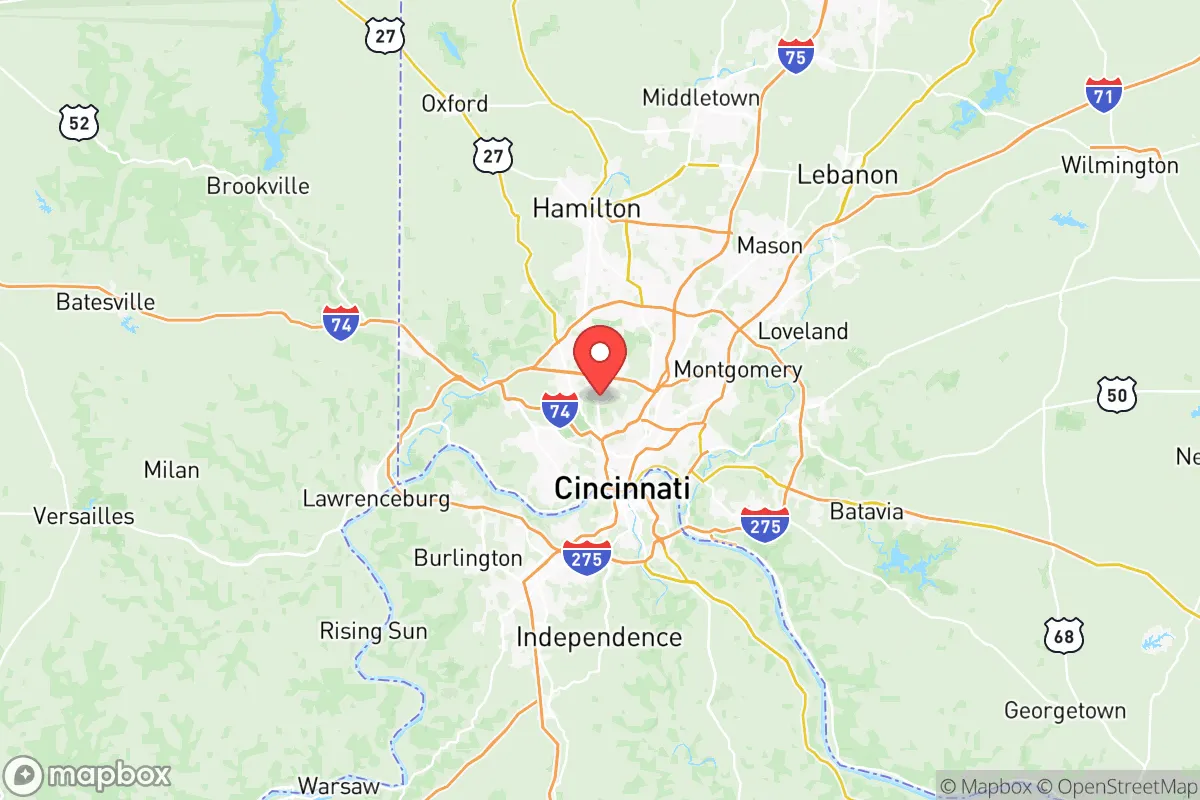
Hamilton County has been trending bluer for a while now, and the numbers back it up—a Cook PVI of D+3 puts it solidly in Democratic territory, a far cry from the rest of Ohio, which sits at R+5. But that county-wide number hides a lot of local variation. You’ve got places like Indian Hill and Symmes Township that still vote reliably red, while Cincinnati proper, Norwood, and St. Bernard have gone deep blue. The real story is how the old moderate Democrats in places like Anderson Township and Green Township have been replaced by a more progressive, activist base, especially since the 2020 election cycle. It’s not your father’s Hamilton County anymore.
How it compares
When you stack Hamilton County against the rest of Ohio, the gap is stark. The state as a whole leans R+5, meaning a typical statewide race sees Republicans winning by about 5 points. But here in the county, Democrats have a 3-point advantage. That’s an 8-point swing from the state average. What that means on the ground is that local elections—county commissioner races, school board seats, even judicial appointments—are increasingly dominated by candidates who push progressive policies on taxes, zoning, and public safety. Meanwhile, the rural and exurban counties surrounding us, like Butler and Warren, are deep red, creating a political island effect. You can drive 20 minutes north and feel like you’re in a different state entirely, where property rights and Second Amendment protections are still taken seriously.
What this means for residents
For folks who value personal freedom and limited government, the shift is concerning. The county government has been more aggressive with business mandates and health orders than surrounding areas, and there’s a growing push to restrict short-term rentals and tighten zoning laws in the name of “equity.” Property taxes have crept up, and there’s talk of new local income taxes to fund expanded social programs. If you’re a small business owner or a homeowner who values keeping what you earn, you’re feeling the squeeze. The school boards in Cincinnati and Norwood have also become battlegrounds over curriculum and parental rights, with progressive majorities pushing policies that many longtime residents see as overreach.
The cultural divide is real, too. In the past, Hamilton County had a live-and-let-live vibe—conservatives in the suburbs, liberals in the city, and everyone got along. Now, the county government is more willing to use its power to enforce a specific vision, from mask mandates that lasted longer than in neighboring counties to sanctuary city policies in Cincinnati that create friction with state law. If you’re looking for a place where local government stays out of your business, the northern and eastern suburbs still offer some breathing room, but the overall trajectory is toward more regulation and higher taxes. It’s worth keeping an eye on the next few election cycles—if the progressive wave continues, the county could look very different in five years.

State Political ClimatePolitical Climate in Ohio
State Political AnalysisPolitical Environment in the State
Ohio has shifted from a classic purple battleground to a solidly Republican-leaning state, with a Cook PVI of R+5, but that number hides a deeply divided political landscape. Over the past 20 years, the state has moved rightward by about 10 points, driven by the collapse of union Democrats in the industrial northeast and the rise of a populist, culturally conservative coalition in the exurbs and rural areas. The 2024 election saw Donald Trump win the state by 11 points, a margin that would have been unthinkable in 2004 when George W. Bush barely carried it by 2 points. Today, the GOP holds supermajorities in both chambers of the legislature, all six statewide executive offices, and a 6-9 split in the US House delegation that leans red.
Urban vs. rural divide
The political map of Ohio is a tale of three regions. The urban cores of Cleveland, Columbus, and Cincinnati are deep blue, with Cuyahoga County (Cleveland) delivering a 66% Democratic vote in 2024 and Franklin County (Columbus) at 58%. But these cities are surrounded by a sea of red that grows darker the farther you get from downtown. The real story is the exurban and rural explosion — places like Delaware County (north of Columbus) flipped from purple to deep red, voting 62% Republican in 2024, while Warren County (north of Cincinnati) hit 71% GOP. The old industrial towns along the Mahoning Valley — Youngstown, Steubenville, East Liverpool — have swung hard right as union Democrats abandoned the party over cultural issues and trade policy. Meanwhile, the Appalachian counties in the southeast, like Vinton and Meigs, now vote 75-80% Republican, a complete inversion from the 1990s when they were competitive. The only blue growth area is the Columbus metro, where suburban counties like Licking and Fairfield are trending purple as white-collar professionals move in, but they're not enough to offset the rural red wave.
Policy environment
Ohio's policy environment is a mixed bag for conservatives. On the plus side, the state has a flat income tax rate of 3.5% (down from 4.8% in 2020), with a phase-out plan that could eliminate it entirely by 2030. Property taxes are moderate, with an effective rate around 1.5% of home value, but they're rising fast in growing suburbs. The regulatory climate is business-friendly, with a right-to-work law (though it was repealed by referendum in 2011) and a strong tort reform system. On education, Ohio has a robust school choice program — the EdChoice scholarship covers private school tuition for low-income families, and over 100,000 students use it. But the state also has a heavy-handed Department of Education that pushes progressive curriculum standards, and local school boards in blue counties have implemented DEI programs that parents are fighting. Healthcare is a mixed bag: Ohio expanded Medicaid under Obamacare, which conservatives view as a government overreach, but the state also has strong religious exemption laws for vaccines and medical procedures. Election laws are solid — voter ID is required, early voting is limited to 28 days, and drop boxes are restricted to one per county. The 2020 election saw no major fraud issues, but the legislature passed SB 148 in 2023 to tighten absentee ballot rules and ban private funding of elections.
Trajectory & freedom
Ohio is becoming more free in some areas and less free in others, and the trend is worth watching. On the positive side, the state passed constitutional carry (permitless concealed carry) in 2022, and the legislature overrode Governor Mike DeWine's veto to ban transgender surgeries for minors in 2024 (HB 68). Parental rights got a boost with the "Parents' Bill of Rights" (HB 8) in 2023, which requires schools to notify parents of any medical or mental health services and prohibits instruction on sexual orientation in grades K-3. On the negative side, the state has seen a creeping expansion of government power: the 2023 state budget included a $600 million bailout for Intel's new semiconductor plant in Licking County, which conservatives criticized as corporate welfare. The Ohio Supreme Court has also upheld local gun bans in Cleveland and Columbus, creating a patchwork of restrictions that frustrate gun owners. Medical freedom took a hit with the state's COVID-19 mandates in 2020-21, though those have since been repealed. The biggest concern is the property rights front: the state's wind and solar siting board has approved massive renewable projects in rural areas over local opposition, effectively overriding county zoning laws. The 2023 law SB 52 gave the state power to approve solar farms regardless of local bans, which many see as a violation of local control.
Civil unrest & political movements
Ohio has seen its share of political flashpoints. The 2020 George Floyd protests in Columbus and Cincinnati turned violent, with looting and arson in the Short North and Over-the-Rhine neighborhoods. The state also saw the 2022 East Palestine train derailment, which became a national story about government and corporate negligence — the EPA's slow response and the railroad's legal maneuvering fueled distrust in both institutions. On the right, the "Ohio Freedom Alliance" and local Moms for Liberty chapters have been active in school board battles, particularly in Delaware and Warren counties. Immigration politics are relatively quiet — Ohio has no sanctuary cities, and the state passed a law in 2024 (HB 33) requiring local law enforcement to cooperate with ICE. But there are tensions in Springfield, where a surge of Haitian migrants has strained social services and sparked local backlash. Election integrity remains a hot topic: the 2020 election was certified without major issues, but the 2024 cycle saw allegations of ballot harvesting in Cuyahoga County, leading to a state investigation. The "Ohio Constitution" movement, which advocates for a state constitutional convention to limit federal overreach, has gained some traction in rural counties but hasn't gone mainstream.
Projection
Over the next 5-10 years, Ohio will likely become more Republican at the state level, but with growing internal tensions. The demographic trends favor the GOP: the population is aging, the rural areas are shrinking but voting more heavily red, and the urban cores are losing black and working-class voters who are shifting right. The Columbus metro will continue to grow and become more purple, but it won't flip the state. The biggest wild card is the in-migration from blue states — people moving from California and New York to places like Dublin and Mason tend to be moderate Republicans or independents, not hardline conservatives. The state's tax cuts will likely continue, with the income tax possibly eliminated by 2030, which will attract more business but also strain local services. The education battle will intensify: expect more school choice expansion and a push for a constitutional amendment to ban DEI in public schools. The biggest threat to freedom is the centralization of power in Columbus — the state legislature is increasingly overriding local control on everything from solar farms to housing policy, which could backfire with rural voters who value local autonomy. A new resident moving in now should expect a state that is broadly conservative but with pockets of progressive activism in the cities, and a political climate that is stable but not static.
For a conservative family or individual looking to relocate, Ohio offers a solid foundation: low taxes, strong gun rights, school choice, and a political majority that aligns with traditional values. But it's not a libertarian paradise — the state government is willing to use its power for both good and ill, and the urban areas will continue to push back against conservative policies. The bottom line is that Ohio is a safe bet for someone who wants a red state with a functioning economy and decent schools, but you'll need to pick your county carefully. Stick to the exurbs of Cincinnati or Columbus, avoid the urban cores, and you'll find a community that shares your values and a state that's trending in the right direction.
* Values derived from national, state, county, city and local statistics and may differ in a specific area. Last updated: 2026-05-14T04:57:29.000Z
Narrative content on this page is AI-generated and may contain mistakes. Verify any details that matter before acting on them.
ReloMaps may earn a commission from affiliate links at no extra cost to you.

