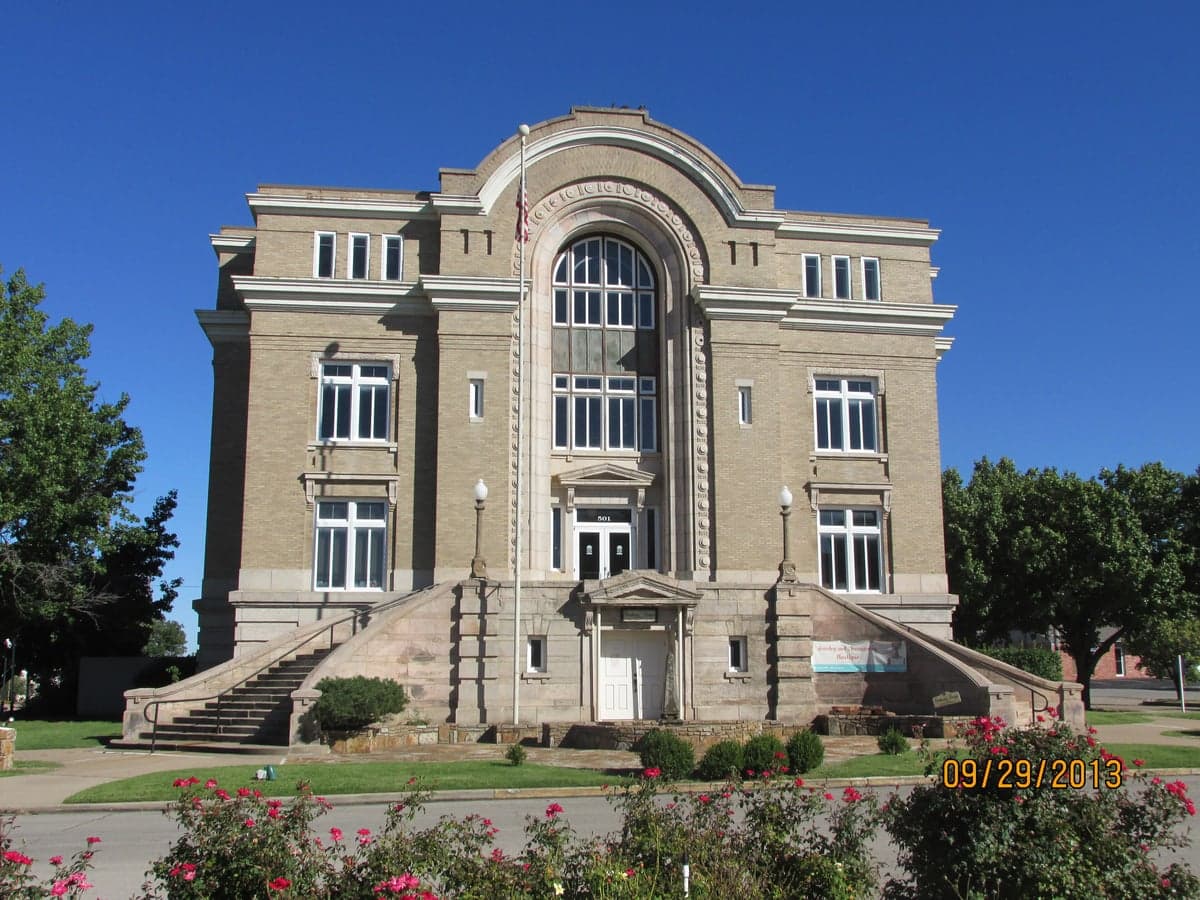
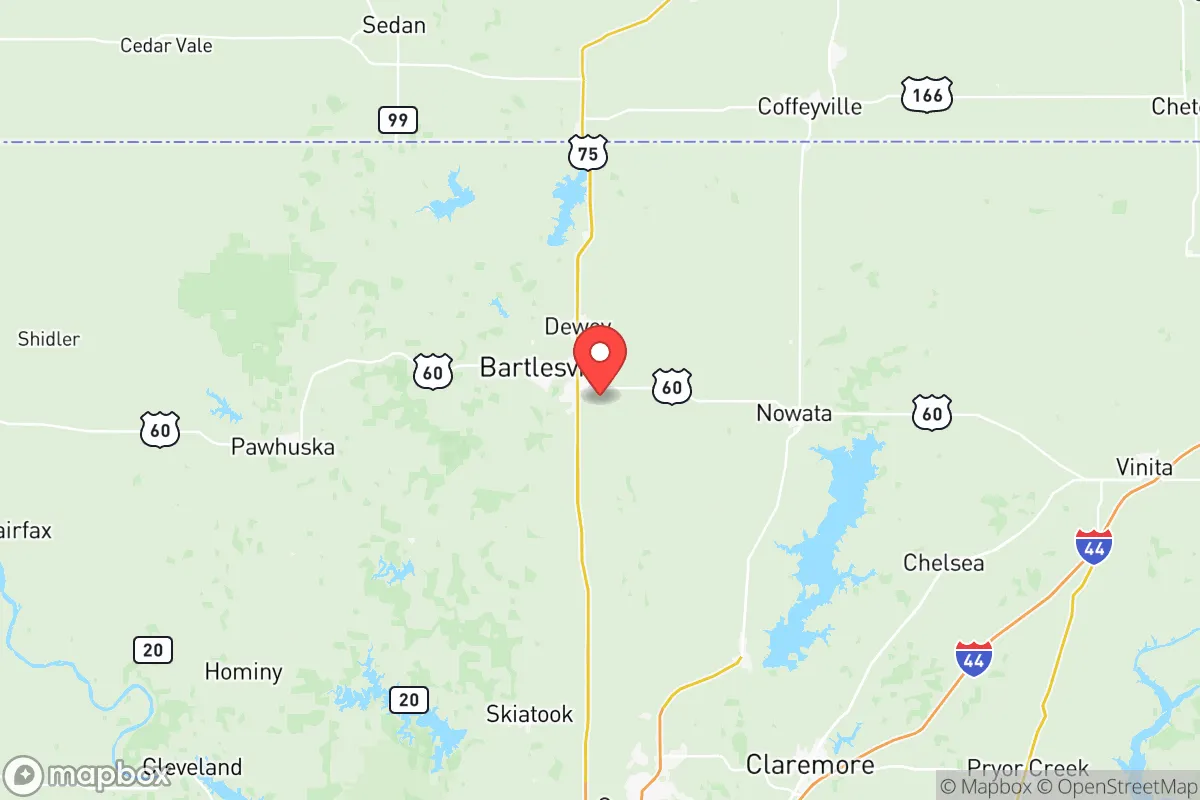
Photo: Wikipedia
Political ClimatePolitical Climate in Washington County
Showing district-level results — no local-only data available.
Local Political AnalysisPolitical Analysis of Washington County
Washington County, Oklahoma, is one of the most reliably Republican areas in the state, with a Cook Partisan Voting Index (PVI) of R+28—a full ten points more conservative than Oklahoma’s already deep-red statewide PVI of R+18. That gap has widened over the past decade as the county’s rural and exurban precincts have shifted further right, while the state as a whole has held relatively steady. The county hasn’t voted for a Democratic presidential candidate since 1948, and in 2024, Donald Trump carried it by a margin closer to 70-28, reflecting a political culture that is both intensely partisan and increasingly uniform.
How it compares
The R+28 PVI puts Washington County in the same league as the most conservative counties in the Texas Panhandle or rural Utah—places where Democratic candidates rarely break 30 percent. By contrast, Oklahoma’s R+18 already makes it the second-most Republican state in the nation (behind Wyoming), so Washington County is essentially an outlier within an outlier. The difference is most visible in the county’s two main population centers: Bartlesville, the county seat and home to Phillips 66’s corporate headquarters, has a small but persistent liberal pocket around the downtown and near the Price Tower, where precincts occasionally hit 35-40 percent Democratic in local races. Meanwhile, Dewey, just west of Bartlesville, and the rural towns of Ramona, Ochelata, and Copan routinely deliver 80 percent or more for Republican candidates. The swing precincts—if you can call them that—are in the newer subdivisions on Bartlesville’s south and east sides, where moderate professionals and Phillips 66 transplants sometimes split tickets in state legislative races. But even those areas have been trending redder since 2020.
What this means for residents
For conservative residents, Washington County is about as comfortable as it gets. Local elected offices—county commissioners, sheriff, school board—are almost uniformly held by Republicans, and policy debates tend to focus on tax cuts, Second Amendment rights, and opposition to federal land management. The county’s Republican state representatives and senators are among the most conservative in the Oklahoma legislature, consistently voting for abortion restrictions, school voucher expansion, and energy industry deregulation. For liberal residents, the reality is more isolating. There is no organized Democratic Party presence in most precincts, and progressive advocacy groups are thin on the ground. Socially liberal residents often drive to Tulsa (45 minutes south) for political events or community. That said, Bartlesville’s small arts scene and the presence of a few progressive churches (like the Unitarian Universalist congregation) provide some social buffer. The practical effect of the county’s lean is that local policy tends to be set by primary elections, not general elections, so the most conservative candidate in the Republican primary usually wins the seat outright.
Culturally, Washington County stands apart from the rest of Oklahoma in a few subtle ways. The Phillips 66 legacy has given Bartlesville a slightly more cosmopolitan, corporate feel than similarly sized towns like Ponca City or Enid—there’s a real symphony orchestra, a respected art museum, and a higher-than-average share of college-educated residents. But that hasn’t translated into political moderation. If anything, the county’s wealthier precincts have moved right alongside the rural ones, driven by energy industry politics and a deep distrust of federal environmental regulations. The local paper, the Bartlesville Examiner-Enterprise, leans conservative editorially but still covers local government with a straight face. One thing that surprises newcomers: despite the red-on-red politics, there’s a strong tradition of civic volunteerism and neighborly mutual aid that cuts across party lines—food banks, church charities, and the local United Way are well-supported by both conservative and liberal residents. It’s a place where you can disagree with your neighbor’s vote but still count on them to help with a broken fence.

State Political ClimatePolitical Climate in Oklahoma
State Political AnalysisPolitical Environment in the State
Oklahoma is one of the most reliably Republican states in the country, with a Cook Partisan Voting Index of R+18, meaning it votes about 18 points more Republican than the national average. Over the last 20 years, the state has shifted hard right, driven by the collapse of its once-dominant Democratic Party in rural areas and the cultural conservatism of the fast-growing Tulsa and Oklahoma City suburbs. While Democrats still hold a few local offices in urban cores and tribal nations, the state legislature is a supermajority Republican, and no Democrat has won a statewide election since 2008.
Urban vs. rural divide
The political map of Oklahoma is a classic story of red rural expanses surrounding blue urban islands. Oklahoma City and Tulsa are the only real Democratic strongholds, and even they are only moderately blue — Oklahoma County (OKC) voted for Biden by about 7 points in 2020, while Tulsa County went for Trump by 12. The real action is in the suburbs: Edmond, Norman, Broken Arrow, and Jenks are reliably Republican, with Norman being the most moderate due to the University of Oklahoma's influence. Rural counties like Beaver, Texas, and Cimarron in the Panhandle routinely vote 85-90% Republican. The southeastern corner of the state, including McCurtain County and Pushmataha County, is deeply conservative and culturally tied to the South, while the north-central and western regions are more libertarian-leaning, with a strong ranching and oil-and-gas identity. The Cherokee Nation and other tribal areas in the east tend to vote more Democratic, but turnout is lower there than in the suburbs.
Policy environment
Oklahoma's policy environment is aggressively conservative. The state has a flat income tax of 4.75% (down from 5% in 2022), and the legislature is actively working to eliminate it entirely. Sales taxes are high, averaging around 8.9% statewide, with local add-ons pushing some cities above 10%. There is no estate tax. The state is a right-to-work state and has some of the weakest labor protections in the country. Education policy is a major battleground: Oklahoma has a robust school voucher program (the Oklahoma Parental Choice Tax Credit Act of 2023) that provides up to $7,500 per student for private school tuition, and the state has banned the teaching of critical race theory and certain diversity initiatives in public schools. Healthcare is limited — Oklahoma did not expand Medicaid until 2021 (via a ballot initiative), and the state has some of the strictest abortion laws in the nation, with a near-total ban from conception (SB 612, 2022). Election laws are restrictive: voter ID is required, absentee ballot drop boxes are banned, and the state has purged voter rolls aggressively. There is no early voting in the traditional sense, though in-person absentee voting is available.
Recent policy direction
The last few years have seen a flurry of legislation that pushes Oklahoma further right on nearly every axis of liberty a relocator might care about. On gun rights, Oklahoma is a constitutional carry state (permitless carry for adults 21+, passed in 2019), and in 2024 the legislature passed a law allowing teachers to carry firearms in schools with minimal training. On parental and education rights, the 2023 Parental Choice Tax Credit Act is the most expansive school choice program in the region, and the state has banned transgender girls from female sports (Save Women's Sports Act, 2022) and restricted gender-affirming care for minors (SB 613, 2023). On speech and privacy, Oklahoma has a broad anti-doxxing law and has considered bills to restrict social media platforms from "censoring" conservative speech. On medical and bodily autonomy, the abortion ban is total with no exceptions for rape or incest, only to save the mother's life. Medical marijuana is legal (since 2018 via State Question 788), and the market is one of the most permissive in the country — no caps on dispensaries, no residency requirement for business licenses, and low fees. On property rights, Oklahoma is a strong property rights state with no statewide zoning, though local municipalities still regulate land use. On taxation, the trend is toward elimination of the income tax, with a trigger mechanism that would phase it out if revenue targets are met. On voting and ballot access, the state has made it harder to vote by mail and has restricted third-party ballot access, but same-day voter registration is not available.
Civil unrest & political movements
Oklahoma has seen relatively little large-scale civil unrest compared to coastal states, but there are flashpoints. The 2022 McCurtain County scandal — where county officials were caught on tape discussing killing journalists and lynching Black people — sparked national outrage and local protests, but resulted in no criminal charges. The 2023 teacher walkout (the state's second in a decade) drew thousands to the Capitol for higher pay and school funding, but the legislature responded with the voucher program instead. Immigration politics are heated but mostly symbolic: Oklahoma passed a strict anti-sanctuary city law (HB 4156, 2024) that threatens jail time for local officials who refuse to cooperate with ICE. There is no serious secession or nullification movement, though some rural counties have passed "Second Amendment sanctuary" resolutions. The 2020 election integrity controversy was less intense here than in states like Arizona or Georgia, but the legislature still passed a bill requiring hand-count audits of random precincts. The Wizard of Oz-themed "Red Dirt" political culture is real — Oklahomans are proud of their independence and suspicious of federal overreach, which cuts across party lines.
Projection
Over the next 5-10 years, Oklahoma will likely become even more Republican, but the flavor of that conservatism may shift. The in-migration from California and Texas (driven by lower housing costs and remote work) is bringing more libertarian-leaning conservatives who are pro-gun, anti-tax, and pro-marijuana but less interested in culture war battles. The suburbs of Oklahoma City and Tulsa are growing fastest, and they are trending toward a more pragmatic, business-friendly conservatism rather than the firebrand populism of rural areas. The Democratic Party will continue to shrink, but may consolidate in the urban cores and among tribal nations. The income tax elimination is likely within the decade, which will further reduce state revenue and force cuts to services — something to watch if you value public schools or infrastructure. The medical marijuana industry is mature and will likely resist any attempts at prohibition, but recreational legalization is not on the near-term horizon. The abortion ban is unlikely to be reversed by the legislature, but a ballot initiative could be attempted if the political winds shift. Overall, expect a state that is freer on economic and gun issues, but more restrictive on social and bodily autonomy issues.
For a new resident, the bottom line is this: if you are a conservative who values low taxes, gun rights, school choice, and a limited government philosophy, Oklahoma will feel like home. If you are a liberal, you will find a small but active community in Oklahoma City or Tulsa, but you will be swimming against a strong current at the state level. The state is affordable, friendly, and politically stable, but the direction is clearly toward a more libertarian-conservative model — less tax, less regulation, less social safety net, and more cultural conservatism. Know what you're signing up for, and you'll be fine.
* Values derived from national, state, county, city and local statistics and may differ in a specific area. Last updated: 2026-07-28T21:26:50.000Z
Narrative content on this page is AI-generated and may contain mistakes. Verify any details that matter before acting on them.
ReloMaps may earn a commission from affiliate links at no extra cost to you.

