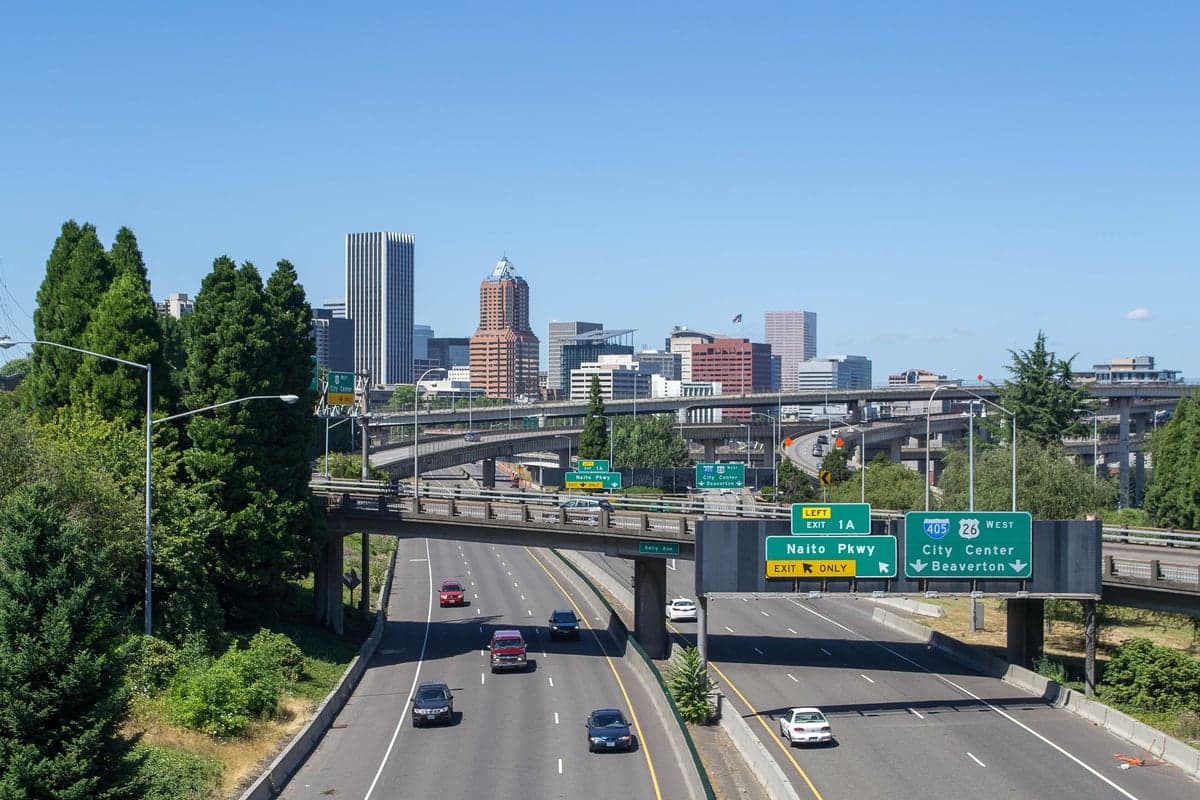
Photo: Wikipedia
Political ClimatePolitical Climate in Multnomah County
Showing district-level results — no local-only data available.
Local Political AnalysisPolitical Analysis of Multnomah County
Multnomah County is the bluest urban stronghold in Oregon, with a Cook Partisan Voting Index of D+24, making it one of the most reliably Democratic counties in the entire Pacific Northwest. That D+24 rating means Democrats outperform the national average by 24 points here, a massive margin that has only widened over the past two decades. In contrast, the state of Oregon as a whole sits at D+8, meaning Multnomah County is roughly 16 points more Democratic than the rest of Oregon. This gap has grown steadily since the 1990s, as the Portland metro area has become younger, more educated, and more culturally progressive, while rural and exurban parts of the state have trended rightward.
How it compares
To understand the political divide within Multnomah County itself, you have to look at specific neighborhoods and towns. Portland's inner eastside neighborhoods like Hawthorne, Alberta, and the Pearl District routinely deliver 85-90% of the vote to Democratic candidates, while Gresham, the county's second-largest city, leans Democratic but with a more moderate tilt, often hitting around 60-65% Democratic. Troutdale and Fairview, smaller suburbs along the Sandy River, are the county's most conservative pockets, occasionally voting 45-50% Republican in local races, though they still trend blue in presidential elections. The contrast is stark: a precinct in the West Hills of Portland might vote 92% Democratic, while a precinct in far east Multnomah County near the Clackamas County line might vote 55% Democratic. This internal variation is driven by income, education, and housing density—denser, walkable urban areas vote far left, while lower-density suburban and rural fringe areas are more centrist.
What this means for residents
For liberal residents, the political climate means their values are reflected in nearly every level of local government—from the Portland City Council to the Multnomah County Board of Commissioners to the state legislative delegation. Policies like universal preschool funding, rent control, and police reform have been enacted here years ahead of the rest of Oregon. For conservative residents, the reality is that they are a distinct minority in local elections, often seeing their preferred candidates lose by 20-30 points. However, they still have influence in state-level races, because Oregon's statewide elections are more competitive—the D+8 PVI means Republicans can win statewide office (like the 2022 governor's race, which was decided by just 3 points). Conservative residents in Multnomah County often feel their votes are "wasted" in local races, but they can still swing state-level primaries and general elections, especially in low-turnout special elections.
Culturally, the county's political dominance has created a distinct policy environment that sets it apart from the rest of Oregon. Multnomah County is the only county in Oregon with a county-level income tax (the Preschool for All tax, passed in 2020), and it has the state's most aggressive homeless services and drug decriminalization policies. The county's Board of Commissioners has been all-Democratic since 2006, and the Portland City Council has had no Republican members since 2012. This uniformity means that policy debates here are often about how far left to go, not whether to go left at all. Looking ahead, the trajectory is for the county to become even more Democratic as Portland's urban core densifies and younger, more progressive residents replace older, more moderate homeowners. The D+24 PVI is likely to hold or even deepen through the 2028 election cycle, barring a major demographic or economic shock.

State Political ClimatePolitical Climate in Oregon
State Political AnalysisPolitical Environment in the State
Oregon is a reliably Democratic state at the presidential level, with a Cook PVI of D+8, but that label hides a deeply fractured political reality. The state hasn’t voted for a Republican presidential candidate since 1984, yet it’s also home to some of the most conservative rural counties in the West, and the statewide partisan balance has shifted leftward over the past 20 years as the Portland metro area has grown and become more progressive. For a conservative-leaning relocator, the key takeaway is that Oregon’s politics are a tale of two states: the urban Willamette Valley corridor, which drives statewide elections, and the rest of the state, which feels like a different country.
Urban vs. rural divide
The political map of Oregon is defined by a stark urban-rural split. Multnomah County (Portland) alone casts about 20% of the state’s vote and delivers margins of 70-80% Democratic, effectively deciding statewide races before rural votes are counted. The I-5 corridor from Portland south through Salem and Eugene forms a solid blue wall, with Lane County (Eugene) and Washington County (suburban Portland) also voting reliably Democratic. In contrast, the vast eastern two-thirds of the state—places like Bend, Medford, Grants Pass, and Pendleton—vote Republican by wide margins. Deschutes County (Bend) has been a notable battleground: it voted for Obama in 2008, then flipped to Trump in 2016 and 2020, reflecting the influx of conservative-leaning Californians and retirees. The rural-urban divide isn’t just about party ID; it’s about culture, with rural residents feeling increasingly alienated from Portland-centric policy on land use, gun rights, and education.
Policy environment
Oregon’s policy environment is shaped by a progressive majority in the state legislature and a Democratic governor, but with significant constraints. The state has no sales tax, which is popular across the political spectrum, but relies heavily on a progressive income tax (top rate 9.9%) and high property taxes in some counties. The regulatory posture is among the most stringent in the West: land-use laws under the 1973 Senate Bill 100 tightly control urban growth boundaries, making housing expensive and development slow. Education policy is a flashpoint—Oregon consistently ranks near the bottom nationally in graduation rates and test scores, and the state has moved toward progressive curriculum mandates, including ethnic studies and LGBTQ-inclusive materials, which frustrates many conservative families. Healthcare is heavily regulated, with a state-run insurance exchange and expanded Medicaid under the Oregon Health Plan. Election laws are among the most accessible in the nation: Oregon was the first state to vote entirely by mail (1998), with automatic voter registration and same-day registration, which tends to boost Democratic turnout. Gun laws are restrictive—Oregon passed a voter-approved magazine capacity limit and a permit-to-purchase requirement in 2022 (Measure 114), though it’s been tied up in court. For a conservative, the policy environment feels like a constant uphill battle at the state level, but local control in rural counties offers some buffer.
Recent policy direction
The last five years have seen Oregon lurch leftward on several fronts, with notable pushback. In 2023, the legislature passed a sweeping package on abortion access and gender-affirming care (House Bill 2002), protecting providers from out-of-state lawsuits and expanding coverage. On gun rights, Measure 114 (2022) banned magazines over 10 rounds and required a permit to purchase, but it’s been blocked by a state court ruling that found it violates the Oregon Constitution’s right to bear arms—a case still pending. On property rights, the 2019 “tenant protection” bill (SB 608) capped rent increases at 7% plus inflation and limited no-cause evictions, which landlords and developers argue has chilled new construction. On education, the 2021 Student Success Act directed $1 billion annually to K-12, but conservative parents have mobilized against curriculum transparency and mask mandates, leading to school board recall efforts in places like Canby and Newberg. On voting, Oregon’s mail system remains intact, but a 2023 law (HB 2005) banned “ballot harvesting” by paid third parties, a nod to election integrity concerns. On privacy, the state passed a strong consumer data privacy law (SB 619) in 2023, but surveillance by local police remains a concern in Portland. The overall direction is toward more regulation and progressive social policy, but the courts and local resistance have slowed some of the most aggressive measures.
Civil unrest & political movements
Oregon has a long history of political activism, from the 2020 Portland protests (which saw nightly clashes between federal agents and demonstrators) to the rise of rural secession movements. The 2020 unrest in Portland was a national flashpoint, with the city becoming a symbol of left-wing militancy; property damage and arson were widespread, and the city’s reputation still suffers. On the right, the “Greater Idaho” movement has gained traction in 11 eastern Oregon counties that have voted to consider seceding to join Idaho, citing cultural and political alienation from Portland. While legally unlikely, it reflects deep frustration. Immigration politics are less heated than in border states, but Oregon is a “sanctuary state” (1987 law), meaning local law enforcement doesn’t cooperate with federal immigration authorities—a point of contention in rural areas. Election integrity controversies have been muted compared to other states, but the 2020 election saw Trump supporters protest outside the state capitol in Salem, and a 2022 audit found no widespread fraud. A new resident would notice the political polarization in everyday life: Portland’s “defund the police” rhetoric versus rural counties where sheriff’s deputies are revered. The flashpoints are real, but most of the state outside the I-5 corridor is quiet and conservative-leaning.
Projection
Over the next 5-10 years, Oregon’s political trajectory points toward continued Democratic dominance at the state level, but with growing internal friction. Demographic trends favor the left: the Portland metro area is growing faster than rural counties, and in-migration from California (which leans Democratic) reinforces the blue vote. However, the 2022 gubernatorial race was a three-way contest where the Democrat won with only 47% of the vote, suggesting a ceiling for progressive candidates. The “Greater Idaho” movement will likely remain a symbolic protest rather than a real split, but it could force the legislature to address rural concerns. Housing costs and homelessness will remain central issues, and the state’s land-use restrictions will continue to constrain supply, pushing more conservatives to exurbs like Hillsboro or Beaverton or to smaller cities like Redmond or Roseburg. Gun rights will be a persistent battleground, with Measure 114 likely to be resolved by the state supreme court. For a conservative moving in now, expect the state government to remain hostile to your values on most social and economic issues, but local communities—especially east of the Cascades—will feel like a safe harbor. The practical reality is that Oregon is a place where you can live a conservative life in a blue state, as long as you’re willing to drive an hour to the nearest big-box store and accept that your vote for president won’t matter.
For a conservative relocator, Oregon offers a trade-off: stunning natural beauty, no sales tax, and strong local communities in rural areas, but a state government that will consistently pass laws you disagree with on guns, education, and taxes. If you’re moving to Bend or Medford, you’ll find plenty of like-minded neighbors and a growing conservative infrastructure. If you’re moving to Portland or Eugene, you’ll be in the minority. The bottom line: Oregon is a blue state with red pockets, and your experience will depend entirely on which pocket you choose.
* Values derived from national, state, county, city and local statistics and may differ in a specific area. Last updated: 2026-06-12T09:29:35.000Z
Narrative content on this page is AI-generated and may contain mistakes. Verify any details that matter before acting on them.
ReloMaps may earn a commission from affiliate links at no extra cost to you.

