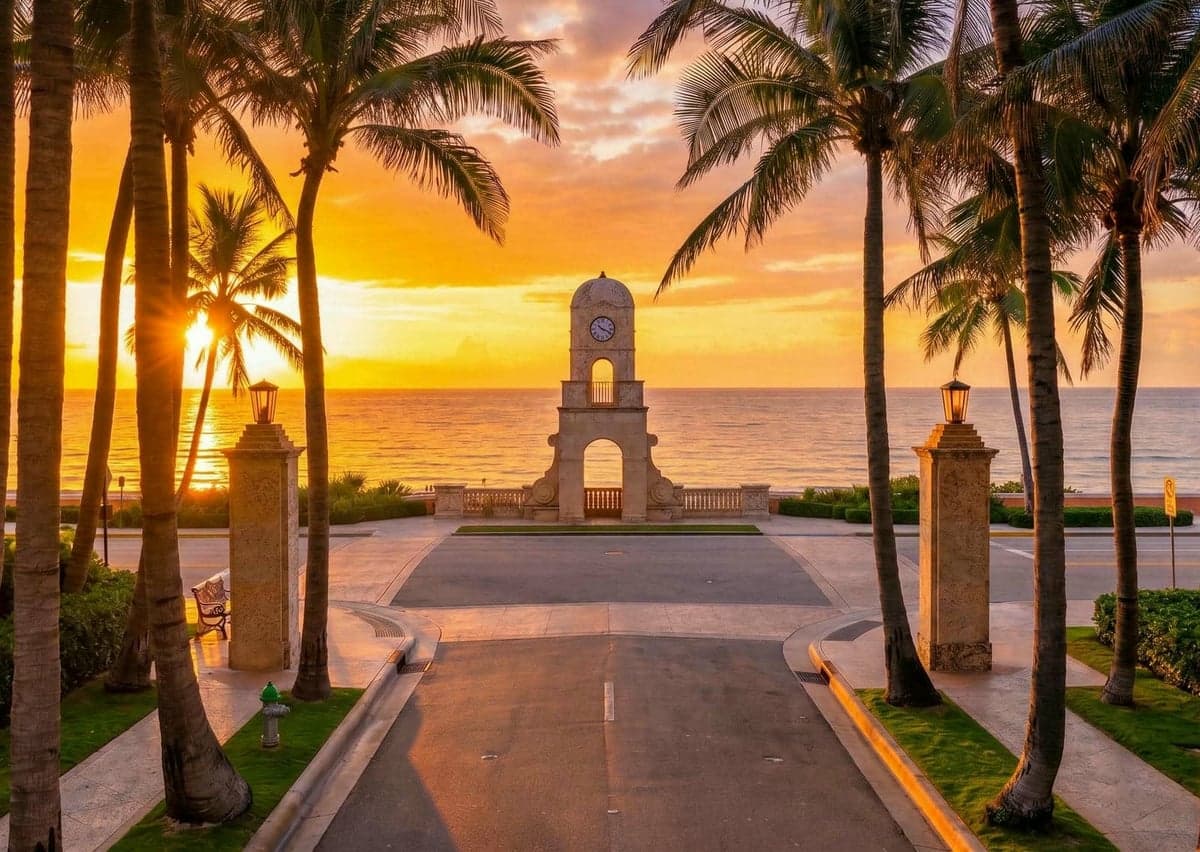
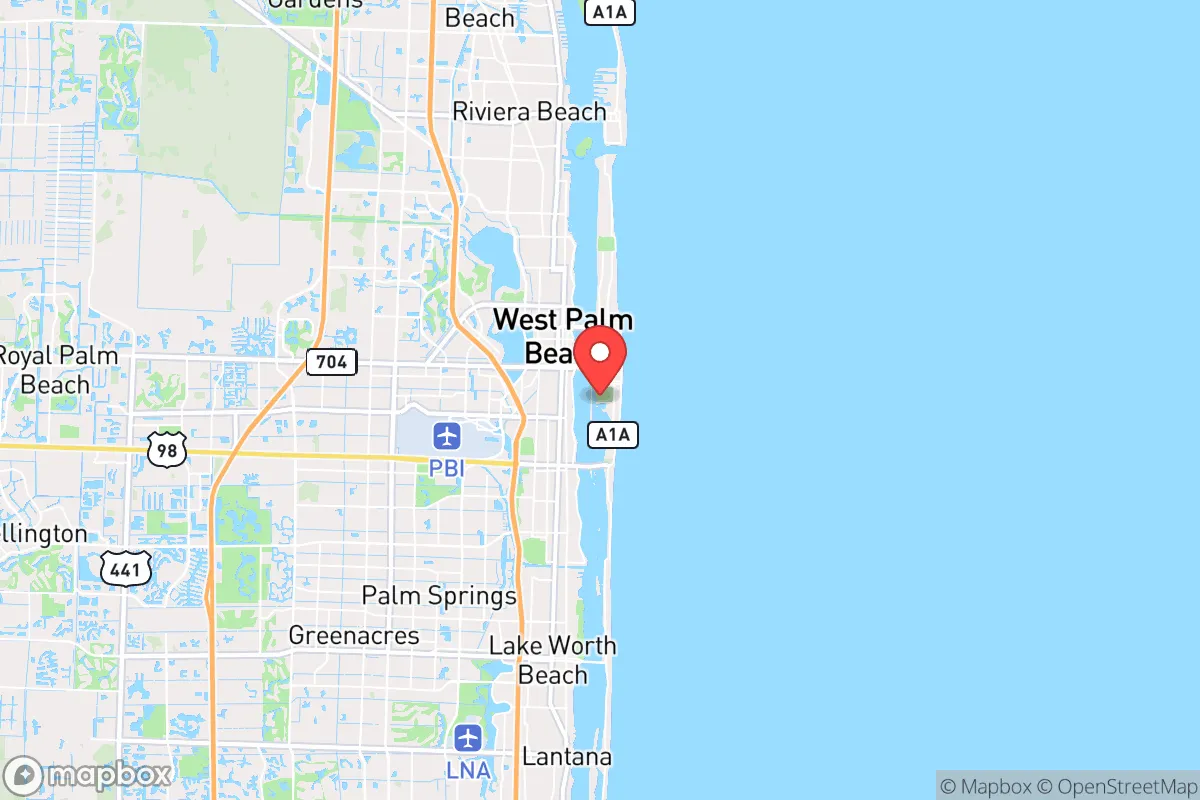
Photo: Made with AI
Strategic Assessment of Palm Beach, FL
Meaningful friction. Expect exposure to either population pressure, blast zones, or natural disaster risk. Consider buying a retreat property.
What does the Strategic Assessment tell us?
Our Strategic Assessment grades tactical survivability of an area. Major population centers, military targets, fallout zones, natural disasters, and border exposure all drive risk — lower exposure means a more defensible position in a crisis.
This is heavily inspired by Joel Skousen's Strategic Relocation book. Highly recommended you checkout the book ($)What does this tell us?
Our Strategic Assessment grades tactical survivability of an area. Major population centers, military targets, fallout zones, natural disasters, and border exposure all drive risk — lower exposure means a more defensible position in a crisis.
This is heavily inspired by Joel Skousen's Strategic Relocation book. Highly recommended you checkout the book ($)Strategic Pillars

Key Distances
Regional Safe Places
Below is our recommended "safe zones" in Florida and the surrounding area based on our strategic heuristics. For most people, it's unrealistic to live in a “safe zone” full-time due to work, family or other personal reasons. They tend to be more rural. However, many of these areas are perfect for second homes and retreat properties that double as a vacation home or even a short-term rental.

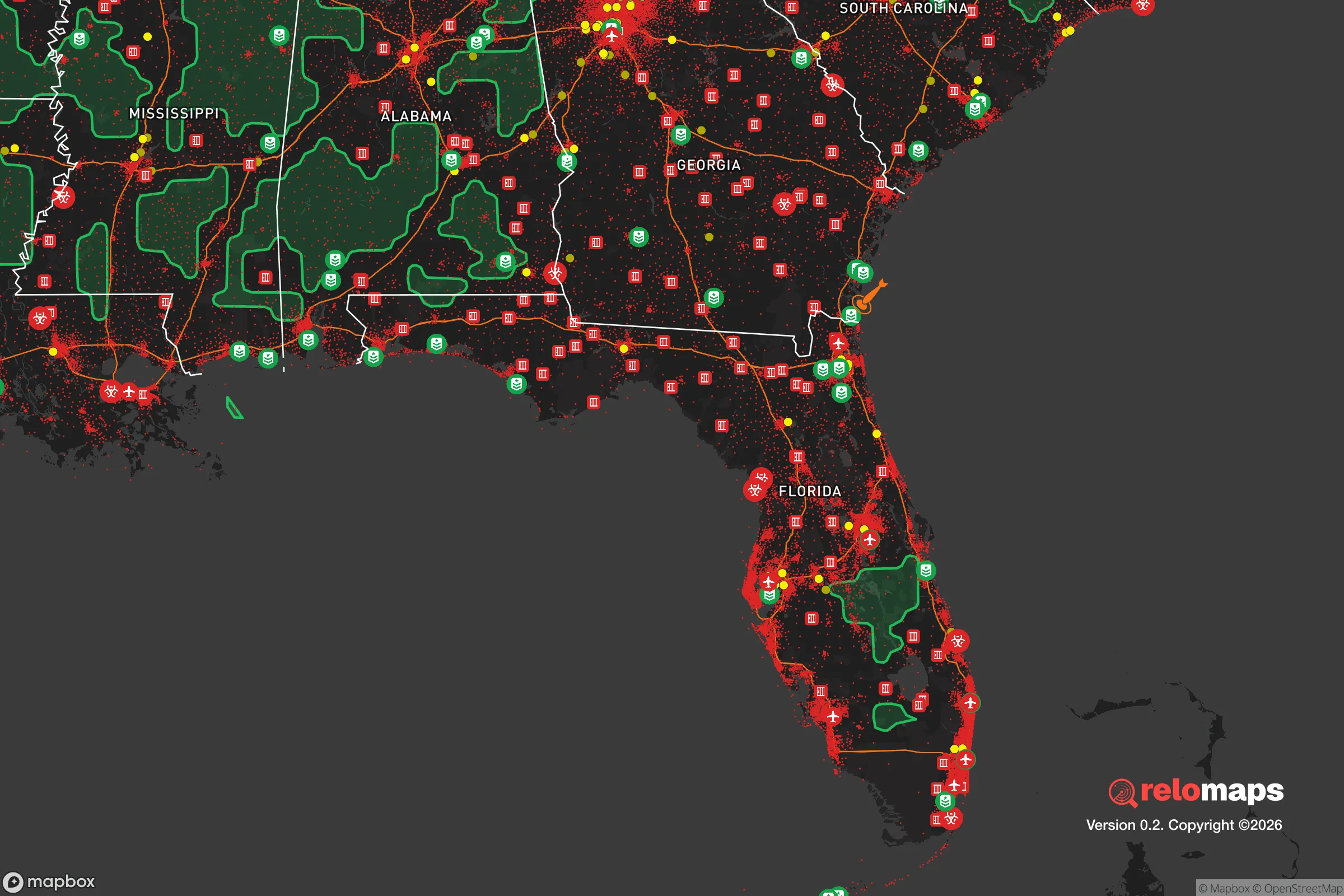


Important Note: For informational purposes only. This does not mean nothing bad ever happens in the green zones. Please use common sense. This is based on public data and modeled with AI. We tried to take a conservative approach but mistakes happen. We update this regularly as new information becomes available.
Solar Generator Recommendations
Backup power matters more here than in safer locations. We've picked three solar generators across budgets and capacity tiers — start with the budget unit if you only need a few essentials, or step up if you want to run a fridge and HVAC for days at a time.

Jackery Portable Power Station Explorer 300
Budget OptionPower on the Go: Weighing only 11 lbs, it's convenient to set up and store with book-sized foldable solar panels

BLUETTI Portable Power Station AC180
Designed for both indoor and outdoor scenarios, AC180 is highly capable as it has a robost capacity and continuous output power.

EF ECOFLOW DELTA Pro Ultra Power Station
Upgraded PickEcoFlow DELTA Pro Ultra is a whole-home energy system designed to grow with your family. Integrated with the Smart Home Panel 2, it scales to meet your evolving energy needs — keeping your home powered, intelligent, and secure through every stage of life.
We earn a commission, at no additional cost to you.
Strategic Assessment Analysis
Palm Beach, Florida, often conjures images of gilded estates and manicured hedgerows, but from a strategic relocation standpoint, its value lies in a different kind of currency: geographic insulation and a layered resilience profile that few coastal enclaves can match. For the conservative-minded prepper or survivalist, this island town offers a paradox—extreme wealth concentration that creates a natural buffer zone, coupled with a physical position that is both a fortress and a liability. The key is understanding that Palm Beach is not a retreat for bugging out to the wilderness; it is a hardened position for those who can afford to ride out a storm, both literal and societal, within a highly controlled environment.
Geographic position and natural advantages for long-term stability
Palm Beach sits on a barrier island, separated from the mainland of West Palm Beach by the Intracoastal Waterway. This 16-mile-long sliver of land is accessible by only three bridges—the Royal Park Bridge, the Flagler Memorial Bridge, and the Southern Boulevard Bridge. In a scenario of civil unrest or mass casualty event, this limited chokepoint access is a significant tactical advantage. The island’s narrow geography means that a small, determined group could effectively control ingress and egress, creating a defensible perimeter that is far more manageable than a sprawling suburban grid. The natural barrier of the Atlantic Ocean to the east and the Intracoastal to the west provides a moat-like effect, making spontaneous mob movements or vehicle-based incursions difficult. Furthermore, the island’s elevation, while modest, is slightly higher than many surrounding coastal areas, offering a marginal but real advantage against storm surge. The prevailing easterly trade winds also provide natural ventilation and a degree of cooling, reducing reliance on mechanical systems during a prolonged grid-down scenario. The proximity to the Gulf Stream current also means the local marine ecosystem is robust, offering a potential food source for those with the skills to harvest it.
Risks, exposures, and proximity to fallout-relevant landmarks
The most glaring vulnerability is Palm Beach’s position as a prime target for both natural and man-made disasters. Its very desirability makes it a high-value asset. Hurricane risk is existential; a Category 4 or 5 storm would render the island uninhabitable for weeks, if not months, due to storm surge, wind damage, and the destruction of the sole causeways. The 2022 Hurricane Ian near-miss was a stark reminder that the island’s luck can run out. Beyond weather, the concentration of wealth makes it a potential target for organized looting or targeted violence during a breakdown of civil order. The island is also within a 30-minute drive of Palm Beach International Airport (PBI) and less than an hour from the Port of Palm Beach, both of which are potential staging areas for federal response or, conversely, vectors for disease or contamination in a pandemic or bioweapon scenario. Proximity to the mainland’s urban core—West Palm Beach, with its population of over 120,000—is a double-edged sword. In a crisis, the mainland population could surge toward the bridges, creating a desperate, potentially hostile crowd at the island’s gates. The presence of Mar-a-Lago, a former president’s residence, also elevates the area’s profile as a symbolic target for domestic terror or foreign-directed action. The island’s very fame is a liability.
Practical resilience for a relocator: food, water, energy, and defensibility
For a relocator, the practicalities of daily life on Palm Beach during a crisis are dictated by one factor: money. The island is not designed for self-sufficiency. There is no meaningful agricultural land, no freshwater aquifer accessible to residents, and no local energy generation beyond the grid. All food, water, and fuel must be trucked over the bridges. A prepper’s plan here must therefore be based on stockpiling and private infrastructure. The wealthy estates often have deep wells for irrigation, but these are not potable without treatment. Reverse osmosis systems and large-scale rainwater catchment are essential investments. Solar panels are common on newer homes, but battery storage is critical, as the grid is vulnerable to both hurricane damage and potential cyberattacks. Defensibility is the island’s strongest suit. The limited access points can be monitored and controlled. The community is already accustomed to private security—many estates have their own guards, and the town employs a robust police force. In a collapse scenario, a neighborhood watch or homeowners’ association could quickly formalize into a de facto security council. The key weakness is the lack of a fallback position. If the bridges are compromised or destroyed, the island becomes a trap. A strategic relocator should have a pre-planned maritime evacuation route—a private boat capable of crossing the Intracoastal or heading offshore to a secondary location in the Everglades or along the coast. The island’s yacht culture makes this a realistic option for those with resources.
The overall strategic picture for Palm Beach is one of high reward paired with high risk. It is not a location for the average prepper seeking off-grid self-reliance. It is a location for the high-net-worth individual or family who can afford to create a self-contained compound within a gilded cage. The island’s natural defenses—its isolation, limited access, and wealthy, security-conscious population—offer a degree of protection against the chaos of the mainland. However, this protection is brittle. A single bridge failure, a direct hurricane hit, or a prolonged supply chain disruption would expose the island’s fundamental dependency on external resources. For the conservative relocator who values order, privacy, and the ability to control their environment, Palm Beach can work—but only as part of a layered strategy that includes robust private infrastructure, a maritime escape plan, and a clear-eyed acceptance that this is a position to hold, not a wilderness to retreat to. It is a fortress, not a farm. And like any fortress, its strength is only as good as the supplies within its walls and the resolve of those who man the gates.

* Values derived from national, state, county, city and local statistics and may differ in a specific area. Last updated: 2026-05-14T02:25:10.000Z
Narrative content on this page is AI-generated and may contain mistakes. Verify any details that matter before acting on them.
ReloMaps may earn a commission from affiliate links at no extra cost to you.

