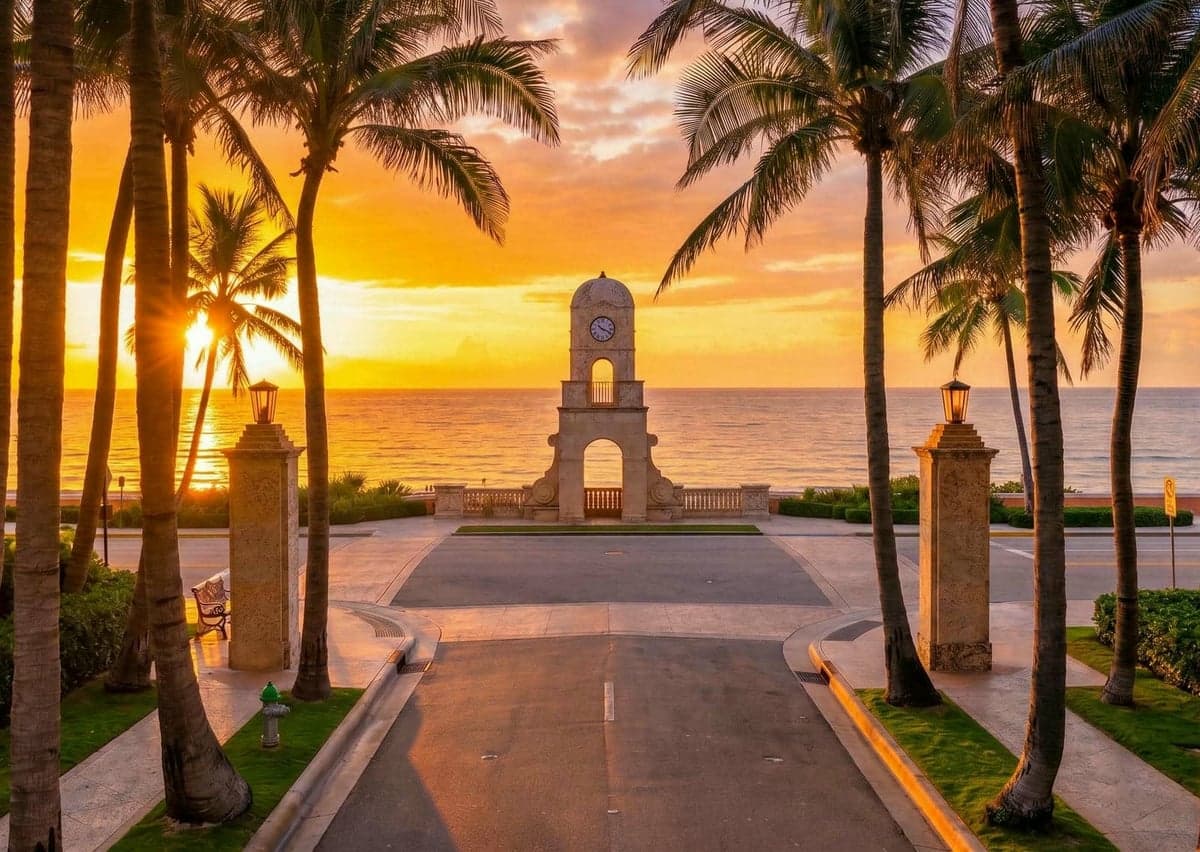
Photo: Made with AI
Personal Sovereignty in Palm Beach, FL
Viable for self-reliance. Generally workable, though some barriers may limit total independence.
What does Personal Sovereignty tell us?
Personal Sovereignty measures your capacity for self-reliance and independence with minimal government friction. Higher scores mean fewer barriers between you and the way you want to live... but it assumes you have the space you need and good neighbors.
What does this tell us?
Personal Sovereignty measures your capacity for self-reliance and independence with minimal government friction. Higher scores mean fewer barriers between you and the way you want to live... but it assumes you have the space you need and good neighbors.
State Policy
Energy independence: Importer (10% of energy produced in-state)
Personal Liberty
Homesteading

Personal Liberty Analysis
For the individual who values personal sovereignty above all else—the survivalist, the prepper, the parent who refuses to cede authority over their children to the state—Palm Beach, Florida presents a paradox of high autonomy and high scrutiny. The state of Florida, under Governor Ron DeSantis, has aggressively positioned itself as a fortress against federal overreach, with preemption laws that nullify local gun control, a Parental Rights in Education Act (the "Don't Say Gay" law), and a refusal to implement vaccine passports or mask mandates in schools. However, Palm Beach itself is a wealthy, heavily regulated enclave where the local government and powerful homeowners’ associations (HOAs) can impose restrictions that would make a libertarian wince. The net result: you get the full force of Florida’s state-level sovereignty protections, but you must navigate a local landscape that is far from laissez-faire. Your personal sovereignty here is less about living off-grid in the woods and more about legally and financially fortifying yourself within a system that, while friendly to conservative values, still demands compliance with strict property and zoning codes.
Tax burden and regulatory posture: How Florida’s no-income-tax model and preemption laws protect your wallet and choices
Florida’s tax structure is the single strongest pillar of personal sovereignty in Palm Beach. There is no state income tax, meaning the state does not take a cut of your labor, investments, or retirement withdrawals. This is a massive advantage for anyone seeking to maximize self-reliance—every dollar you earn stays in your pocket to spend on land, supplies, or savings. The state sales tax is 6%, but local options in Palm Beach County push it to 7% on most goods, though groceries and prescription drugs are exempt. Property taxes are a mixed bag: the average effective rate in Palm Beach County is around 1.0% of assessed value, which is moderate for Florida, but with median home values hovering near $600,000, the annual bill is substantial. The Save Our Homes amendment caps annual assessment increases at 3% for homesteaded properties, which is a powerful tool for long-term residents to lock in low taxes, but new buyers pay full market rate. On the regulatory front, Florida has a strong preemption doctrine: state law overrides local ordinances on firearms, occupational licensing, and pandemic restrictions. This means Palm Beach cannot enact its own gun bans or business shutdowns that exceed state law. However, the town of Palm Beach itself has notoriously strict zoning and historic preservation boards that can dictate paint colors, fence heights, and tree removal. For the prepper, this means you can legally stockpile ammunition and build a survival library, but you cannot erect a privacy fence over six feet without a variance, and you certainly cannot dig a bunker without extensive permitting. The regulatory posture is thus a trade-off: state-level freedom from income tax and local tyranny, but municipal-level control over your physical property.
Self-defense and gun law specifics: Constitutional carry, castle doctrine, and what that means for daily carry in Palm Beach
Florida is a constitutional carry state as of July 1, 2023, meaning any law-abiding adult 21 or older can carry a concealed firearm without a permit. Open carry is generally prohibited except for hunting, fishing, or camping, but the practical effect for daily life is that you can keep a pistol hidden on your person or in your vehicle without government permission. The castle doctrine is fully codified in Florida Statute 776.013, establishing a presumption of reasonable fear of death or great bodily harm if an intruder unlawfully enters your occupied dwelling, residence, or vehicle. There is no duty to retreat anywhere you have a legal right to be—this is a true stand-your-ground state. For Palm Beach specifically, the local police department is well-funded and responsive, but response times in the wealthier barrier island neighborhoods can be faster than in the western suburbs. The county sheriff’s office is generally pro-Second Amendment, and there are no local ordinances that further restrict state law. However, be aware that Palm Beach International Airport and many private clubs and gated communities have their own security checkpoints and weapon policies. If you live in a high-rise condo or an HOA-controlled subdivision, the association may ban firearms in common areas, though your unit remains your castle. For the survivalist, the legal framework is excellent: you can defend your home and family with lethal force, carry concealed without a permit, and buy any firearm not restricted by federal law (NFA items like suppressors and short-barreled rifles are legal with a tax stamp). The practical limitation is that you cannot open carry in public, and you must be mindful of posted "no guns" signs at private businesses, which carry the force of trespassing law.
Self-reliance and homesteading viability: Lot sizes, zoning, and off-grid feasibility in a manicured paradise
If your vision of personal sovereignty involves raising chickens, growing your own food, drilling a well, and disconnecting from the grid, Palm Beach is a challenging environment. The town of Palm Beach itself is composed almost entirely of estate-sized lots (often half an acre to several acres) on the barrier island, but these properties are governed by the Palm Beach Architectural Review Commission and strict zoning codes that prohibit agricultural uses, livestock, and anything that could be deemed "unsightly." You cannot keep chickens, goats, or bees within the town limits. Rainwater collection is technically allowed but must be integrated into the landscaping plan and cannot be visible from the street. Solar panels are permitted but must be flush-mounted and not visible from the road—effectively banning ground-mounted arrays. In the unincorporated areas of Palm Beach County, such as the western communities near the Loxahatchee National Wildlife Refuge, lot sizes can be as large as 5 to 20 acres, and zoning is more permissive. Here, you can keep horses, chickens, and even small livestock, and you can install solar panels, rainwater cisterns, and backup generators without much hassle. However, off-grid living is effectively illegal in all of Palm Beach County: the county requires connection to the municipal water and sewer system if available, and there is no provision for composting toilets or permanent off-grid power. You can have a generator and solar as backup, but you must maintain a grid connection. For the serious prepper, the western agricultural reserve areas offer the best balance—large lots, lower density, and fewer HOAs—but you will still pay a premium for land and face county-level building codes that mandate modern construction standards. Homesteading here is possible, but it looks more like a well-managed hobby farm than a self-sufficient compound.
Personal liberties: Parental rights, medical autonomy, free speech, and property rights in the post-2020 landscape
Florida has become a national battleground for personal liberties, and Palm Beach sits at the center of that fight. On parental rights, the state’s Parental Rights in Education Act (HB 1557) prohibits classroom instruction on sexual orientation and gender identity in grades K-3, and gives parents the right to review school materials and opt their children out of any instruction they find objectionable. The school district of Palm Beach County, one of the largest in the nation, has implemented these laws, though enforcement has been uneven and subject to legal challenges. For parents who want to homeschool or enroll in private religious schools, Florida offers a robust school choice system with tax-credit scholarships and education savings accounts (ESAs) that can be used for tuition, curriculum, and tutoring. On medical autonomy, Florida banned vaccine passports and prohibited mask mandates in schools during the pandemic, and Governor DeSantis signed a law in 2023 banning mRNA COVID-19 vaccines for children under 18 and prohibiting any future vaccine mandates by private employers. This is a strong signal that the state respects individual medical choice, though the practical effect in Palm Beach is that many private doctors and hospitals still follow CDC guidelines. Free speech is protected under the Florida Constitution, and the state has passed laws to protect conservative speakers on college campuses and to prevent "deplatforming" by social media companies. In Palm Beach, the local political climate is mixed—the island itself is heavily Republican, while West Palm Beach and Lake Worth are more liberal—but you can generally express your views without fear of government retaliation. Property rights are the weakest link: the town’s historic preservation ordinances and HOA covenants can restrict what you do with your land, and eminent domain is a real concern for large-scale redevelopment projects. The state has a strong property rights law (the Bert Harris Act) that allows landowners to sue if a government regulation reduces property value, but it is rarely invoked successfully against local zoning boards.
Overall, Palm Beach offers a high degree of personal sovereignty relative to most coastal urban areas in the United States, but it is not a libertarian paradise. The state-level protections—no income tax, constitutional carry, parental rights, medical autonomy—create a legal environment where you can live your life largely free from government intrusion. However, the local reality of Palm Beach is one of strict property regulation, high cost of living, and a culture that values conformity and aesthetics over rugged individualism. For the survivalist or prepper who wants to be left alone, the western parts of the county or even neighboring Martin County offer more room to breathe. For the conservative professional who wants to protect their family within the system while enjoying world-class amenities, Palm Beach is a strong contender. The sovereignty here is real, but it is the sovereignty of a fortress within a city, not a cabin in the woods.

* Values derived from national, state, county, city and local statistics and may differ in a specific area. Last updated: 2026-05-14T02:25:10.000Z
Narrative content on this page is AI-generated and may contain mistakes. Verify any details that matter before acting on them.
ReloMaps may earn a commission from affiliate links at no extra cost to you.

