Photo: Wikipedia
Demographics of Panama City Beach, FL
Affluence Level in Panama City Beach, FL
An upper-middle-class area. Household wealth, education levels, and homeownership run ahead of national benchmarks.
People of Panama City Beach, FL
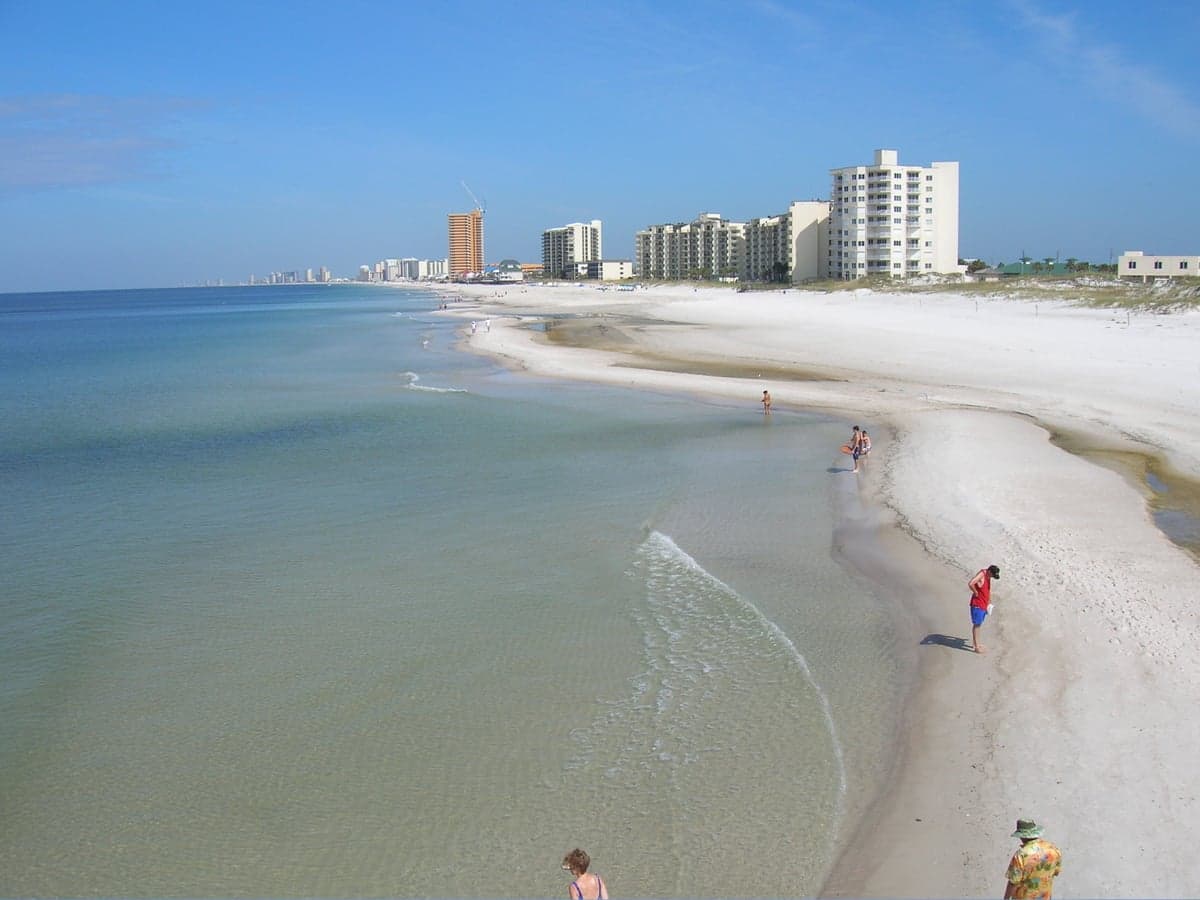
Panama City Beach, Florida, is a city of 18,493 residents that remains predominantly white (77.8%) with a growing Hispanic (8.6%) and Black (7.1%) presence, shaped by tourism, military connections, and Sun Belt migration. The foreign-born population stands at 5.6%, with East/Southeast Asian (1.0%) and Indian subcontinent (1.0%) communities forming small but distinct enclaves. Over a third of adults (36.8%) hold a college degree, reflecting a workforce tied to hospitality, healthcare, and construction. The city’s identity is rooted in its beachfront economy and seasonal rhythms, with a population that swells dramatically during spring break and summer months.
How the city was settled and grew
Panama City Beach was not a colonial-era settlement; its development began in earnest after World War II. The area was sparsely populated until the 1930s, when the construction of the Hathaway Bridge (completed 1938) connected the beach to Panama City on the mainland. The original population consisted of small fishing and farming families, with the first subdivisions emerging along the Gulf of Mexico. The post-war tourism boom of the 1950s and 1960s drew the first major wave of permanent residents, primarily white families from the Southeast and Midwest seeking work in the growing hospitality industry. The Thomas Drive corridor became an early hub for motels and seasonal housing, while the area around Front Beach Road saw the construction of beach cottages and small apartment complexes. By 1970, the population was nearly entirely white, with a small Black community concentrated in the St. Andrews area (a historic neighborhood on the mainland side of the bridge) rather than on the beach itself.
Modern era (post-1965)
The 1965 Hart-Cellar Act had a limited direct impact on Panama City Beach, as the city’s foreign-born population remains modest at 5.6%. Instead, the modern era has been defined by domestic in-migration. The 1980s and 1990s saw a surge of retirees and second-home buyers from the Midwest and Northeast, drawn by low property taxes and warm winters. These newcomers settled in newer subdivisions like Edgewater Beach and the gated communities along Panama City Beach Parkway, which offered larger lots and modern amenities. The Hispanic population began growing in the 1990s, driven by construction and service-sector jobs; many families settled in the Laguna Beach area (the western end of the city) and in apartment complexes near Pier Park. The Black population, historically small on the beach itself, has grown modestly to 7.1%, with residents concentrated in the Long Beach Resort area and scattered throughout the city’s rental stock. The East/Southeast Asian community (1.0%) is largely tied to the hospitality industry, with families living in the Bid-A-Wee neighborhood near the beach. The Indian subcontinent community (1.0%) includes professionals in healthcare and engineering, with households spread across the city rather than in a single enclave.
The future
Panama City Beach is likely to continue its trajectory of moderate growth, driven by domestic migration rather than international immigration. The foreign-born share (5.6%) is below the national average and is expected to plateau, as the city lacks the industrial or agricultural base that attracts large immigrant populations in other parts of Florida. The Hispanic share (8.6%) is the fastest-growing demographic segment, projected to reach 12-14% by 2035, driven by natural increase and continued migration from other parts of the state. The white population (77.8%) will remain the majority but will slowly decline as a share of the total, as younger white residents move to larger metro areas for career opportunities. The Black population (7.1%) is stable, with growth limited by the city’s high housing costs and seasonal economy. The East/Southeast Asian and Indian communities are likely to remain small, as the city does not have the tech or academic sectors that attract these groups in larger numbers. The city is not tribalizing into distinct ethnic enclaves; instead, it is slowly homogenizing into a predominantly white, English-dominant community with a growing Hispanic minority that is assimilating into the broader culture.
For a conservative-leaning individual or family considering relocation, Panama City Beach offers a stable, low-density environment with a strong tourism economy and a population that is overwhelmingly native-born and English-speaking. The city is becoming slightly more diverse, but the pace is slow, and the cultural character remains rooted in its beach-town identity. The next decade will likely see continued growth in the Hispanic population, but without the rapid demographic shifts seen in larger Florida cities like Miami or Orlando. This is a place where the population is evolving gradually, not transforming.

* Values derived from national, state, county, city and local statistics and may differ in a specific area. Last updated: 2026-05-13T17:02:50.000Z
Narrative content on this page is AI-generated and may contain mistakes. Verify any details that matter before acting on them.
ReloMaps may earn a commission from affiliate links at no extra cost to you.

