 Popular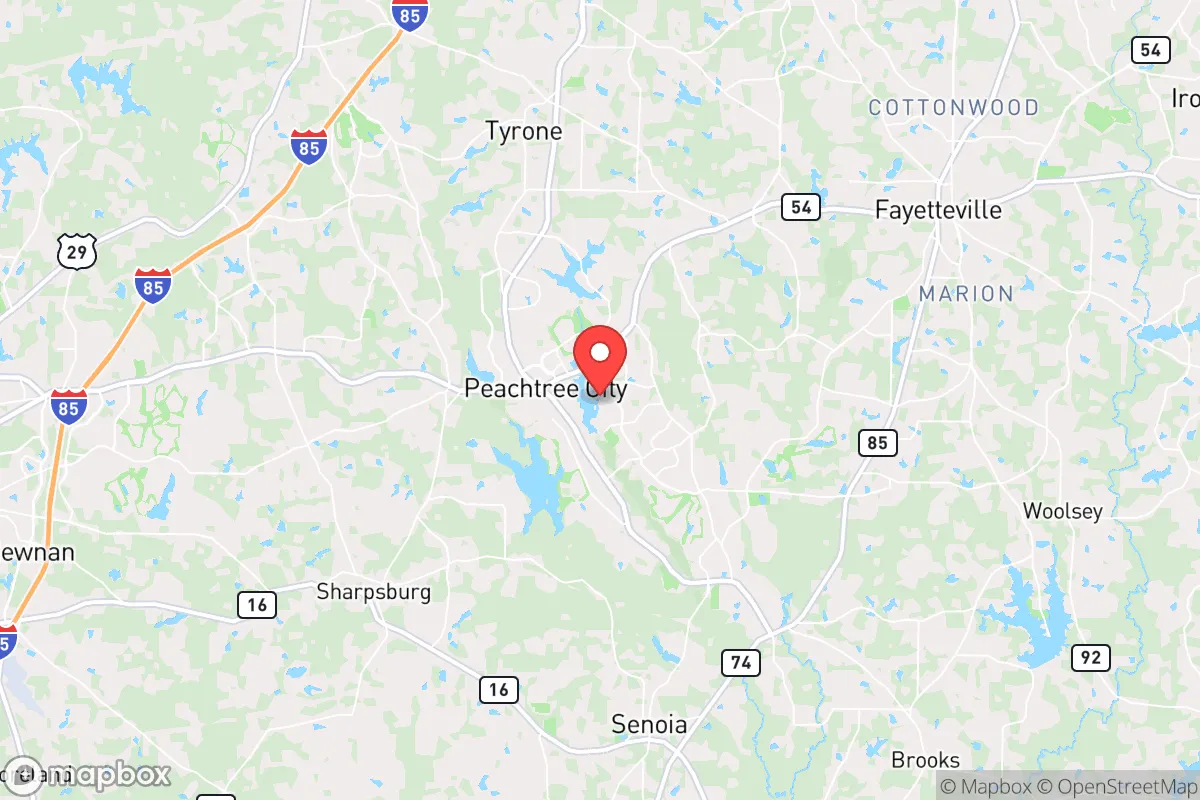
Photo: Wikipedia
Political ClimatePolitical Climate in Peachtree City, GA
District shown is the primary district for this city’s centroid. Cities may span multiple districts.
Local Political AnalysisPolitical Analysis of Peachtree City, GA
Peachtree City has long been a stronghold for conservative values, and that hasn't changed much despite the rapid growth all around metro Atlanta. The area's Cook Partisan Voting Index of R+15 tells you everything you need to know about the baseline here—this is a place where folks still believe in limited government, personal responsibility, and keeping the government out of your backyard and your wallet. If you look at the voting patterns over the last decade, you'll see that while the suburbs closer to Atlanta have shifted left, Peachtree City has held firm, with Republican candidates routinely winning by double digits in local, state, and federal races. That said, there's been a subtle but real undercurrent of concern among long-time residents as new development brings in folks from more progressive areas, and some worry that the next decade could see a slow erosion of the community's core principles if we're not careful.
How it compares
Drive 15 minutes north to Fayetteville, and you'll notice a slightly different vibe—still conservative, but with more of a mixed bag in local elections, especially as the county seat attracts more government-adjacent types. Head east toward Stockbridge or McDonough in Henry County, and you're in a completely different world; those areas have flipped from reliably red to competitive or even blue in recent cycles, thanks to an influx of Atlanta commuters and younger families. Peachtree City's political climate stands out because it's not just about voting—it's about a culture of self-governance. The city's famous golf cart paths and strict zoning laws are a perfect example: residents here want local control, not state or federal mandates telling them how to live. Compare that to nearby Newnan, which has seen more progressive city council candidates win seats in the last few years, and you can see why Peachtree City feels like a last bastion of common sense in a region that's slowly losing its way.
What this means for residents
For the people who live here, the political climate translates directly into daily life. You don't have to worry about the city council pushing through woke policies or overreaching regulations that infringe on your property rights. The school board, for instance, has consistently pushed back against critical race theory and other divisive curriculum changes that have plagued other districts in the state. Property taxes remain relatively low compared to neighboring counties, and there's a general understanding that the government's job is to pave the roads and keep the parks clean, not to tell you how to raise your kids or run your business. The downside? As more people discover Peachtree City, there's a growing tension between the old guard who want to keep things exactly as they are and newcomers who sometimes bring big-government ideas with them. If you value your freedoms and want to live somewhere that still respects the Tenth Amendment, this is still a great place—but you'll want to stay engaged in local politics to make sure it stays that way.
One cultural distinction that really sets Peachtree City apart is the fierce independence of its residents. You see it in the way people organize their own neighborhood watch programs, maintain their own golf carts, and push back against any hint of HOA overreach. The city's unique layout—with those miles of cart paths connecting everything—was designed to give people freedom of movement without relying on government-funded public transit. That spirit of self-reliance is what makes this place special, and it's why so many of us who've been here for decades are keeping a close eye on the next few election cycles. If the progressive wave that's swallowed up other Atlanta suburbs ever reaches Peachtree City, it won't be because the people here wanted it—it'll be because we got complacent. So far, we haven't, and that's the best news I can give you if you're thinking about making the move.

State Political ClimatePolitical Climate in Georgia
State Political AnalysisPolitical Environment in the State
Georgia has shifted from a reliably conservative stronghold to a true battleground state over the past two decades, with its partisan lean narrowing from a solid +8 Republican margin in 2004 to a razor-thin +0.2 Democratic margin in 2020 before settling back to a competitive +2.5 Republican lean in 2024. The state is now defined by a coalition of fast-growing, diverse metro Atlanta suburbs that lean Democratic, pitted against a deeply conservative rural and exurban base that still holds significant legislative power. For a conservative considering relocation, Georgia offers a mixed bag: low taxes and business-friendly policies at the state level, but a cultural and electoral trajectory that has shifted leftward faster than almost any other Southern state.
Urban vs. rural divide
The political map of Georgia is essentially a story of Atlanta versus everything else. The core of Atlanta (Fulton and DeKalb counties) is overwhelmingly Democratic, delivering margins of 70-80% for Democratic candidates. But the real story is the suburban ring — counties like Gwinnett, Cobb, and Henry, which were reliably Republican as recently as 2012, have flipped to Democratic control due to massive in-migration from other states and a diversifying population. Gwinnett County, for example, went from +15 Republican in 2012 to +14 Democratic in 2020. Meanwhile, the rest of the state remains deeply red: rural south Georgia counties like Brooks and rural north Georgia counties like Union routinely vote 70-80% Republican. The exurban counties on Atlanta’s fringe — Cherokee, Forsyth, and Paulding — have become the new Republican strongholds, absorbing conservatives fleeing the urban core. Outside of Atlanta, the only other significant Democratic pockets are the cities of Augusta, Savannah, Columbus, and Macon, but none of these metros are large enough to offset the Atlanta suburbs alone.
Policy environment
Georgia’s state-level policy environment remains broadly conservative, though with some notable exceptions. The state has a flat income tax rate of 5.49%, which is scheduled to drop to 4.99% by 2029 under legislation passed in 2022. Property taxes are relatively low, with a median effective rate of 0.87%, and there is no state inheritance or estate tax. The regulatory climate is business-friendly, with Georgia ranking in the top 10 nationally for ease of doing business. On education, the state has expanded school choice through the Georgia Promise Scholarship Act (2024), which provides $6,500 per student for private school tuition or homeschooling expenses. However, the state’s public school system remains heavily influenced by the metro Atlanta counties, which have adopted progressive curricula and DEI initiatives that many conservatives find concerning. On healthcare, Georgia did not expand Medicaid under the Affordable Care Act, but the state’s Waiver Program (2023) imposes work requirements on able-bodied adults, a policy conservatives generally support. Election laws were tightened with the Election Integrity Act of 2021 (SB 202), which added voter ID requirements for absentee ballots, limited drop boxes, and banned mobile voting vans — measures that have been criticized by progressives but defended by Republicans as necessary for security.
Trajectory & freedom
Georgia’s trajectory on personal freedom is a mixed picture that should give conservatives pause. On the positive side, the state has expanded gun rights significantly: Constitutional Carry (HB 218) was signed into law in 2022, allowing permitless carry of firearms for anyone 21 or older who can legally possess a gun. This was a major win for Second Amendment advocates. On parental rights, the Parental Rights in Education Act (HB 1178) was passed in 2023, requiring schools to notify parents of any changes to a student’s mental, emotional, or physical health — a direct response to concerns about schools hiding gender transitions from parents. However, the state has also seen concerning expansions of government power. The Georgia Hate Crimes Law (HB 426) passed in 2020, which conservatives argue creates a slippery slope for prosecuting protected speech. More troubling is the Medical Cannabis Expansion (HB 324) in 2023, which expanded the state’s low-THC oil program but also created a new regulatory bureaucracy. Property rights remain strong, with no statewide rent control and relatively weak eminent domain powers. The biggest freedom concern for conservatives is the growing influence of local governments in metro Atlanta, which have imposed mask mandates, vaccine requirements, and zoning restrictions that conflict with state law — a trend that shows no sign of reversing.
Civil unrest & political movements
Georgia has been a flashpoint for political activism on both sides. The 2020 election controversy remains a raw nerve, with many conservatives still questioning the integrity of the state’s election system despite multiple audits and recounts confirming the results. The Atlanta protests of 2020 over the killing of George Floyd saw significant property damage and arson, particularly around the city’s downtown and Midtown areas, leading to a conservative backlash that helped flip some suburban counties back toward Republicans in 2022. Immigration politics are increasingly visible: the Georgia Criminal Alien Program (HB 1105, 2024) requires local law enforcement to cooperate with ICE, but sanctuary city policies have been proposed in Atlanta and Athens, creating a patchwork of enforcement. The Stop Cop City movement — a militant activist campaign against the construction of a police training facility in DeKalb County — has led to violent clashes, with the state designating the group as a domestic terrorism organization. On the right, the Georgia Republican Assembly and MAGA-aligned groups have become increasingly active in primary challenges, pushing the party further right on issues like election integrity and immigration enforcement. A new resident would notice the stark contrast between the political signs and bumper stickers in rural areas (overwhelmingly pro-Trump) versus the Atlanta suburbs (a mix of moderate Republican and Democratic messaging).
Projection
Over the next 5-10 years, Georgia is likely to become more competitive, not less. The Atlanta metro area continues to grow rapidly, attracting a diverse, college-educated population that leans Democratic. The counties of Gwinnett, Cobb, and Henry are unlikely to flip back to Republican control barring a major political realignment. However, the exurban and rural areas are also growing, and the state’s legislative maps remain gerrymandered to favor Republicans, meaning the state legislature will likely stay conservative even if statewide elections become toss-ups. The biggest wild card is in-migration from blue states: many of the newcomers to the Atlanta suburbs are from California, New York, and Illinois, and they bring their voting habits with them. For a conservative moving to Georgia, the practical reality is that you can find a deeply red community in places like Forsyth County, Cherokee County, or Hall County, but you will be living in a state where the cultural and political center of gravity is shifting leftward. The state’s policy environment will likely remain conservative at the state level for the next decade, but local control in metro Atlanta will continue to erode conservative values.
For a conservative considering a move to Georgia, the bottom line is this: you can still find a strong community of like-minded people in the exurbs and rural areas, and the state-level policies on taxes, guns, and school choice are among the best in the country. But you need to be aware that the political winds are shifting, and the state’s major population center is increasingly hostile to conservative values. If you’re looking for a place where your vote will consistently matter and your values will be reflected in local government, stick to the counties north and east of Atlanta — Cherokee, Forsyth, Hall, and Jackson — and avoid the I-85 corridor south of the city. Georgia is still a good state for conservatives, but it’s no longer a safe one.
* Values derived from national, state, county, city and local statistics and may differ in a specific area. Last updated: 2026-04-23T05:27:54.000Z
Narrative content on this page is AI-generated and may contain mistakes. Verify any details that matter before acting on them.
ReloMaps may earn a commission from affiliate links at no extra cost to you.

