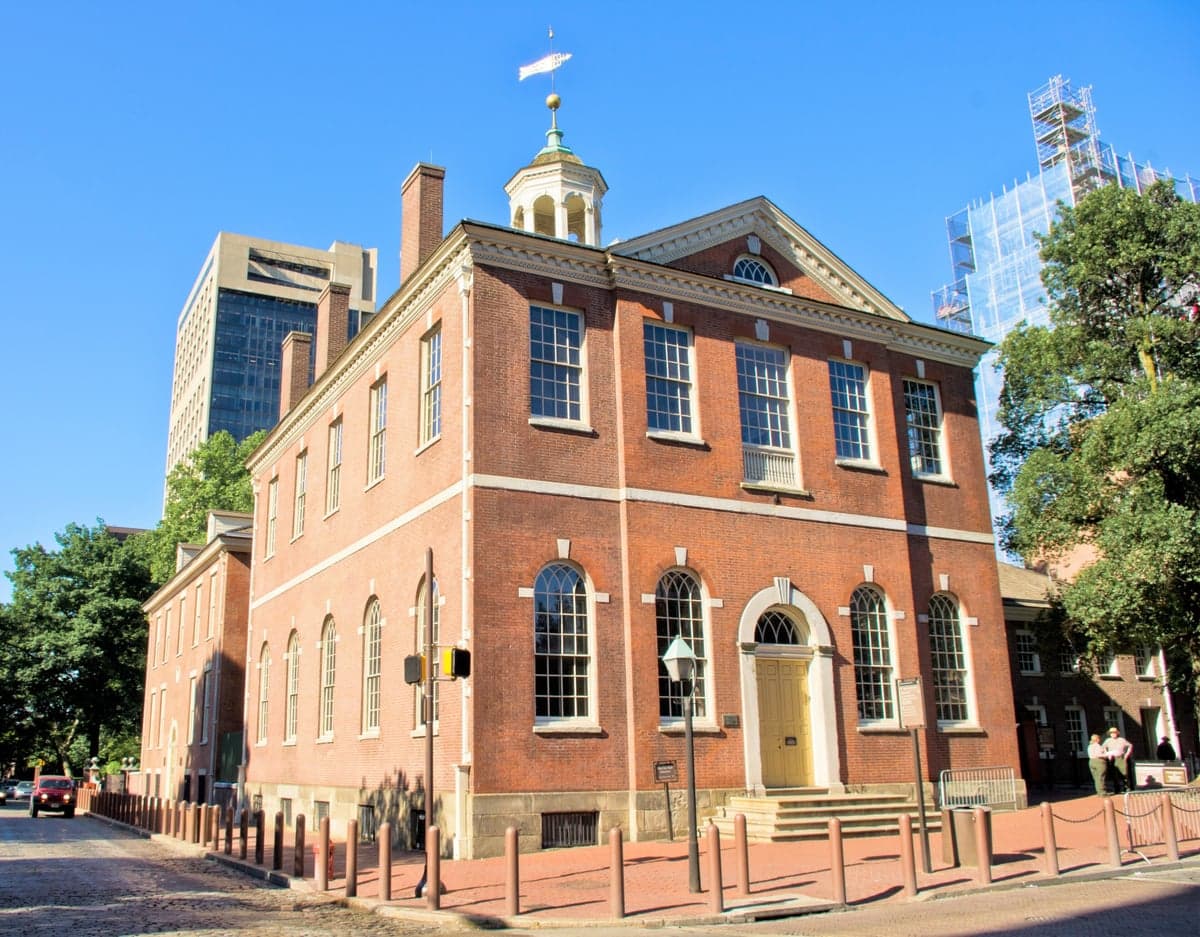
Photo: Wikipedia
Personal Sovereignty in Philadelphia County
Strong independent fundamentals that actively favor personal liberty and low regulation.
What does Personal Sovereignty tell us?
Personal Sovereignty measures your capacity for self-reliance and independence with minimal government friction. Higher scores mean fewer barriers between you and the way you want to live... but it assumes you have the space you need and good neighbors.
What does this tell us?
Personal Sovereignty measures your capacity for self-reliance and independence with minimal government friction. Higher scores mean fewer barriers between you and the way you want to live... but it assumes you have the space you need and good neighbors.
State Policy
Energy independence: Net exporter (150% of energy produced in-state)
Personal Liberty
Homesteading

Personal Liberty Analysis
Philadelphia County, Pennsylvania, presents a complex and often contradictory environment for personal sovereignty, where state-level preemptions on certain liberties clash with a dense, heavily regulated urban core. As a consolidated city-county, Philadelphia itself dictates nearly all local policy, creating a uniform regulatory landscape across its 135 square miles that is markedly different from the surrounding suburban and rural counties. For a relocation reader prioritizing autonomy, the key takeaway is that Philadelphia offers robust protections for certain personal liberties—such as medical decision-making and parental rights—while imposing a significant tax burden and restrictive gun laws that directly limit self-reliance and self-defense.
Tax burden and regulatory posture in Philadelphia County
The financial cost of living in Philadelphia County is a major constraint on personal sovereignty. The city levies a wage tax of 3.75% for residents and 3.44% for non-residents, a rare municipal income tax that directly reduces take-home pay and is a heavy burden compared to most of the country. This is compounded by a real estate transfer tax of 4.278% (split between buyer and seller) and a sales tax of 8% (state plus city portion). Property taxes, while not as high as some New Jersey suburbs, are significant, with the county's effective rate around 1.4% of assessed value. The regulatory posture is dense and city-wide; there is no escape within the county to a lighter-touch township. Zoning is strict, building codes are aggressively enforced by the Department of Licenses and Inspections (L&I), and operating a home-based business requires specific permits. For example, neighborhoods like Fishtown and Kensington have seen intense development pressure, but the regulatory hurdles for small-scale entrepreneurship or property modification remain high. This environment favors those who can navigate bureaucracy over those seeking maximum independence from government oversight.
Self-defense and gun law specifics in Philadelphia County
Pennsylvania is generally a "shall-issue" state for concealed carry permits, but Philadelphia County operates under unique restrictions that significantly curtail self-defense rights. While the state preempts most local firearm ordinances, Philadelphia has been granted special authority to enforce its own, stricter regulations. Open carry is legal without a license outside of Philadelphia, but within the city limits, it is illegal without a valid License to Carry Firearms (LTCF). Furthermore, the Philadelphia Police Department has a well-documented history of slow processing times for LTCF applications, often pushing the legal limit of 45 days, and denial rates are higher than in surrounding counties like Montgomery or Delaware County. The city also bans the possession of "assault weapons" (as defined by a 2022 ordinance, currently under legal challenge) and large-capacity magazines. For a gun owner, the practical reality is that exercising the right to self-defense in Philadelphia is more expensive, slower, and legally riskier than in any other part of the state. Neighborhoods like Roxborough or Mount Airy may feel safer, but the same restrictive city-wide gun laws apply everywhere within the county.
Self-reliance and homesteading viability in Philadelphia County
True homesteading or off-grid living is virtually impossible within Philadelphia County due to its high population density and comprehensive municipal code. The county is entirely built-out, with no agricultural zoning and very few parcels large enough for significant self-reliance. Lot sizes in most residential neighborhoods, such as South Philadelphia or Port Richmond, are typically 15 to 20 feet wide, offering minimal yard space for gardening or livestock. The city's zoning code prohibits keeping chickens, goats, or bees in most residential districts without special permits, which are rarely granted. Off-grid systems like solar panels with battery storage are technically allowed but must meet strict building and electrical codes, and connecting to the city's water and sewer grid is mandatory for habitable dwellings. Composting toilets and rainwater collection for primary use are not permitted. For a reader seeking self-reliance, the only viable option within the county is intensive urban gardening on a small scale, such as in community garden plots in neighborhoods like Germantown or West Philadelphia. The regulatory environment is fundamentally designed for dense urban living, not individual homesteading.
Personal liberties in Philadelphia County
On several key personal liberty fronts, Philadelphia County offers strong protections that align with a conservative emphasis on family and medical autonomy. Pennsylvania has robust parental rights laws, including a "Parental Bill of Rights" that affirms parents' authority over their children's education, healthcare, and religious upbringing. Philadelphia's school district, while struggling academically, does offer a range of school choice options, including charter schools and a voucher-like program for low-income students. Medical autonomy is also well-protected; Pennsylvania has no state-level vaccine mandate for adults, and while Philadelphia had its own COVID-19 vaccine mandate for indoor dining (since rescinded), the state's general posture is one of medical freedom. Property rights are more constrained, however. The city's strong tenant protections, rent control ordinances (for certain units), and aggressive use of eminent domain for development projects can feel intrusive to property owners. Free speech is protected, but the city has enacted noise ordinances and public assembly restrictions that are more stringent than in surrounding areas. Overall, Philadelphia offers a mixed bag: strong family and medical freedoms, but a heavy-handed approach to property and public conduct.
Compared to other major U.S. cities, Philadelphia County ranks as a moderate-to-heavy regulatory environment for personal sovereignty. Its tax burden is among the highest for a city its size, its gun laws are among the most restrictive in the Northeast, and its zoning makes homesteading a non-starter. However, its protections for parental rights and medical autonomy are stronger than in many blue states, offering a meaningful degree of personal liberty. For a relocation reader who values self-reliance above all, the surrounding counties of Bucks, Chester, or Lancaster would provide far more room for autonomy. For someone who needs to be in a major city for work or family but wants to retain control over their children's education and healthcare decisions, Philadelphia County offers a viable, if constrained, environment for personal sovereignty.

* Values derived from national, state, county, city and local statistics and may differ in a specific area. Last updated: 2026-08-08T13:14:41.000Z
Narrative content on this page is AI-generated and may contain mistakes. Verify any details that matter before acting on them.
ReloMaps may earn a commission from affiliate links at no extra cost to you.

