Photo: Wikipedia
Political ClimatePolitical Climate in Peoria, IL
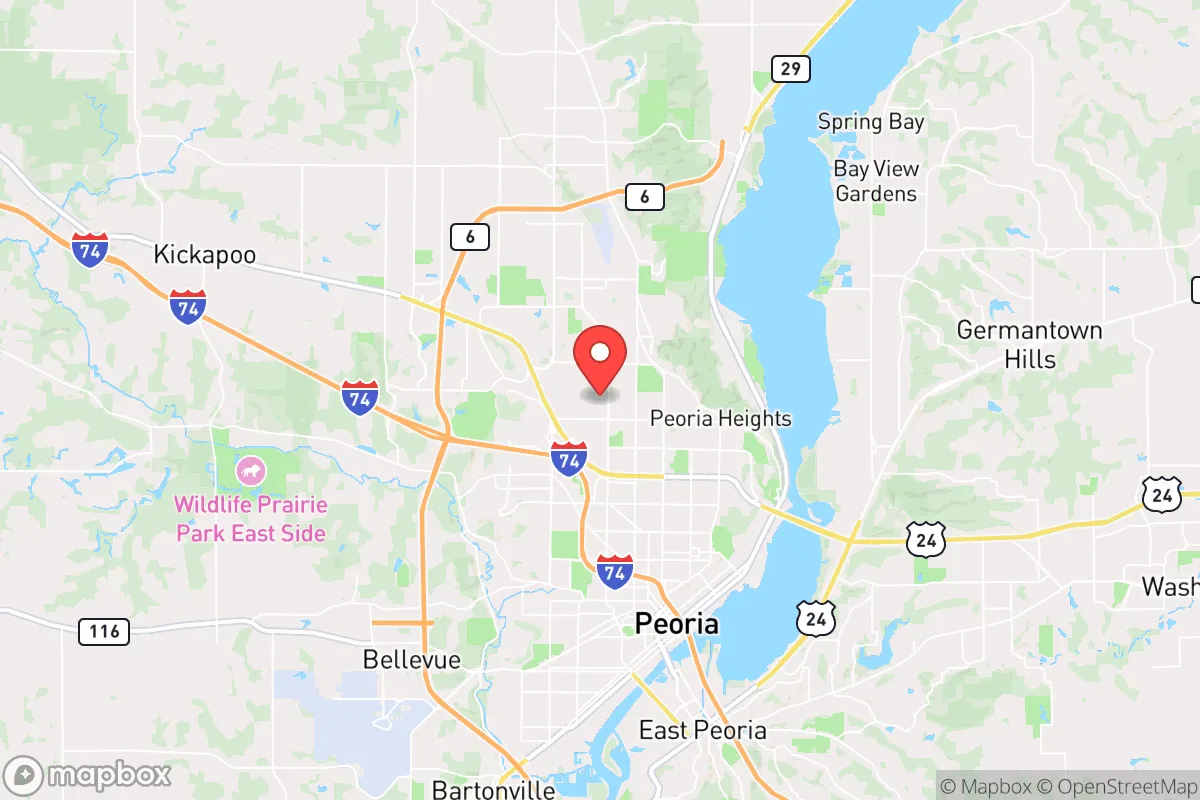
District shown is the primary district for this city’s centroid. Cities may span multiple districts.
Local Political AnalysisPolitical Analysis of Peoria, IL
Peoria’s political climate has shifted noticeably over the past decade, and if you’ve lived here as long as I have, you’ve felt it. The city itself leans left, with a Cook PVI of D+3, meaning it votes about three points more Democratic than the national average. But that number doesn’t tell the whole story. Peoria County as a whole is more purple than the city limits suggest, and the surrounding towns—like Dunlap, Chillicothe, and Washington—are reliably conservative. The real story is how the city’s progressive tilt has accelerated since 2020, driven by younger transplants and a growing reliance on state-level mandates from Springfield. For folks who value local control and personal freedoms, that’s a trend worth watching.
How it compares
Drive 15 minutes in any direction from downtown Peoria, and you’ll hit a different political world. To the north, Dunlap and Germantown Hills vote heavily Republican, with precincts often going 60-70% for GOP candidates. To the east, Washington and Morton are solidly red, anchored by manufacturing and agriculture. Even Peoria’s own suburbs—like the Heights and West Peoria—are more moderate than the city core. The contrast is stark: Peoria proper votes like a mini Chicago, while the surrounding towns vote like downstate Illinois. That split means county-level elections are often competitive, but city council and mayoral races have tilted left since 2015. The last Republican mayor left office in 2005, and the current council has passed several ordinances—like a plastic bag ban and a non-discrimination policy for city contractors—that feel more like Chicago than central Illinois. If you’re used to the hands-off approach of places like Pekin or East Peoria, Peoria’s recent moves can feel like government creeping into everyday life.
What this means for residents
For a long-time resident, the biggest concern is how much say you actually have anymore. Property taxes in Peoria County are among the highest in the state, and a lot of that money goes to programs you might not agree with—like the county’s equity initiatives or the city’s climate action plan. Meanwhile, state-level mandates from Springfield keep piling on: stricter gun laws, higher minimum wages, and renewable energy requirements that drive up utility costs. The city council has also shown a willingness to use zoning and licensing to push its agenda, like the 2023 debate over short-term rental regulations that made it harder for homeowners to rent out their properties. For someone who values personal freedom—whether it’s choosing your own healthcare, deciding how to use your property, or keeping more of your paycheck—Peoria’s trajectory is concerning. The silver lining is that the surrounding towns offer a real alternative. You can live in Dunlap or Washington, work in Peoria, and still vote for candidates who believe in limited government and local control.
Culturally, Peoria still has a strong blue-collar, union-rooted identity, but that’s fading. The old Caterpillar workforce that leaned conservative is retiring, and the new economy—healthcare, education, and tech—brings in people who are more comfortable with progressive policies. You’ll see it in the local news: debates over mask mandates in schools, the push for a civilian police review board, and the city’s decision to opt into the state’s sanctuary policies. None of this is unique to Peoria—it’s happening in midsize cities across the Midwest—but it feels more personal here. If you’re looking for a place where the government stays out of your business and lets you live your life, Peoria’s core is moving in the wrong direction. The suburbs and exurbs, though, still feel like the Peoria I grew up in. For now, that’s where the balance of freedom still tips in your favor.

State Political ClimatePolitical Climate in Illinois
State Political AnalysisPolitical Environment in the State
Illinois is a solidly blue state in federal elections, having voted Democratic in every presidential race since 1992, but its political reality is far more complicated than a simple partisan label. The state is dominated by the Chicago metropolitan area, which accounts for roughly 65% of the population and drives the statewide Democratic majority, while the rest of Illinois—from the collar counties to the Mississippi River—has been trending sharply red. Over the last 20 years, the state has shifted from a purple battleground to a one-party Democratic stronghold at the state level, with the GOP losing ground in the suburbs and rural areas becoming more conservative in response.
Urban vs. rural divide
The political map of Illinois is a textbook example of the urban-rural split. Cook County, home to Chicago, delivers a massive Democratic margin—typically 70-75% of the vote—that overwhelms the rest of the state. The Chicago metro area, including the collar counties of DuPage, Lake, and Will, has shifted leftward over the past decade, with once-reliable Republican suburbs like Naperville and Arlington Heights now voting Democratic in state and federal races. Meanwhile, downstate Illinois—places like Effingham, Quincy, and Mount Vernon—has become deeply Republican, with many rural counties voting 70-80% for GOP candidates. The divide is stark: a voter in rural Williamson County lives in a completely different political universe than someone in downtown Chicago, and that tension defines Illinois politics.
Policy environment
Illinois’s policy environment is heavily progressive, with a tax structure that is among the most burdensome in the nation. The state has a flat income tax rate of 4.95%, but property taxes are the second-highest in the country, averaging over 2% of home value annually, which hits homeowners in places like Lake Forest and Springfield hard. The regulatory posture is business-unfriendly, with a $15 minimum wage, strict environmental rules, and a powerful public-sector union lobby that has blocked pension reform for decades. Education policy is dominated by the Chicago Teachers Union, which has pushed for progressive curricula and defunded police initiatives in Chicago Public Schools. Healthcare is heavily regulated, with Illinois expanding Medicaid under the Affordable Care Act and passing a law requiring insurers to cover abortion and gender transition procedures. Election laws are among the most liberal in the country, with no voter ID requirement, automatic voter registration, and universal mail-in voting—a system that conservatives argue lacks integrity safeguards.
Trajectory & freedom
Illinois is becoming less free by nearly any measure, especially for conservatives. The state has passed a series of laws that expand government control over personal decisions. In 2023, Governor J.B. Pritzker signed a sweeping gun ban (HB 5471) that prohibits the sale and possession of dozens of semi-automatic firearms and high-capacity magazines, effectively nullifying the Second Amendment for law-abiding citizens. Parental rights have been eroded by the 2021 repeal of the parental notification law for minors seeking abortions, and by the 2023 passage of the "Keeping Youth Safe and Healthy" law, which allows minors to access gender-affirming care without parental consent. Medical autonomy has been curtailed by vaccine mandates for healthcare workers and schoolchildren, though some COVID-era mandates have been rolled back. Property rights are under pressure from a progressive property tax system that penalizes long-term homeowners, and from the 2020 passage of a constitutional amendment allowing a graduated income tax (though it was rejected by voters). The state’s fiscal trajectory is dire: unfunded pension liabilities exceed $140 billion, and the state’s credit rating is the lowest in the nation, signaling that tax hikes are likely in the future.
Civil unrest & political movements
Illinois has seen significant civil unrest and political activism, particularly in Chicago. The 2020 George Floyd protests in Chicago turned violent, with looting and property damage in the Loop and along the Magnificent Mile, and the city’s progressive leadership was slow to deploy law enforcement. The Black Lives Matter movement remains active, and there are ongoing tensions over police reform and defunding. On the right, the "Illinois Family Action" and "Awake Illinois" movements have mobilized around parental rights in schools, opposing critical race theory and LGBTQ+ curriculum mandates. Immigration politics are a flashpoint: Illinois is a sanctuary state, with the TRUST Act prohibiting local law enforcement from cooperating with federal immigration authorities, and Chicago has seen a surge of migrant arrivals from the southern border, straining city resources and sparking backlash in working-class neighborhoods. Election integrity remains a hot-button issue, with conservatives pointing to the state’s lack of voter ID laws and the 2020 expansion of mail-in voting as vulnerabilities. There have been secessionist murmurs in downstate counties—like the "Illinois Secession" movement in Effingham County—but these remain fringe efforts with no real political traction.
Projection
Over the next 5-10 years, Illinois is likely to become more Democratic and more progressive, driven by demographic trends. Chicago continues to lose population—down about 2% since 2020—but the remaining population is increasingly concentrated in the city and inner suburbs, while rural areas are depopulating. In-migration from other states is minimal, and the state’s net domestic migration is negative, meaning the people leaving are often conservatives and middle-class families fleeing high taxes and crime. The state’s fiscal crisis will force either massive tax increases or drastic service cuts, and given the political dynamics, tax hikes are more likely. The gun ban will likely survive legal challenges in the Illinois Supreme Court, and further restrictions on speech and parental rights are possible as the legislature becomes more progressive. For a conservative moving in now, the expectation should be a state where your vote is increasingly irrelevant in statewide elections, your taxes will rise, and your personal freedoms—especially on guns, medical choices, and education—will continue to be restricted by a government that sees itself as a guardian of progressive values.
For a new resident, the bottom line is this: Illinois offers world-class cultural amenities, strong job markets in Chicago and its suburbs, and excellent universities, but it comes at a steep price in taxes, regulatory burden, and personal freedom. If you value low taxes, gun rights, parental control over education, and a government that stays out of your life, Illinois is a tough place to call home. If you can afford the cost and are willing to navigate a heavily regulated environment, the state’s economic opportunities and urban energy are unmatched in the Midwest. Just know that the political trajectory is firmly leftward, and the state’s problems—pension debt, population loss, and crime in Chicago—are not going away anytime soon.
* Values derived from national, state, county, city and local statistics and may differ in a specific area. Last updated: 2026-04-23T09:18:09.000Z
Narrative content on this page is AI-generated and may contain mistakes. Verify any details that matter before acting on them.
ReloMaps may earn a commission from affiliate links at no extra cost to you.

