Photo: Wikipedia
Demographics of Puyallup, WA
Affluence Level in Puyallup, WA
A middle-class area roughly in line with national averages across income, home values, education, and employment.
People of Puyallup, WA
The people of Puyallup, Washington, today form a predominantly white, family-oriented community of 42,642, with a notably lower foreign-born share (4.4%) than the national average. The city’s character is rooted in its agricultural past and steady suburban growth, producing a population that is 69.9% white, 10.2% Hispanic, 4.8% East/Southeast Asian, 4.0% Black, and 1.4% Indian (subcontinent). With 28.3% holding a college degree, Puyallup leans toward middle-class, blue-collar roots, and its residents often identify strongly with local institutions like the Washington State Fair and the Puyallup School District.
How the city was settled and grew
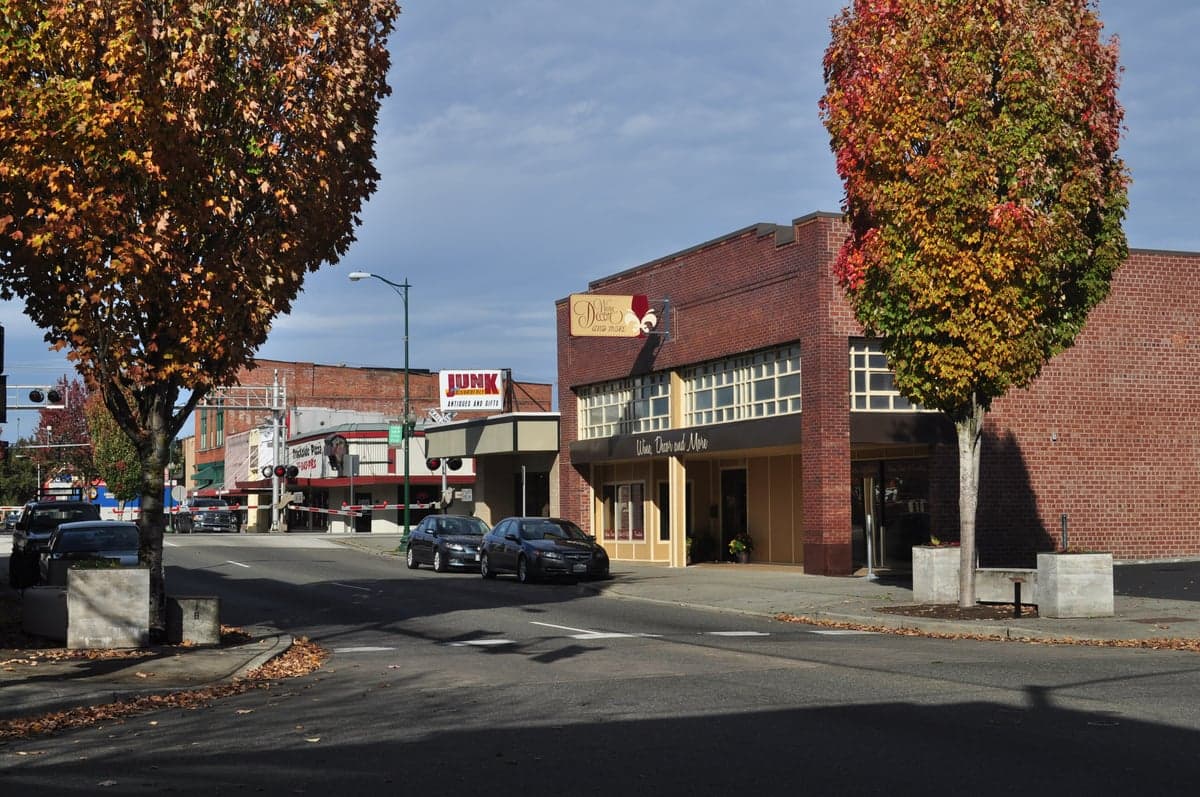
Puyallup’s human history begins with the Puyallup Tribe, whose ancestral lands along the Puyallup River drew the first non-Native settlers in the 1850s. The Donation Land Claim Act of 1850 brought Euro-American farmers, who found the fertile river valley ideal for hops and later berries. By the 1880s, the Northern Pacific Railroad connected the area, and the town was formally platted in 1884. The original settlers were largely of Northern European stock—English, German, and Scandinavian—who built the early homes in what is now the Historic Downtown Puyallup district, centered around Meridian and Pioneer Avenues. A second wave arrived in the early 1900s, drawn by the expanding berry and dairy industries, settling in the South Hill area, which remained rural farmland until the post-war era. The Puyallup Valley’s Japanese American community, which had worked the berry fields, was forcibly removed during World War II, and many did not return, leaving a demographic gap that was filled by white in-migrants from the Midwest and other parts of Washington in the 1950s and 1960s.
Modern era (post-1965)
After the 1965 Immigration and Nationality Act, Puyallup’s demographic change was modest compared to nearby Tacoma or Seattle. The city’s foreign-born population remains low at 4.4%, and most growth came from domestic in-migration—families seeking affordable housing and good schools. The South Hill neighborhood exploded with suburban tract homes in the 1980s and 1990s, attracting white and some Hispanic families from the Puget Sound region. Hispanic residents, now 10.2% of the population, concentrated in the East Puyallup area near the river, where older, more affordable housing stock exists. East/Southeast Asian residents (4.8%)—primarily Filipino and Vietnamese—settled in the North Puyallup neighborhoods near the Puyallup River, often working in healthcare and manufacturing. The Indian subcontinent community (1.4%) is smaller and more dispersed, with clusters in the West Puyallup area near the new commercial developments along 39th Avenue. Black residents (4.0%) are spread across the city, with no single dominant neighborhood, reflecting Puyallup’s relatively low racial segregation compared to larger cities. The city’s white share has declined from over 85% in 1990 to 69.9% today, driven primarily by Hispanic and Asian in-migration, though the pace has been gradual.
The future
Puyallup’s population is projected to grow modestly, reaching roughly 50,000 by 2040, driven by continued suburban expansion into the South Hill and West Puyallup areas. The Hispanic share is expected to rise to 15-18% as families from Mexico and Central America move into older neighborhoods like East Puyallup and the Pioneer Valley district. East/Southeast Asian and Indian communities are likely to grow slowly, plateauing near 6% and 2% respectively, as new arrivals are drawn more to Seattle’s suburbs. The white population will continue to decline as a share but remain the majority. The city is not tribalizing into distinct enclaves; instead, it is slowly homogenizing into a more diverse, middle-class suburb, though the pace of change is slow enough that long-time residents may not perceive a dramatic shift. The main demographic story is the gradual Hispanicization of the eastern neighborhoods and the continued white suburban dominance of South Hill.
For someone moving in now, Puyallup offers a stable, family-oriented environment with a population that is becoming slightly more diverse but remains overwhelmingly white and native-born. The city’s future is one of steady, incremental change rather than rapid transformation, making it a predictable choice for those seeking a traditional suburban lifestyle with good schools and a strong sense of local identity.

* Values derived from national, state, county, city and local statistics and may differ in a specific area. Last updated: 2026-04-21T11:00:17.000Z
Narrative content on this page is AI-generated and may contain mistakes. Verify any details that matter before acting on them.
ReloMaps may earn a commission from affiliate links at no extra cost to you.

