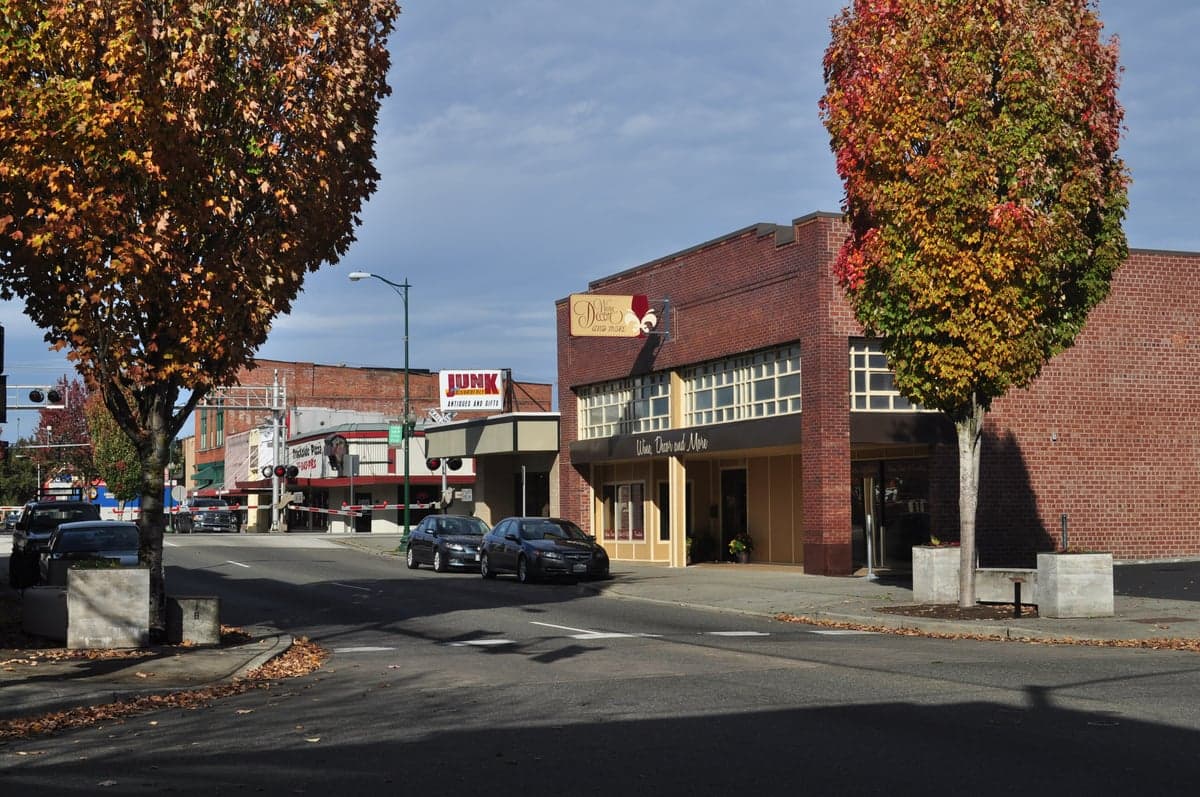
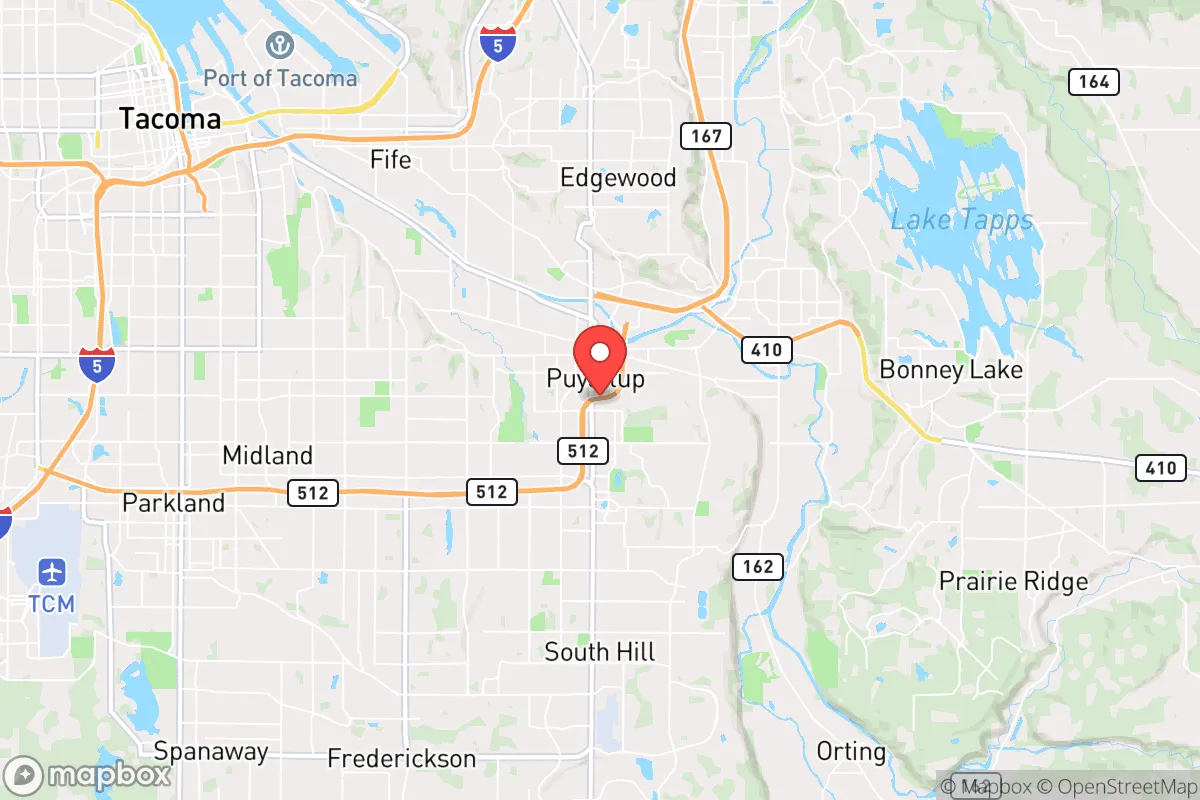
Photo: Wikipedia
Political ClimatePolitical Climate in Puyallup, WA
District shown is the primary district for this city’s centroid. Cities may span multiple districts.
Local Political AnalysisPolitical Analysis of Puyallup, WA
Puyallup, Washington, has a Cook PVI of D+9, meaning it leans about nine points more Democratic than the national average, but that number doesn't tell the whole story for folks who've lived here a while. This area used to be a solid conservative stronghold, with a strong farming and blue-collar base that voted reliably Republican. Over the last decade, though, the political climate has shifted noticeably leftward, driven largely by an influx of commuters from Seattle and Tacoma who bring their progressive politics with them. It's not a radical change overnight, but the trend is clear: Puyallup is becoming more aligned with the urban corridor to its north, and that has real consequences for local governance and personal freedoms.
How it compares
If you drive ten miles north to Tacoma, you're in a deep-blue city with a Cook PVI of D+17, where progressive policies on zoning, policing, and taxes are the norm. Head east toward the more rural areas like Orting or Buckley, and you'll find communities that still lean conservative, with PVI scores closer to R+5 or R+10. Puyallup sits right in the middle, but it's trending toward Tacoma's model faster than many locals are comfortable with. The city council and school board elections have seen more candidates backed by progressive groups, and ballot measures on things like property tax increases and housing density mandates have passed by slim margins. It's a stark contrast to places like Bonney Lake or Graham, where voters still push back hard against what they see as government overreach.
What this means for residents
For a long-time resident, the most visible shift is in how local government approaches everyday life. Zoning changes that allow higher-density housing in single-family neighborhoods are being pushed through, often with little public input, and that's a red flag for anyone who values property rights. The school district has adopted curriculum changes that emphasize social-emotional learning and equity initiatives, which some parents see as unnecessary government intrusion into how kids are taught. There's also been a steady creep of new regulations on small businesses, from paid sick leave mandates to stricter environmental rules, that make it harder for mom-and-pop shops to survive. The tax burden has increased too, with property taxes rising faster than inflation, and new fees for things like stormwater management and transportation projects that feel like they're funding priorities you didn't vote for.
What daily life is like for families
Despite the political drift, daily life in Puyallup still has a lot of the old-school feel if you know where to look. The Puyallup Fairgrounds still host the annual fair and rodeo, and there are plenty of churches and community groups that keep conservative values alive. But you'll notice more yard signs for progressive candidates during election season, and conversations at the local coffee shop or hardware store often turn to frustration over new city ordinances or school policies. The long-term trajectory is concerning for anyone who believes in limited government and personal responsibility. If the current trend continues, Puyallup could look a lot more like Tacoma in a decade, with higher taxes, more regulations, and a local government that's less responsive to the people who built this community.

State Political ClimatePolitical Climate in Washington
State Political AnalysisPolitical Environment in the State
Washington State has shifted from a purple battleground to a solidly blue stronghold over the past two decades, with Democrats controlling every statewide office and both legislative chambers since 2017. The state voted for Hillary Clinton by 16 points in 2016, Joe Biden by 19 points in 2020, and Kamala Harris by roughly 18 points in 2024, driven overwhelmingly by the Seattle metro area’s explosive growth and the collapse of rural Republican turnout. For a conservative considering relocation, the political reality is stark: the state’s trajectory is firmly progressive, with no sign of reversal, though pockets of red resistance remain in the eastern half and some exurban counties.
Urban vs. rural divide
The political map of Washington is a tale of two states. King County, home to Seattle and its sprawling suburbs, casts about 30% of the state’s votes and delivers a Democratic margin of roughly 40 points—enough to swamp the rest of the state combined. Pierce County (Tacoma) and Snohomish County (Everett) have also trended blue, with Snohomish flipping from a swing county in 2012 to a consistent +10-15 Democratic margin by 2024. Meanwhile, the eastern half of the state—Spokane, the Tri-Cities (Kennewick, Pasco, Richland), and Yakima—votes reliably Republican, but their populations are growing slower than the I-5 corridor. A notable exception is Clark County (Vancouver), which was a Republican stronghold as recently as 2016 but flipped to Biden in 2020 and Harris in 2024, driven by Portland exurbanites fleeing Oregon’s taxes but bringing their politics with them. The rural-urban divide is so sharp that some eastern Washington counties, like Garfield and Columbia, vote 80% Republican, while King County votes 75% Democratic. This geographic polarization means a conservative moving to Spokane or the Tri-Cities will find a red community, but one moving to Seattle, Bellevue, or even Olympia will be in deep blue territory.
Policy environment
Washington’s policy environment is aggressively progressive, with a tax structure that uniquely burdens high earners and businesses. The state has no personal income tax, but it relies on a high sales tax (6.5% state, plus local add-ons up to 10.6%) and a gross receipts business tax (B&O) that hits companies regardless of profitability. In 2021, the legislature enacted a 7% capital gains tax on profits over $250,000, which the state Supreme Court upheld in 2023 as an excise tax, not an income tax—a workaround conservatives view as a slippery slope toward a full income tax. Education policy is dominated by the teachers’ union; Washington has some of the strongest collective bargaining laws in the country, and the state mandates “social emotional learning” and comprehensive sex education starting in kindergarten. Healthcare is heavily regulated, with a state-based insurance exchange and a public option (Cascade Care) that has seen low enrollment but signals future expansion. Election laws are among the most liberal: all-mail voting is universal, same-day registration is allowed, and ballots are automatically sent to every registered voter. Voter ID is not required to receive a ballot, though a signature is checked against the voter file. This system has produced high turnout but persistent concerns about ballot security among conservatives, especially after the 2020 and 2022 elections saw no significant fraud but widespread distrust in rural counties.
Trajectory & freedom
Washington is becoming less free by nearly every measure conservatives care about. Gun rights have been systematically eroded: in 2023, the legislature passed a ban on “assault weapons” (defined by cosmetic features), a ban on high-capacity magazines (over 10 rounds), and a requirement for a 10-day waiting period and safety training for all firearm purchases. A 2024 law also imposed liability on gun manufacturers for “negligent” marketing. These laws survived initial court challenges under the state constitution, though federal challenges continue. Parental rights have taken hits: a 2023 law allows minors 13 and older to consent to gender-affirming care without parental notification, and the state’s “My Health My Data” act creates a private right of action against entities that share reproductive or gender-related health information—effectively shielding abortion and transgender care from any parental oversight. Medical autonomy was expanded for abortion and gender transition but contracted for COVID-19 vaccine mandates, which remain in effect for healthcare workers and state employees as of 2025. Property rights are weak: the state’s Growth Management Act heavily restricts development in rural areas, and a 2023 law allows cities to upzone single-family neighborhoods for duplexes and fourplexes without local input. The state also enacted a “public health emergency” law in 2024 that gives the governor sweeping powers to close businesses and mandate masking without legislative approval—a direct response to the pandemic that conservatives see as a permanent power grab.
Civil unrest & political movements
Washington has a long history of political activism, from the 1999 WTO protests in Seattle to the 2020 Capitol Hill Autonomous Zone (CHAZ) in Seattle, where six blocks were occupied by leftist activists for three weeks, resulting in two deaths and widespread property damage. The CHAZ episode remains a flashpoint: conservatives point to it as evidence of progressive governance failure, while liberals defend it as a community response to police brutality. Immigration politics are dominated by the state’s “sanctuary” law (2019’s Keep Washington Working Act), which prohibits state and local law enforcement from cooperating with federal immigration authorities except in narrow circumstances. This has led to tensions with ICE and occasional standoffs, particularly in Yakima and the Tri-Cities, where agricultural communities have mixed views. Election integrity controversies flared after 2020, with Republican-led counties like Douglas and Grant demanding hand recounts; none found significant fraud, but distrust persists. Secession movements are mostly rhetorical: the “Liberty State” proposal to carve out eastern Washington has no serious legislative support, but it reflects a deep cultural divide. Visible flashpoints for a new resident include frequent protests in Seattle and Olympia over climate, abortion, and police reform, and occasional counter-protests in Spokane and the Tri-Cities over gun rights and parental rights.
Projection
Over the next 5-10 years, Washington will likely become even more progressive. Demographic trends favor the blue side: King County continues to grow through international immigration and domestic migration from California and Oregon, while rural counties stagnate or decline. The state’s Democratic supermajority in the legislature (as of 2025) is poised to pass a state-level single-payer healthcare system, a wealth tax on high-net-worth individuals, and further gun restrictions, including a permit-to-purchase requirement. The capital gains tax will almost certainly be expanded into a broader income tax, as the state Supreme Court’s 2023 ruling left the door open. In-migration from blue states like California and Oregon reinforces the political tilt, while conservatives moving in from red states are a smaller counterflow. A conservative moving to Washington now should expect to live under a government that is increasingly hostile to gun ownership, skeptical of parental authority, and aggressive in taxing high earners. The only realistic hope for a political shift is a major economic downturn that discredits progressive governance, or a federal court ruling that strikes down key state laws—but neither is likely in the near term.
For a conservative considering relocation, the bottom line is this: Washington offers stunning natural beauty, a strong economy, and no income tax, but those benefits come at the cost of living under a government that is actively restricting gun rights, eroding parental authority, and expanding its regulatory reach. If you’re moving to Spokane or the Tri-Cities, you’ll find a like-minded community and some local political insulation, but state-level policies will still affect your daily life. If you’re moving to Seattle or its suburbs, you’ll be in deep blue territory where your political views may be a minority. The state is not going to flip red anytime soon, so the decision comes down to whether the trade-offs—natural beauty and economic opportunity versus progressive governance—are worth it for you and your family.
* Values derived from national, state, county, city and local statistics and may differ in a specific area. Last updated: 2026-04-21T11:00:17.000Z
Narrative content on this page is AI-generated and may contain mistakes. Verify any details that matter before acting on them.
ReloMaps may earn a commission from affiliate links at no extra cost to you.

