Photo: Wikipedia
Demographics of Rochester, MN
Affluence Level in Rochester, MN
A middle-class area roughly in line with national averages across income, home values, education, and employment.
People of Rochester, MN
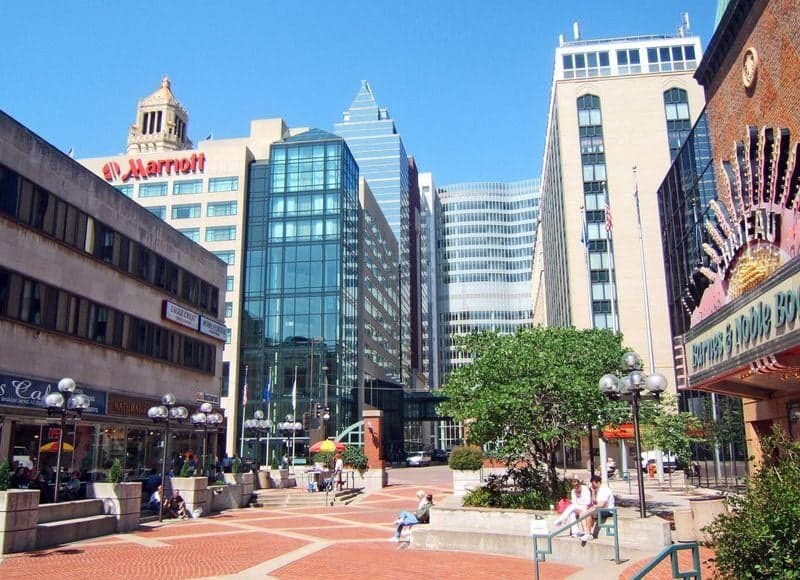
The people of Rochester, Minnesota, today form a notably educated and medically anchored population of 121,638, with a character shaped more by institutional employment than by any single ethnic or cultural tradition. The city is 71.5% white, with a Black population of 9.4%, a Hispanic population of 6.2%, and distinct East/Southeast Asian (6.1%) and Indian-subcontinent (1.9%) communities. Over half of adults hold a college degree, a figure that reflects the gravitational pull of the Mayo Clinic and its allied research and healthcare sectors, giving Rochester a professional-class density unusual for a Midwestern city of its size.
How the city was settled and grew
Rochester’s original population was drawn not by medicine but by the land. The city was platted in 1854 along the Zumbro River, and its first permanent settlers were Yankee farmers and German immigrants who cleared the surrounding prairie. The Pill Hill neighborhood, now synonymous with the Mayo Clinic campus, was originally farmland. The arrival of the Winona and St. Peter Railroad in the 1860s turned Rochester into a regional grain-shipping hub, attracting a second wave of German, Irish, and Norwegian immigrants who settled in the Historic Southwest district and along the rail corridor near what is now Slatterly Park. The 1883 tornado that devastated the city inadvertently created its modern identity: Mother Alfred Moes and Dr. William Worrall Mayo founded St. Marys Hospital in its aftermath, and the Mayo Clinic grew from that partnership. By 1900, the city’s population had reached roughly 6,000, and the clinic’s reputation began drawing patients and physicians from across the country. The Kutzky Park neighborhood, platted in the 1910s, became home to many of the nurses and support staff who built the early medical infrastructure.
Modern era (post-1965)
The 1965 Hart-Cellar Act reshaped Rochester’s demographics more gradually than in coastal cities, but the effects are visible today. The Mayo Clinic’s global reputation began attracting medical professionals and trainees from abroad in the 1970s and 1980s. The Eastside neighborhoods, particularly around 37th Street and East Circle Drive, absorbed many of the East/Southeast Asian families—Vietnamese, Filipino, and Chinese—who came as medical researchers and technicians. The Indian-subcontinent community, smaller but highly concentrated, settled near the clinic’s downtown campus and in the Bamber Valley area, drawn by residency programs and specialty fellowships. Domestic in-migration accelerated after 2000, with white professionals from the Upper Midwest and, increasingly, from the coasts moving to Rochester for Mayo-affiliated jobs. The Northwest district, including the newer developments near Cascade Lake, grew rapidly as suburban-style subdivisions attracted families seeking good schools and lower crime rates. The Black population, which stood at roughly 2% in 1990, rose to 9.4% by 2020, driven by Somali and Ethiopian families who arrived through secondary migration from Minneapolis and by African American professionals recruited to Mayo’s expanding workforce. Hispanic growth has been steadier, concentrated in the Historic Southwest and Slatterly Park neighborhoods, where Mexican-origin families have established small businesses and service-sector employment.
The future
Rochester’s population is heading toward greater diversity, but not toward rapid homogenization. The foreign-born share, currently 5.9%, is likely to rise as Mayo continues its international recruitment, particularly of East/Southeast Asian and Indian-subcontinent medical professionals. The white share, while still dominant, is declining slowly as the city’s birth rates among white families fall below replacement and as younger professionals delay childbearing. The Black and Hispanic shares are projected to grow modestly, driven by family reunification and service-sector demand, but Rochester lacks the chain-migration infrastructure of larger Twin Cities suburbs. The city is not tribalizing into stark ethnic enclaves—most neighborhoods remain majority white—but subtle clustering persists: East/Southeast Asian families in the Eastside, Indian families near the clinic, and Hispanic families in the older southwest grid. The Downtown Waterfront redevelopment and the Destination Medical Center (DMC) initiative are adding high-density housing aimed at young professionals, which will likely attract more domestic migrants from outside Minnesota than international arrivals. The next 10–20 years will see Rochester become slightly more Asian and Indian, slightly less white, and more educated, but it will remain a city where the Mayo Clinic, not any ethnic group, defines the dominant culture.
For someone moving in now, Rochester is becoming a more diverse, more professional, and more expensive place than its Midwestern peers. The population is stable, not booming, and the social fabric is shaped less by ethnic competition than by the shared identity of working for or alongside the region’s dominant employer. It is a city where a college degree is the norm, where international medical talent is visible but not overwhelming, and where the conservative-leaning audience will find a reliably Republican-voting area (Olmsted County voted +8 R in 2024) with a pragmatic, institution-focused civic culture.

* Values derived from national, state, county, city and local statistics and may differ in a specific area. Last updated: 2026-04-30T04:17:35.000Z
Narrative content on this page is AI-generated and may contain mistakes. Verify any details that matter before acting on them.
ReloMaps may earn a commission from affiliate links at no extra cost to you.

