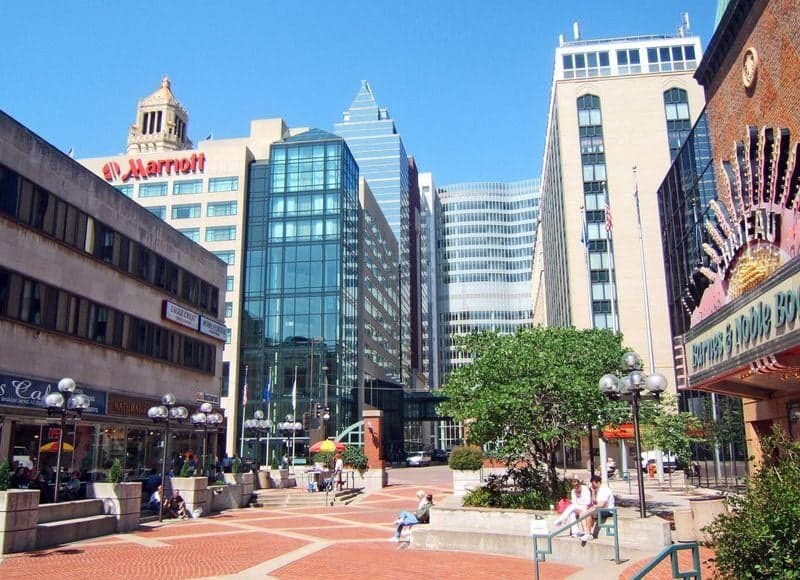
Photo: Wikipedia
Strategic Assessment of Rochester, MN
Workable tactical position. Some exposure to population density or targets, but generally defensible in a crisis.
What does the Strategic Assessment tell us?
Our Strategic Assessment grades tactical survivability of an area. Major population centers, military targets, fallout zones, natural disasters, and border exposure all drive risk — lower exposure means a more defensible position in a crisis.
This is heavily inspired by Joel Skousen's Strategic Relocation book. Highly recommended you checkout the book ($)What does this tell us?
Our Strategic Assessment grades tactical survivability of an area. Major population centers, military targets, fallout zones, natural disasters, and border exposure all drive risk — lower exposure means a more defensible position in a crisis.
This is heavily inspired by Joel Skousen's Strategic Relocation book. Highly recommended you checkout the book ($)Strategic Pillars

Key Distances
Regional Safe Places
Below is our recommended "safe zones" in Minnesota and the surrounding area based on our strategic heuristics. For most people, it's unrealistic to live in a “safe zone” full-time due to work, family or other personal reasons. They tend to be more rural. However, many of these areas are perfect for second homes and retreat properties that double as a vacation home or even a short-term rental.
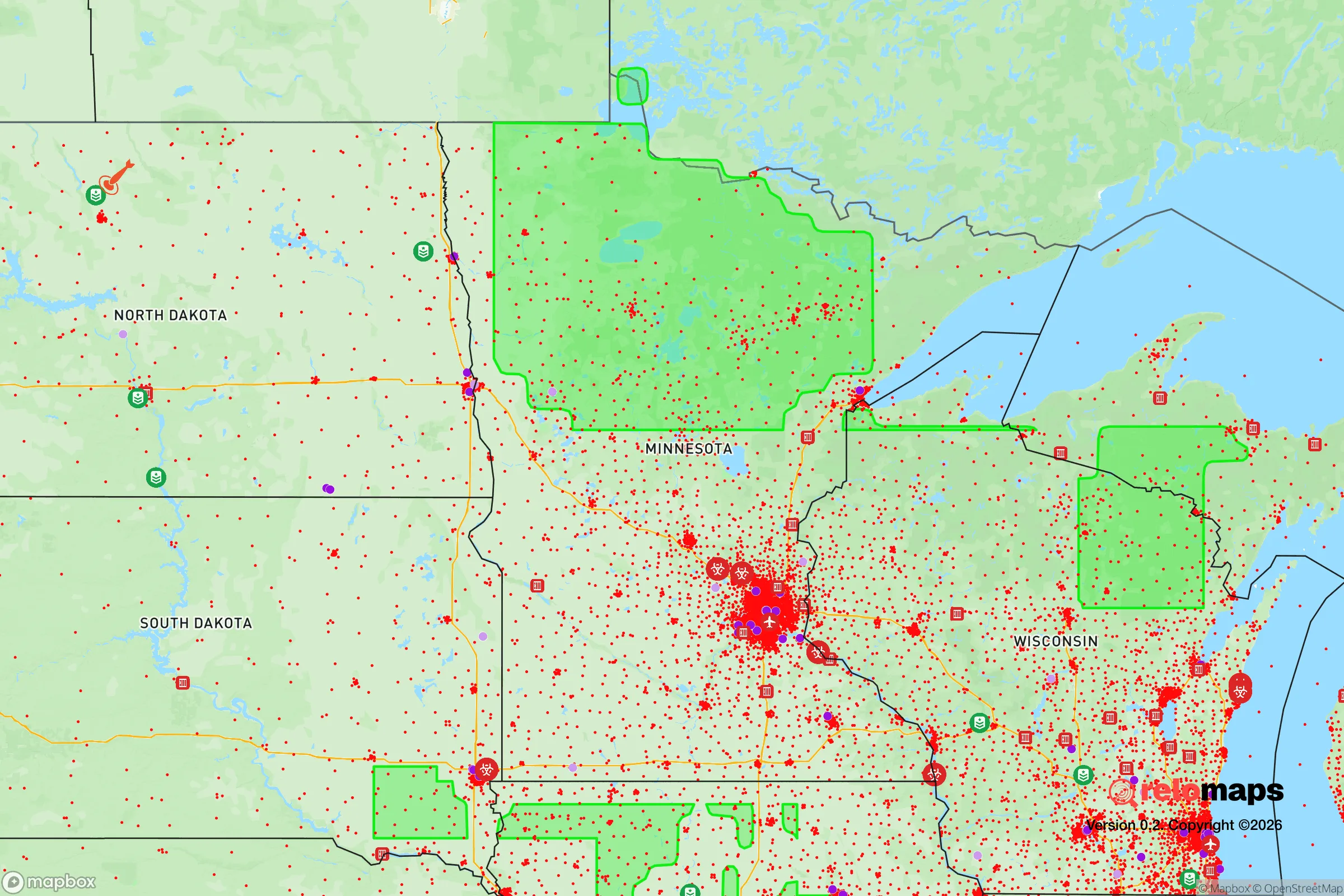
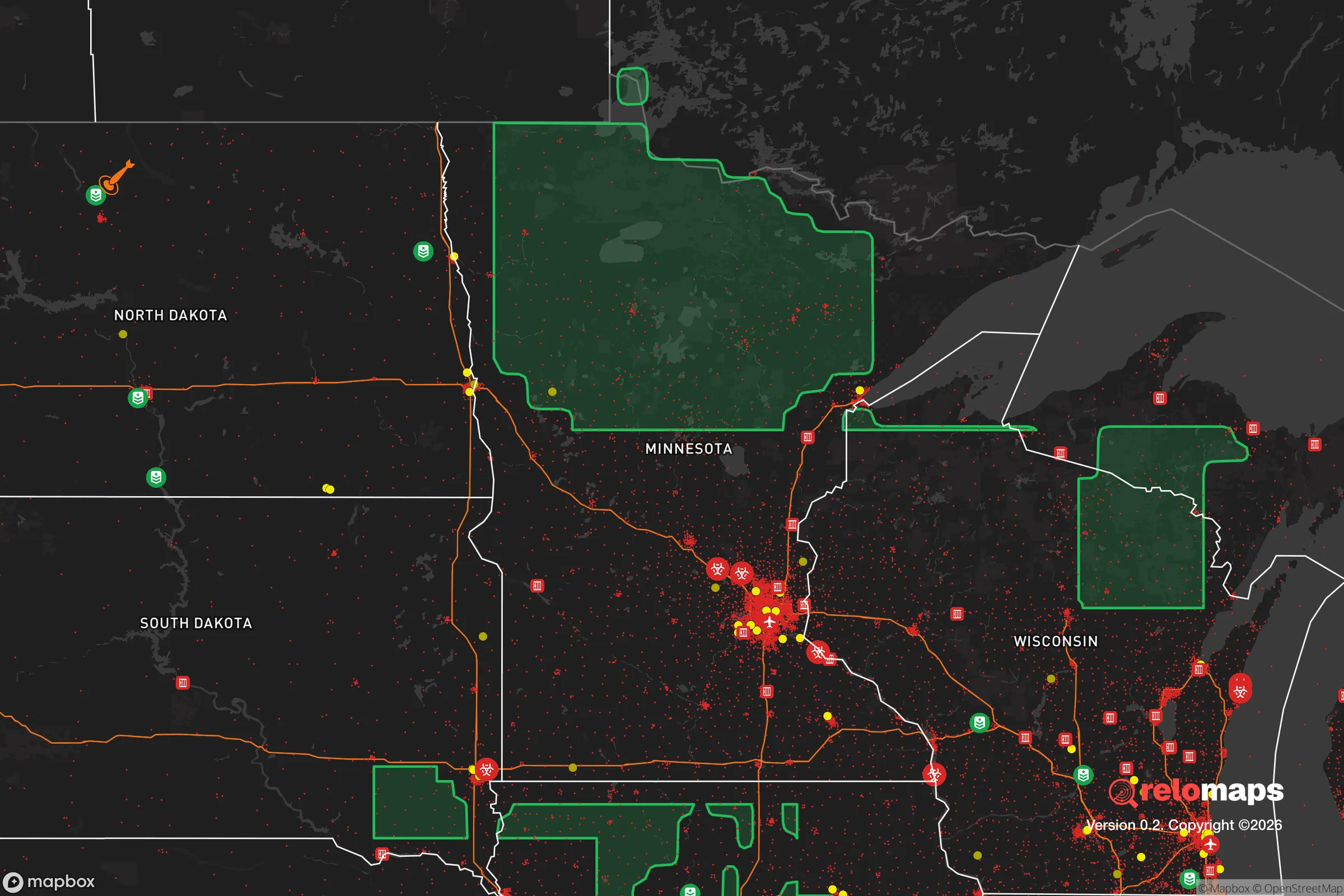


Important Note: For informational purposes only. This does not mean nothing bad ever happens in the green zones. Please use common sense. This is based on public data and modeled with AI. We tried to take a conservative approach but mistakes happen. We update this regularly as new information becomes available.
Solar Generator Recommendations
Backup power matters more here than in safer locations. We've picked three solar generators across budgets and capacity tiers — start with the budget unit if you only need a few essentials, or step up if you want to run a fridge and HVAC for days at a time.

Jackery Portable Power Station Explorer 300
Budget OptionPower on the Go: Weighing only 11 lbs, it's convenient to set up and store with book-sized foldable solar panels

BLUETTI Portable Power Station AC180
Designed for both indoor and outdoor scenarios, AC180 is highly capable as it has a robost capacity and continuous output power.

EF ECOFLOW DELTA Pro Ultra Power Station
Upgraded PickEcoFlow DELTA Pro Ultra is a whole-home energy system designed to grow with your family. Integrated with the Smart Home Panel 2, it scales to meet your evolving energy needs — keeping your home powered, intelligent, and secure through every stage of life.
We earn a commission, at no additional cost to you.
Strategic Assessment Analysis
Rochester, Minnesota, offers a surprisingly resilient strategic position for those prioritizing long-term stability and preparedness, blending a robust local economy with a location that is far enough from major metropolitan chaos to provide a buffer, yet close enough to critical infrastructure to matter. The city’s anchor, the Mayo Clinic, creates a unique ecosystem of high-value medical resources, skilled labor, and a population that is both educated and, by necessity, accustomed to crisis management. For a conservative-leaning individual or family looking to weather civic unrest, economic volatility, or large-scale disasters, Rochester presents a compelling case as a secondary hub—a place where you can build a life that is both prosperous and defensible, provided you understand its specific vulnerabilities and advantages.
Geographic position and natural advantages: A Midwestern fortress with soft edges
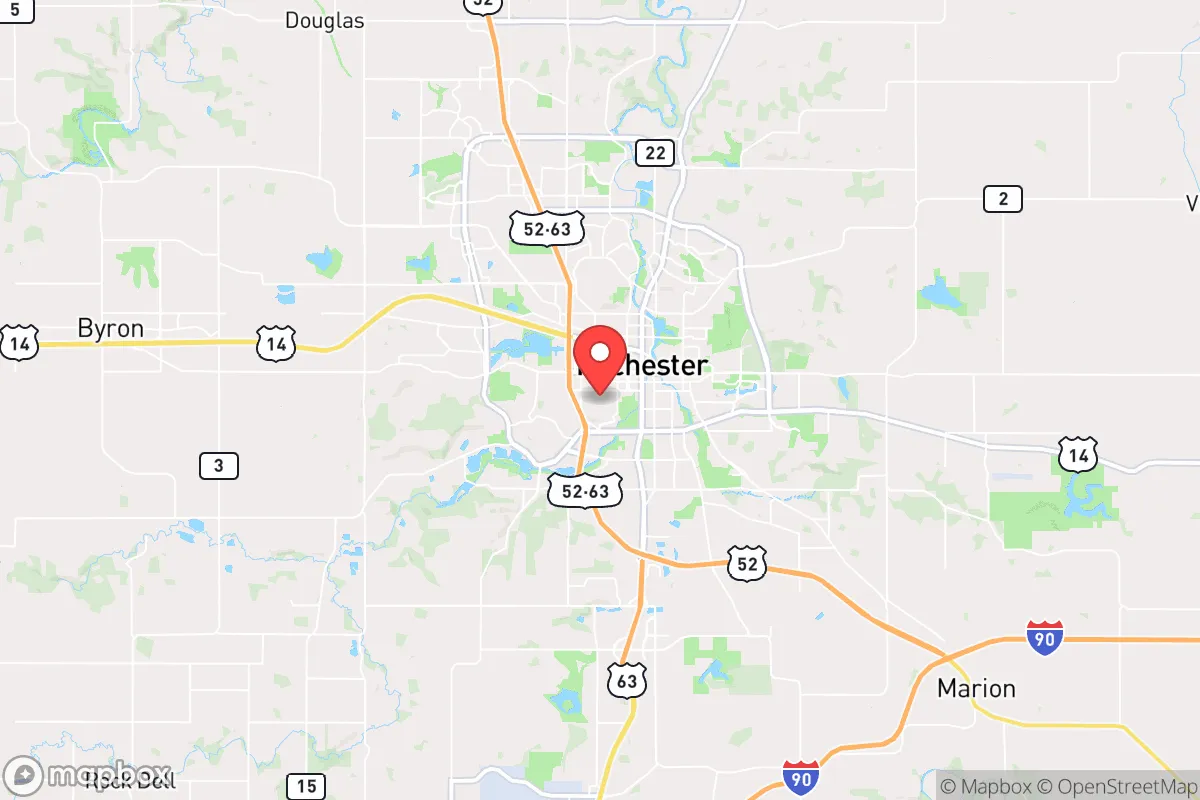
Rochester sits in southeastern Minnesota’s driftless area, a region of rolling hills, limestone bluffs, and deep river valleys that escaped the flattening of the last Ice Age. This topography provides natural defensibility—elevated vantage points, limited sightlines for any approaching threat, and numerous small creeks and the Zumbro River that can serve as both water sources and natural barriers. The city is roughly 80 miles south of the Twin Cities metroplex, a distance that places it outside the immediate blast radius of any major urban event, yet close enough to access the region’s logistical hubs if needed. To the west, the open prairies of southern Minnesota offer agricultural abundance, while to the east, the Mississippi River corridor provides a natural boundary and a potential escape route. The climate is four-season, with cold winters that naturally reduce population mobility and summer heat that is manageable without extreme wildfire risk. The area is not prone to earthquakes, hurricanes, or tsunamis, making it a stable geological choice. The primary natural risk is severe thunderstorms and occasional tornadoes—a manageable threat with proper shelter planning.
Risks, exposures, and proximity to fallout-relevant landmarks
The most significant strategic risk for Rochester is its dependence on the Mayo Clinic as a single-point-of-failure economic and social anchor. If the clinic were to suffer a catastrophic event—whether from a pandemic, a cyberattack, or a mass casualty incident—the entire city’s stability would be compromised. The clinic’s global draw also means a constant influx of transient populations, including international travelers, which elevates the risk of disease introduction and creates a surveillance target for bad actors. Proximity to the Twin Cities (80 miles) is a double-edged sword: it provides access to supply chains and federal resources, but it also means that any major unrest, nuclear incident, or infrastructure collapse in Minneapolis-St. Paul will send refugees and cascading disruptions southward along Interstate 90 and Highway 52. Rochester is also within 200 miles of the Prairie Island Indian Community’s nuclear generating plant (near Red Wing), a potential fallout source in a worst-case scenario. The city’s position along major transportation corridors—I-90 east-west and Highway 52 north-south—makes it a natural chokepoint for movement, which could be both a tactical advantage and a vulnerability during mass evacuations. There are no major military bases or federal command centers nearby, which reduces the likelihood of being a direct target, but also means limited immediate military response capability.
Practical resilience for a relocator: Food, water, energy, and defensibility
For a relocator focused on practical preparedness, Rochester offers a strong baseline. The surrounding farmland is some of the most productive in the nation, with corn, soybeans, and livestock operations within a 20-minute drive. Local farmers’ markets and co-ops (like the Rochester Farmers Market and People’s Food Co-op) provide direct access to fresh food, and the region’s agricultural surplus means that barter and local trade networks are viable in a crisis. Water is abundant: the Zumbro River runs through the city, and the area sits atop the Jordan Aquifer, a deep sandstone aquifer that provides clean groundwater. Most homes have access to municipal water, but a well-equipped prepper should plan for private well installation or rainwater catchment, as municipal systems are vulnerable to contamination or disruption. Energy infrastructure is relatively stable, with Xcel Energy providing electricity from a mix of coal, natural gas, and renewables. However, the grid is not hardened against EMP or cyberattack; a backup generator with fuel storage is a wise investment. Natural gas is widely available for heating, but propane storage is a more resilient alternative. Defensibility is moderate: the city’s layout is a mix of suburban sprawl and older, denser neighborhoods. The best strategy is to secure a property on the outskirts—preferably with acreage, a well, and a septic system—where you can establish a perimeter and maintain a low profile. The local gun culture is present but not aggressive; Minnesota is a shall-issue state for concealed carry, and there are several gun clubs and ranges in the area. Law enforcement is professional but stretched thin in a crisis, so personal security planning is essential. The community itself is generally polite and law-abiding, but the influx of transient medical professionals and patients means you cannot assume neighborly trust in a breakdown scenario.
The overall strategic picture for Rochester is one of calculated opportunity. It is not a hardened bunker or a remote survivalist retreat—it is a functioning, prosperous city with a strong institutional backbone that can provide stability during normal times and a foundation for resilience during disruptions. The key is to leverage its strengths (medical resources, agricultural access, stable climate, educated population) while mitigating its weaknesses (single-industry dependence, corridor vulnerability, proximity to urban chaos). For a conservative-leaning individual or family who wants to maintain a professional career while building a prepared lifestyle, Rochester offers a rare balance: you can work in a world-class medical system, send your kids to good schools, and still have a realistic plan for self-sufficiency. The smart move is to buy land on the city’s periphery, invest in off-grid capabilities, and maintain a low profile. The city will not save you from a total collapse, but it will give you a fighting chance to ride out the storm and rebuild. In a world where most urban centers are ticking time bombs, Rochester is a place where you can actually live well while being ready for the worst.

* Values derived from national, state, county, city and local statistics and may differ in a specific area. Last updated: 2026-04-30T04:17:35.000Z
Narrative content on this page is AI-generated and may contain mistakes. Verify any details that matter before acting on them.
ReloMaps may earn a commission from affiliate links at no extra cost to you.

